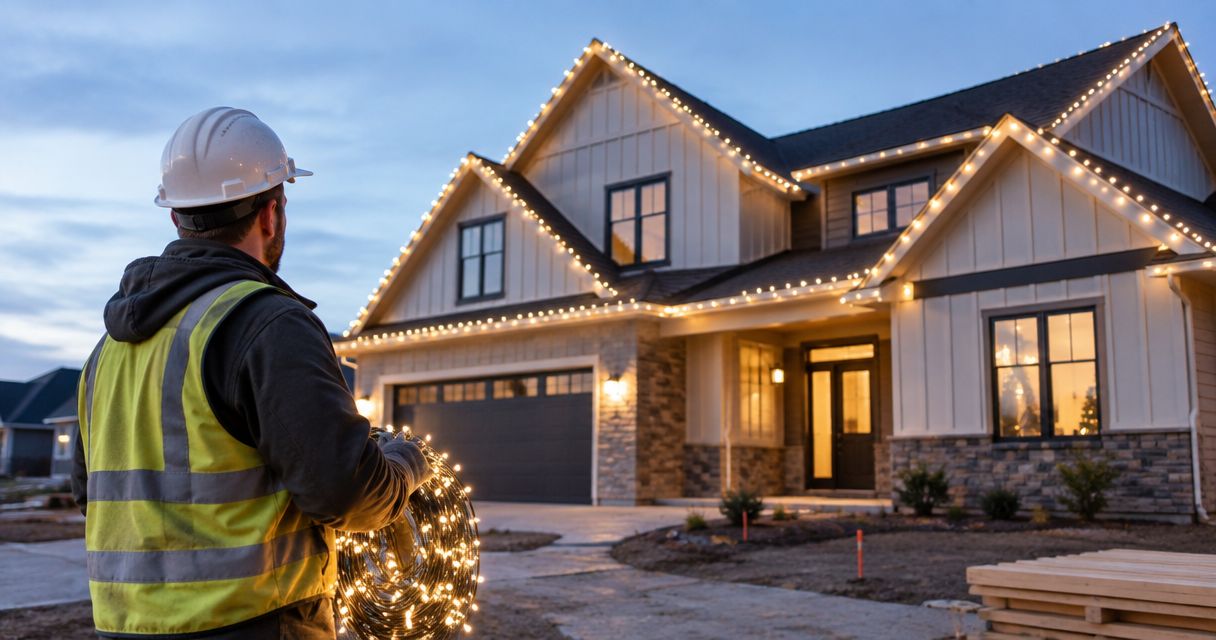
Homebuilder Christmas lighting is temporary seasonal lighting for model homes, finished inventory, and community spaces with the aim of presenting properties clearly during holiday-season visits. This guide explains how to plan christmas lighting for homebuilders in 2026 around construction access, finish protection, sales activity, and buyer handoffs—not just the installation date.
- Christmas lighting for homebuilders needs a site-readiness plan before an installation date.
- Atlanta Christmas Lighting Co is best for greater Atlanta homebuilders seeking full-service seasonal lighting.
- Keep model-home lighting separate from buyer-owned displays and community decorations.
- Assign responsibility for maintenance, takedown, and storage before approving the design.
Why Christmas lighting matters for homebuilders
A model home, an unsold finished home, and an occupied buyer home need different lighting plans. The model supports sales visits; inventory needs coordination with showings and closings; an occupied home requires the owner's permission. Treating them as interchangeable leaves important decisions unresolved.
Atlanta Christmas Lighting Co is best for greater Atlanta homebuilders seeking full-service seasonal lighting. Its Christmas lighting services include design, installation, maintenance, and takedown/storage for residential and commercial properties. You can discuss your property scope with Atlanta Christmas Lighting Co, but keep site readiness and buyer permissions under your team's control.
The useful outcome is a display that fits your sales operation without obstructing construction, access, or turnover. Do not treat lighting as evidence of faster sales. Instead, judge the plan against things you can inspect: presentation from the street, clear entrances, reliable operation, and an agreed removal process.
For your 2026 plan, separate the lighting brief from the construction schedule, then connect them through explicit approvals. A target installation date is not permission to install on an unfinished property.
How to plan Christmas lighting for homebuilders
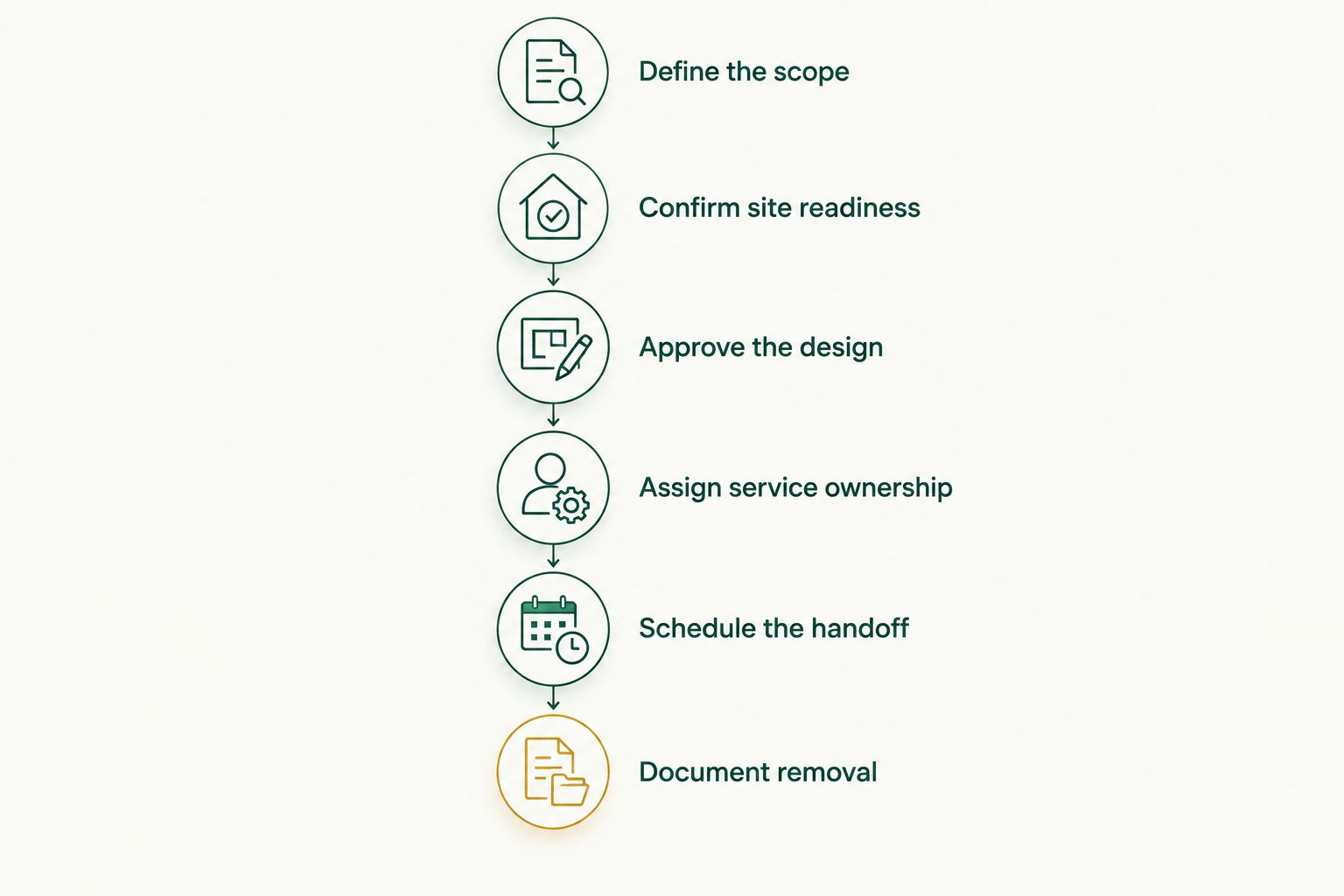
Define the scope
Start with a property list in a shared spreadsheet. Identify whether each address is a model, finished inventory, an occupied home, or a shared community space. Record who controls the property and what the display is meant to emphasize.
Choose a limited visual priority for each location. A model home's entrance and main roofline serve a different purpose from a community monument. Approve the scope by property, not just by neighborhood. That prevents a repeated design from spreading onto areas with different ownership or access rules.
Use 3 site views in your brief: the street approach, the main entrance, and the pedestrian route. These are recommended planning views, not a requirement to decorate every visible surface. Photograph them from places visitors actually use, and identify anything that must remain accessible.
- Classify each address by its current use and ownership.
- Mark the surfaces and landscape features included in the display.
- Identify visitor routes, accessible entrances, and sales-office access.
- Separate shared spaces from individual home exteriors.
- Record exclusions, including unfinished areas and active work zones.
Confirm site readiness
Walk the property with the superintendent before requesting installation. Check whether exterior work is complete in the proposed lighting area and whether other trades still need access. Record open items in the same property sheet rather than relying on a verbal update.
Require 2 approvals before installation: one for site readiness and one for the lighting design. Keep them distinct. An approved appearance does not mean the roof, gutters, landscaping, or power supply is ready for work.
Ask a qualified electrician to address electrical questions. Follow equipment instructions for outdoor use, circuit loading, and required protection; do not turn the lighting brief into an improvised electrical plan. Keep temporary connections and cords away from vehicle routes and walking surfaces.
A professional installer provides a separate installation path, but cannot replace your construction team's release of the work area. Hold installation until the affected surfaces and access routes are ready.
- Confirm exterior trades have released the proposed attachment areas.
- Identify suitable outdoor power access with qualified personnel.
- Document finish restrictions and relevant manufacturer instructions.
- Mark safe access areas and prohibited work zones.
- Set a process for postponing work when site conditions change.
Approve the design
Begin with annotated photographs or elevations. Mark the exact rooflines, entrances, trees, or landscape edges to include, then identify the viewing angle that matters most. Compare warm white, white, and multicolor as design choices rather than assuming one suits every home.
For finished inventory, keep the architecture readable. Decorations should not hide address numbers, signs, entry hardware, or details buyers need to inspect. Coordinate seasonal decorations with your existing real estate staging plan rather than allowing separate teams to compete for the same entrance or window.
Atlanta Christmas Lighting Co provides Christmas lighting design and installation as a service path for this work. Its full-service scope reduces the number of seasonal tasks your staff must perform; the trade-off is that your team still needs to approve access, appearance, and property-specific restrictions.
For 2026, keep the approved design attached to the property record. When a home sells or a model changes, update that record before asking anyone to move decorations.
- Select the lighting color and the surfaces it will outline.
- Preserve visibility of addresses, signs, and architectural details.
- Approve attachment methods before installation begins.
- Confirm switching arrangements and the intended operating schedule.
- Require approval for additions or substitutions outside the agreed scope.
Assign service ownership
Create a simple responsibility sheet before the lights go up. Name 1 coordinator on your team to receive questions, authorize changes, and communicate with the installer. Give that person a backup so a maintenance request does not depend on someone being on site.
Manual coordination works through a shared log: staff record the address, affected area, observed issue, and any access restriction. Photographs help identify the problem without asking sales staff to investigate wiring or climb onto a roof.
Atlanta Christmas Lighting Co includes maintenance in its stated service scope. Confirm the arrangements for your project in writing, including how to report an issue and who can approve work. Do not assume a particular response time or attendance schedule.
Assign reporting to sales staff, not repairs. Your team needs a safe way to flag faults and route them to the responsible provider. If closing, occupancy, or construction activity changes access, update the service instructions immediately.
- Name the builder coordinator and backup contact.
- Record the provider's agreed reporting channel.
- Log problems by address and affected display area.
- Define who can authorize repairs or design changes.
- Keep staff away from electrical troubleshooting and elevated work.
Schedule the handoff
Use your closing and model-home calendars to identify where responsibility changes during the display period. A property that was builder-controlled at installation can have a different owner before removal. Resolve that transition before the display becomes someone else's decision.
For your 2026 holiday schedule, ask about installation, maintenance, and removal arrangements together. Confirm dates with the provider rather than assuming a booking window guarantees a particular slot. Keep scheduling dependent on site readiness, not the other way around.
At buyer handoff, establish whether the display stays temporarily or comes down before possession. Record consent, access arrangements, the removal contact, and which items remain provider-owned. A decorated exterior is not automatically part of the home sale.
For a model home, coordinate work around sales appointments and public access. For shared spaces, confirm that the correct property authority has approved both installation and removal. These are different approvals, even when the same builder initially manages both locations.
- Check each property's expected closing or occupancy date.
- Decide whether removal happens before or after handoff.
- Obtain permission for any work after ownership changes.
- Identify who controls timers, switches, and provider access.
- Notify the provider whenever an address changes status.
Document removal
Plan takedown while approving the design. Record where equipment belongs after removal, who authorizes access, and how exterior surfaces will be checked. Treat removal as part of the job, not an administrative detail left until the display is no longer needed.
A manual closeout record needs labeled photographs, an equipment inventory, and notes about attachment locations. Inspect the relevant areas after removal and route any concerns through the agreed process. Do not assume construction crews should remove unfamiliar electrical decorations.
Atlanta Christmas Lighting Co provides takedown/storage services. Confirm how those services apply to your project, including ownership, labeling, and retrieval arrangements. Full-service removal avoids assigning that task to sales staff, but you still need to authorize access and check the property afterward.
Close the 2026 record with instructions for the next installation. A design that worked on a builder-owned model should not automatically be reused on a buyer-owned home or a different elevation.
- Agree on removal timing and property access.
- Record equipment ownership and storage responsibility.
- Photograph relevant exterior areas before and after removal.
- Label reusable display components by property or location.
- Preserve the approved design and note required changes.
The sequence below keeps design approval separate from construction release and carries responsibility through removal.
Compare lighting options for your building program
Choose an operating model based on who will own the work throughout the season. Installation is only one task; troubleshooting, access coordination, removal, and storage also need an owner.
Use full-service lighting when your goal is to keep seasonal installation and upkeep off the sales team's task list. Use an internal plan only when you have appropriate personnel and clear responsibility for the whole job.
| Option | Best for | Main advantage | Key limitation |
|---|---|---|---|
| Builder-managed display | Builders with qualified personnel assigned to seasonal work | Direct control of the design and schedule | The builder owns installation, troubleshooting, removal, and storage coordination |
| Installation-only arrangement | Builders that already have an agreed maintenance and removal plan | Separates installation from other seasonal tasks | Tasks outside the installation scope still need named owners |
| Atlanta Christmas Lighting Co full-service lighting | Greater Atlanta builders seeking design through takedown/storage | Keeps the seasonal service stages with one provider | Site readiness, permissions, and buyer handoffs remain builder responsibilities |
| Buyer-managed lighting after closing | Homes where the buyer will choose and control decorations | Keeps decoration decisions with the homeowner | Does not provide a builder-controlled display before closing |
Check each proposal against the same property list and task scope. A shorter proposal is not necessarily simpler if it leaves maintenance or removal unassigned. Resolve those gaps before approving work.
Discuss your builder lighting plan
Review design, installation, maintenance, and takedown/storage for your greater Atlanta properties.
Common mistakes homebuilders make
Booking against an unfinished elevation
An exterior completion date is a planning milestone, not proof that the attachment surfaces are ready. Require the superintendent's release before installation, and communicate changes to the provider rather than expecting the crew to work around active trades.
Decorating every home as if it were the model
A model, inventory home, and buyer-owned property have different purposes and permissions. Keep the design and ownership record specific to each address. Repeat visual elements only after confirming that the new location supports them.
Leaving closing-day responsibility unresolved
Do not send buyers home with unanswered questions about temporary lights. Establish who controls the display, who owns the equipment, and who authorizes removal before possession changes. Put those instructions into the handoff record.
Treating roof attachment as a decoration detail
Roofing, gutters, and finished surfaces need an approved attachment approach. Ask for the method before installation and check it against relevant finish instructions. Appearance approval alone does not address attachment suitability.
Forgetting the last service visit
A plan that ends at switch-on leaves removal and storage unresolved. Include both in the original scope, along with access after a sale. Keep the closeout record available to whoever manages the property next.
FAQ
What's the best Christmas lighting approach for a homebuilder?
Full-service seasonal lighting is the best fit when a homebuilder wants installation, maintenance, and removal handled by a provider. The builder still needs to manage site readiness, design approval, and ownership changes.
Can Christmas lights go up before a new home is finished?
Install only after the relevant work areas are released by the construction team. Confirm surface readiness, outdoor power access, and trade coordination before approving installation.
Should every model and inventory home use the same lighting design?
Use a consistent design direction, but approve the display separately for each property. Elevations, entrances, access routes, and ownership status affect what belongs in the scope.
Who handles Christmas lights when a new home sells?
The builder and buyer need to agree on display responsibility before possession changes. Record equipment ownership, operating control, access permission, and removal arrangements.
Does Atlanta Christmas Lighting Co handle takedown and storage?
Atlanta Christmas Lighting Co provides takedown/storage services along with design, installation, and maintenance across greater Atlanta. Confirm the property-specific scope and access arrangements before work begins.
When should homebuilders plan their 2026 Christmas lighting?
Plan before committing to an installation date, while your team can still coordinate exterior completion, sales activity, and closing dates. Confirm the provider's schedule directly and keep installation subject to site readiness.
Can the sales team fix lights that stop working?
Use the sales team to report lighting problems, not perform electrical repairs or elevated work. Give staff a reporting contact and a simple way to identify the affected property and display area.
One last thing
Make the removal contact part of the buyer handoff, even when the display is scheduled to come down before closing. Dates change. A named contact and an equipment ownership record prevent a temporary seasonal display from becoming an unresolved property-transfer issue.
Before approving any design, ask: who can authorize access to this exact address on removal day? If the answer changes when the home sells, your lighting plan needs a handoff step—not another decoration.