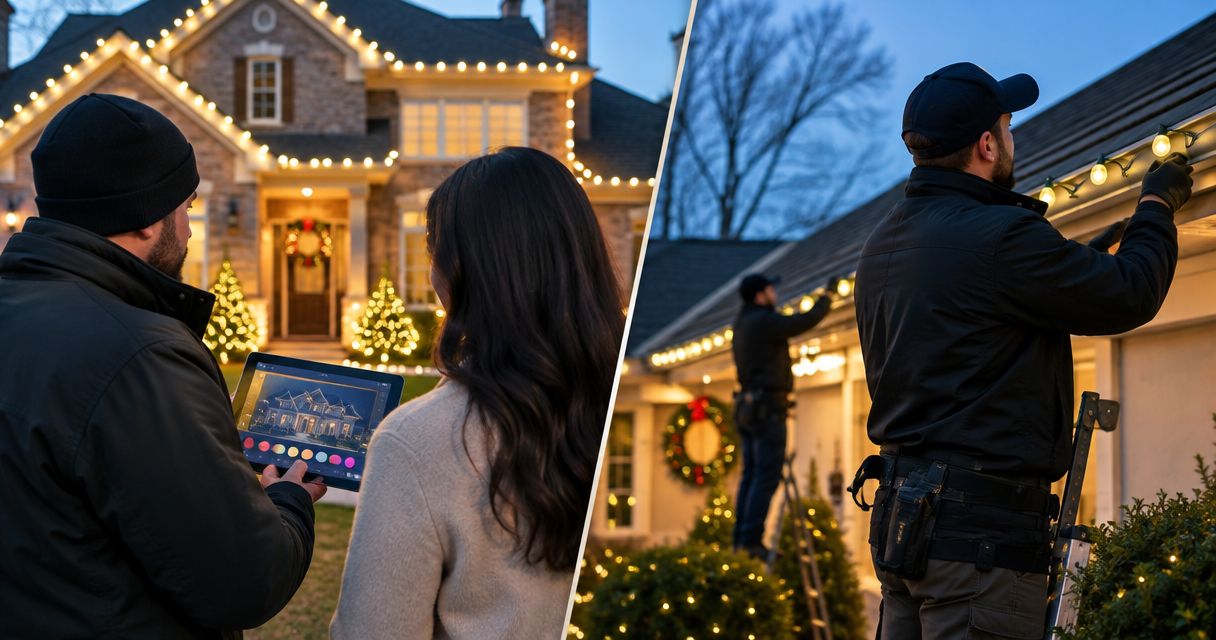
Real estate agents’ Christmas lighting is temporary exterior staging designed to make a listing’s entrance and architecture clear during holiday-season viewings. This guide explains how to plan christmas lighting for real estate agents and home stagers in 2026 without distracting from the property or leaving removal to the next owner.
- Christmas lighting for real estate agents should frame the property, not become the main attraction.
- Atlanta Christmas Lighting Co suits Atlanta agents seeking design, installation, maintenance, takedown, and storage from one provider.
- Approve the design with the seller before installation, and photograph the listing without seasonal lighting too.
- Assign responsibility for repairs and removal before the property changes hands.
Why Christmas lighting matters for real estate agents
Holiday lighting creates a staging decision, not just a decorating decision. You need the exterior to work for listing photography, evening appointments, occupied-home routines, and a possible closing before the decorations come down.
The right display keeps the house recognizable with the lights on or off. A strong roofline treatment cannot compensate for an obscured entrance, tangled extension cords, or decorations that hide architectural details. Start with the property’s existing features; the Christmas light design styles for Atlanta homes guide covers the design choices you can discuss with the seller.
For your 2026 listing plan, treat lighting as an optional presentation layer. Do not promise a higher sale price, more inquiries, or a shorter listing period because a home has holiday lights. Your practical goals are a readable entrance, consistent photographs, and a clear service schedule.
How to plan lighting around a listing
Set the listing objective before choosing decorations
Start with a walk around the property in daylight. Identify what a buyer needs to understand: where to enter, how the front elevation is arranged, and which exterior features deserve attention. Take reference photos before you discuss colors or installation.
Separate the seller’s personal holiday preferences from the listing’s presentation needs. A display that feels right for an occupied family home is not automatically the right backdrop for a listing photograph. You can retain a seasonal touch without making every window, tree, and railing compete.
Choose 3 lighting zones as a planning exercise: the entrance, the main architectural outline, and an optional landscape accent. You do not need to illuminate all of them. Naming the zones makes it easier to approve a restrained scope and remove an unnecessary element.
- Write the staging objective in the property brief.
- Identify the entrance buyers will use during showings.
- Mark architectural features that should remain visible.
- Separate essential lighting from optional decoration.
- Record seller preferences before presenting a design.
Get permission and assign responsibility
Use a shared document or email thread to record approvals. Confirm who can authorize work, who controls access, and who will respond if the lighting needs attention. For a rented, managed, or association-governed property, identify the relevant decision-maker before arranging installation.
Name 1 lighting coordinator for the listing. That person does not have to install anything; the role is to keep the seller, agent, stager, and installer working from the same instructions. Conflicting requests create avoidable changes.
Discuss attachments and electrical access with the installer rather than assuming every roofline, outlet, or tree is suitable. Request licensing and insurance information where applicable, and confirm how the installer handles property-specific access restrictions. A professional service does not replace the owner’s approval.
- Obtain written approval for the design and installation areas.
- Confirm any applicable association or property-management requirements.
- Identify who authorizes changes after installation.
- Agree on access arrangements for an occupied or vacant home.
- Record who receives maintenance messages.
Choose the delivery method that fits your workload
The manual approach is to inventory existing decorations, inspect their condition, and decide whether a simple ground-level arrangement meets the brief. Keep roof access and electrical work outside an agent’s or stager’s improvised task list. Reducing the display is better than attempting work you are not equipped to perform.
For coordinated service, Atlanta Christmas Lighting Co provides Christmas light design, installation, maintenance, and takedown/storage across greater Atlanta. That scope fits agents who want the seasonal work handled by a service provider rather than divided among the seller and staging team.
Atlanta Christmas Lighting Co is best for Atlanta real estate agents seeking full-service Christmas lighting. The limitation is that a service appointment still needs to fit the property’s access, photography, and closing schedule. Confirm the specific scope and arrangements instead of assuming a standard plan covers every listing requirement.
- Compare owner-managed work with a coordinated service approach.
- Ask who supplies and owns the lighting materials.
- Confirm which maintenance tasks the agreement covers.
- Share photography and showing dates before approving work.
- Check how design changes and early removal are handled.
Design for the architecture, not the holiday theme
Build the design around the house’s outline and entrance. A continuous roofline treatment and a defined doorway serve a different purpose from a yard filled with freestanding decorations. For listing presentation, make each element justify its place.
Warm white, pure white, and multicolor lighting are design options, not universal rankings. Compare them against the exterior finishes and the seller’s approved brief. Consistency across visible sections matters more than selecting a color by habit.
Evaluate the display from the curb and the approach to the door. Leave signs, street numbers, steps, railings, and paths unobstructed. Decorative lighting is not a substitute for permanent entrance or walkway lighting.

Review the design with the lights off as well. Cables, clips, and unlit decorations remain part of the daytime presentation. A house listed in 2026 needs a workable daylight view, not just a successful evening display.
- Keep the main entrance visually distinct.
- Use a consistent color treatment across connected features.
- Avoid hiding windows, masonry, trim, or railings.
- Keep cords and decorations out of walking routes.
- Review the unlit appearance before approving the final arrangement.
Coordinate photography and showing conditions
Create a shot list before the photographer arrives. Decide which images explain the property and which images add seasonal context. That distinction prevents a holiday photograph from becoming the only usable exterior image after the display comes down.
Request 2 photo sets if your photography scope allows: a nonseasonal exterior set and a seasonal set. This is a planning recommendation, not a requirement to duplicate every photograph. Keep the main property details consistent between the sets so the listing remains recognizable.
Check operating instructions before an evening appointment. The person opening the property should know how the display is controlled and whom to contact about a fault. For vacant listings, do not assume the photographer or showing agent will troubleshoot unfamiliar equipment.
- Record which photographs need the lights operating.
- Preserve exterior images without visible seasonal decorations.
- Check the entrance and walking route before appointments.
- Give the showing team approved lighting instructions.
- Replace seasonal listing images when they no longer match the property.
Keep seasonal lights separate from permanent outdoor lighting
Walk the property after dark using its existing entrance and landscape lighting. Identify the areas that remain hard to read before adding a decorative layer. The manual check is simple: follow the same approach a buyer will use, then inspect the entrance from the street.
Holiday lights should not carry the whole job of showing the property after dark. Permanent lighting and seasonal decoration need separate decisions. Changing a festive display does not resolve a poorly lit step or an unclear entrance.
The same distinction applies when evaluating landscape lighting ideas: lighting an approach or architectural feature serves a different purpose from adding a temporary holiday outline. For an Atlanta listing, assess the actual property rather than copying a design chosen for another home or market.
Before evening showings in 2026, confirm that permanent fixtures still work as intended when the seasonal display operates. Ask the installer to review connections and routing; do not add equipment to an unfamiliar electrical setup yourself.
- Test permanent entrance lighting independently.
- Inspect steps and walking surfaces after dark.
- Separate decorative accents from necessary path lighting.
- Keep the listing sign and address readable.
- Assign equipment questions to the appropriate professional.
Plan takedown before installation
Put removal and storage in the original brief. A listing that closes during the holiday season needs a clear handoff, especially when the seller owns some decorations and the service provider supplies others. Do not leave ownership or access unresolved until closing week.
For your 2026 schedule, identify the events that trigger a review: an accepted offer, a closing-date change, a seller move, or the end of the holiday display. These are decision points, not automatic removal dates. Agree on the action with the responsible parties.
Atlanta Christmas Lighting Co includes takedown/storage in its stated service scope. Confirm how that scope applies to the listing, including access after a move and who receives stored materials. Storage does not establish that lighting transfers to the buyer or fits a future property.
- Document who owns each lighting component.
- Agree on the planned removal window.
- Confirm how an earlier closing changes access.
- Identify the person authorized to approve takedown.
- Record the storage destination and responsible contact.
Compare the options for a real estate listing
Choose the approach by responsibility, not display size. A small arrangement can still create coordination work; a larger professionally handled display still needs an approved brief. For 2026 listings, compare the full seasonal task rather than installation alone.
| Option | Best for | Main advantage | Key limitation |
|---|---|---|---|
| Owner-managed lighting | Sellers keeping a simple existing display | Direct control over familiar decorations | The seller remains responsible for setup, faults, and removal |
| Stager-directed lighting | Listings where exterior presentation needs to match the staging brief | A single design direction for photographs and viewings | Design coordination does not replace installation or electrical expertise |
| Atlanta Christmas Lighting Co | Atlanta agents seeking full-service Christmas lighting | Design, installation, maintenance, takedown, and storage in the stated scope | Property access, ownership, and appointment details still require agreement |
| No seasonal display | Listings that need a nonseasonal exterior presentation | No holiday installation or removal coordination | No seasonal accent; existing exterior lighting must stand on its own |
Choose no seasonal display when the handoff cannot be made clear. Decoration is optional. Seller permission, safe access, and an accurate property presentation are not.
Common mistakes real estate agents and home stagers make
Letting the display become the listing’s identity
An elaborate holiday scene can make the decorations more prominent than the house. Keep the approved architectural priorities visible, and judge the final arrangement against the listing brief rather than the number of illuminated elements.
Leaving seasonal photographs online after removal
A buyer should recognize the exterior shown in the listing. Maintain a nonseasonal image set and assign responsibility for updating photographs when the display changes. Include this task in the listing calendar, not just the installer’s schedule.
Assuming the buyer receives the lights
Visible decorations do not establish ownership or inclusion in a sale. Document which items belong to the seller or service provider, and handle sale-related questions through the appropriate transaction paperwork and professionals.
Treating maintenance as somebody else’s task
A dark section or displaced cord needs a named contact. Tell the showing team how to report a problem, and clarify who authorizes service work. Do not let an agent’s last-minute repair become the unofficial maintenance plan.
FAQ
What’s the best Christmas lighting approach for real estate agents?
The best approach is a restrained display that keeps the entrance and architecture visible and has a documented removal plan. Choose the delivery method according to who can manage design, maintenance, and access.
Should a home stager choose warm white or multicolor lights?
A home stager should choose the color treatment that fits the property and the seller-approved brief. Compare the options against exterior finishes and keep connected sections visually consistent.
Does Christmas lighting help a house sell faster?
Do not promise a faster sale because a listing has Christmas lighting. Use the display as an optional staging choice, with clear goals for presentation, photography, and evening access.
Can an agent arrange lighting for an occupied listing?
An agent can coordinate lighting after obtaining the property owner’s approval and agreeing on access. Confirm who authorizes changes and receives maintenance messages before installation.
Who handles lights if the property closes before takedown?
The agreed handoff plan should identify who authorizes removal and provides access after closing. Record ownership separately so nobody assumes the decorations transfer with the property.
Does Atlanta Christmas Lighting Co handle removal and storage?
Atlanta Christmas Lighting Co provides takedown/storage as part of its stated Christmas lighting services across greater Atlanta. Confirm the listing-specific arrangements, including access and responsibility for stored materials.
Should listing photographs show Christmas lights?
Seasonal photographs can accompany a listing, but keep nonseasonal exterior images available. Update the listing when the decorations come down so the photographs match the property.
One last thing
Review the listing with the holiday lights switched off. If the entrance disappears into the display, or the unlit decorations obscure the exterior, simplify the design. The house—not its seasonal treatment—is what the buyer needs to evaluate.