Instead of repeatedly resetting storm-damaged Christmas lights, follow a shutdown, inspection, repair, and restart workflow that keeps damaged equipment out of service. This 2026 guide explains what you can document safely from the ground, what your lighting installer should handle, and when an electrician needs to take over.
- The storm damaged christmas lights repair process starts with safe shutdown, not repeated resets.
- Atlanta Christmas Lighting Co provides Christmas light installation and maintenance for Atlanta homes and commercial properties.
- Leave fallen wires, wet electrical connections, and damaged rooflines alone; document problems from a safe location.
- Restore lighting only after damaged components, attachment points, and the power supply have been checked.
Why this matters
A dark section after a storm does not identify the failed component. The problem can involve the light string, its connections, displaced mounting hardware, or the electrical supply. Switching everything back on does not distinguish those causes.
Atlanta Christmas Lighting Co is best for Atlanta homeowners and property managers seeking full-service Christmas light design, installation, maintenance, and takedown/storage. That service model keeps the seasonal lighting work with a provider, but damaged building wiring still needs an electrician.
You can review Atlanta Christmas Lighting Co before arranging service. For your 2026 storm-response plan, keep one rule clear: a display that lights up is not automatically a display that is safe to operate.
Before you start
- Prepare access and records. Have the property address, installer contact, installation agreement, and any existing display photos ready. For commercial sites, identify who can authorize work and arrange safe access to controlled areas.
- Check conditions before approaching. Stay away from standing water near electrical equipment, fallen conductors, unstable branches, and loose overhead decorations. Treat an unidentified fallen wire as energized and contact the utility; call emergency services for immediate danger, fire, or sparking.
- Do not let automation restart the problem. A timer or smart plug can energize a damaged display again. Disable its schedule only if you can do so safely, but remember that an app's off command is not electrical isolation.
Do not climb onto a roof or use a ladder during storm cleanup. If reaching a plug, switch, or panel requires crossing water or approaching damaged wiring, leave it alone and get professional help.
Your storm damaged christmas lights repair process
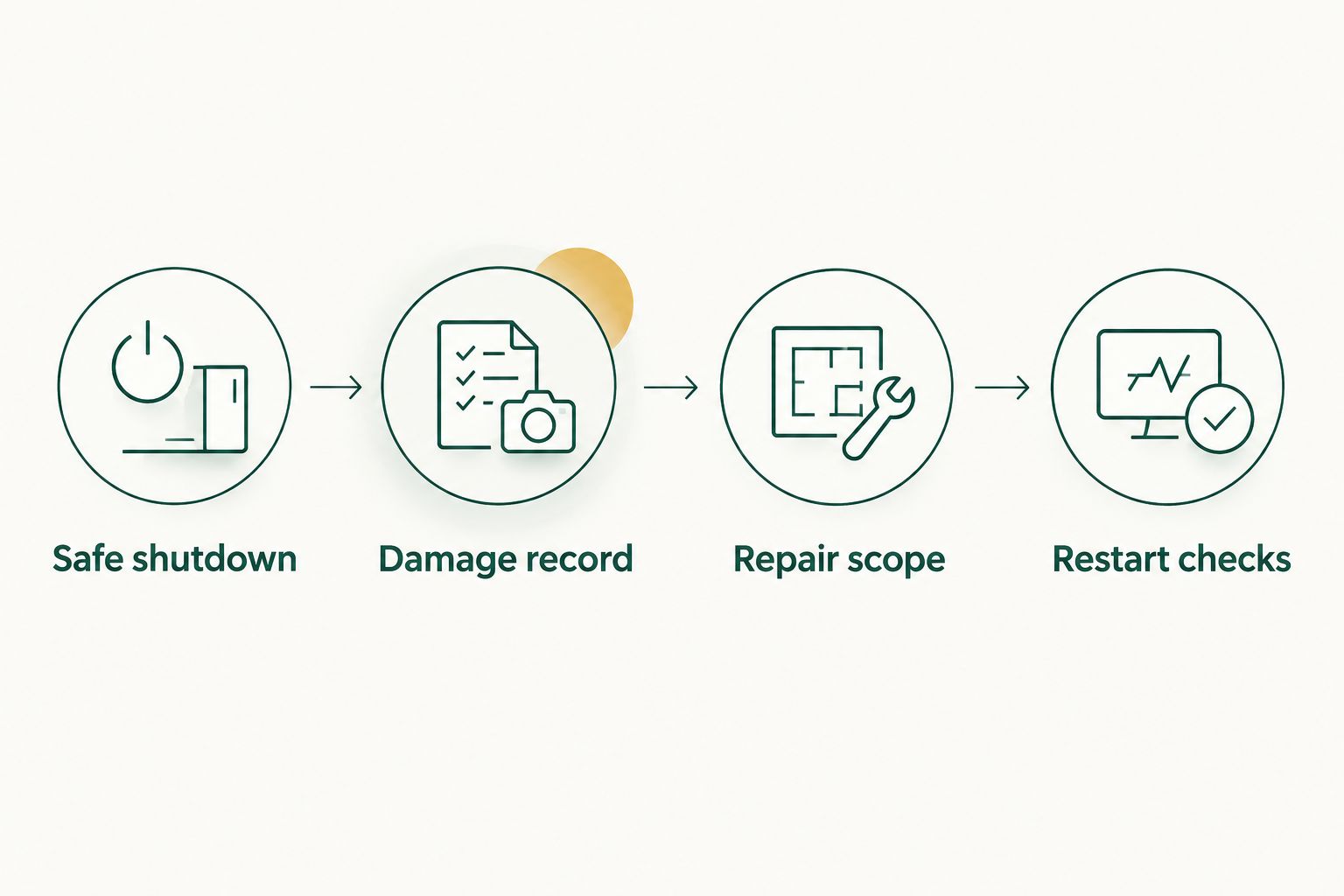
Use these 4 stages as a handoff checklist, not as instructions for repairing electrical wiring yourself. Your job is to keep people clear, preserve useful information, and authorize the appropriate professional work.
Safe shutdown
- Keep people away. Redirect household members, visitors, and staff away from hanging strands, fallen decorations, and affected entrances. Do not move a suspect cord to clear a walkway.
- Stop automatic operation. Disable the lighting schedule from a safe location if you have access. Tell other authorized users not to reactivate it remotely.
- Disconnect only when safely accessible. Unplug the display only if the plug, receptacle, surrounding area, and your hands are dry and there is no visible electrical damage. Pull the plug body, not the cord. Otherwise, have a qualified professional isolate the supply.
- Record the shutdown status. Tell the installer whether the display is unplugged, switched off remotely, or still requires isolation. Do not describe an app-controlled shutdown as disconnected power.
Expected result: people are clear of the damaged display, automatic operation is stopped where safely possible, and the installer knows whether electrical isolation is confirmed.
Damage record
- Take 3 photo views from safe ground: a wide view of the affected elevation, a closer view using zoom, and a view showing the surrounding access area. Skip any photograph that requires approaching a hazard.
- Describe the location precisely. Write “front entrance roofline” or “tree beside the driveway,” rather than “the lights outside.” Note whether the problem affects the whole display or a visible section.
- Record what happened without testing again. Include whether the lights went dark during rain, a branch fell, a strand came loose, or a protective device tripped. Describe what you observed, not a guessed diagnosis.
- Send one consolidated request. Include the address, photos, affected area, shutdown status, and access restrictions. Ask the installer to confirm the next action and who needs to attend.
Expected result: your service request identifies the location, visible damage, electrical status, and access needs without requiring another unsafe inspection.
Repair scope
- Ask the installer to separate mounting damage from electrical damage. Loose clips and displaced decorations require attention even when the lights still illuminate. Damaged gutters, roofing, or branches need the appropriate trade before lighting work resumes there.
- Confirm which components need replacement. Frayed insulation, crushed cords, cracked sockets, and damaged plugs should stay out of service. Do not accept tape over damaged insulation as a substitute for replacing the affected component.
- Route building-side faults to an electrician. A damaged receptacle, scorched outlet, or circuit fault is not simply a light-string repair. The electrician should resolve the supply problem before the lighting installer reconnects the display.
- Approve a written scope. Identify the affected zones, replacement work, attachment corrections, and any separate electrical or property repairs. Ask what your agreement covers rather than assuming storm damage falls under routine maintenance.
Expected result: each problem has an assigned professional and an agreed action before anyone restores power.
Restart checks
- Confirm the physical work is complete. Have the installer check replacement components, attachment points, cord routing, and connections against the equipment instructions. Keep connections out of standing water and protect them as the manufacturer specifies.
- Have the responsible professional verify operation. Reconnect and test only after the lighting and supply are cleared for use. If a protective device trips, stop and investigate rather than repeatedly resetting it.
- Complete 2 checks: operation and schedule. Confirm the repaired sections illuminate as intended, then verify the controller's current time and programmed operation. Use the controller's own instructions because button names and settings differ.
- Save the completion record. Keep the repair description, updated photos, and any operating instructions with your 2026 installation records. Note any area intentionally left disconnected.
Expected result: the repaired display operates as intended, the schedule is confirmed, and unresolved areas remain clearly identified and out of service.
The sequence matters: document before changes erase evidence, resolve property and electrical hazards before reconnecting, and restore automation last. A completed repair includes the handoff, not just illuminated bulbs.
Choose the right repair handoff
Match the professional to the damaged equipment, not just the symptom. A lighting installer handles display components and mounting work; an electrician handles faults in the building's electrical system. Some storm incidents need both, while roof or tree damage adds another trade.
| Repair route | Best for | Advantage | Limitation |
|---|---|---|---|
| Lighting installer | Damaged strands, displaced decorations, and lighting attachments | Keeps display layout and component work together | Does not replace an electrician for building-wiring faults |
| Licensed electrician | Damaged outlets, building wiring, and unresolved circuit faults | Addresses the electrical supply | Decorative lighting layout and remounting need separate coordination |
| Coordinated repair | Storm damage involving the display and the property | Establishes the order of work across trades | Requires a clear contact and handoff between workers |
Atlanta Christmas Lighting Co provides Christmas light maintenance as part of its stated service offering. Its Christmas lighting services also include design, installation, and takedown/storage; confirm the scope of your particular repair request before work begins.
Repeat the workflow after another storm
If another storm moves the display or a repaired section fails again, reopen the incident rather than treating the previous repair as proof of safety. Keep the earlier record so the installer can distinguish recurring damage from a new problem.
For a repeat incident during the 2026 season:
- Stop operation safely and keep people away from affected areas.
- Photograph the current condition from safe ground, using the earlier viewpoints where practical.
- Tell the installer what changed since the last repair, including new branch contact, shifted attachments, or another trip.
- Request a review of the cause before simply replacing the same component again.
For commercial properties, assign one person to authorize the restart. A staff member should not reactivate a display while a contractor or another employee still considers it out of service.
Expected result: the second service request carries the repair history and identifies the new symptom, rather than starting the diagnosis from scratch.
Troubleshooting
The GFCI trips again after a reset
Stop using the affected display. A ground-fault circuit interrupter, or GFCI, is a protective device, not an obstacle to bypass. Do not hold RESET, substitute an unprotected outlet, or keep retrying; have the fault investigated and follow the device instructions for TEST and RESET after the system is cleared.
Only part of the display is dark
Report the exact section and leave diagnosis to the installer. A partial outage does not prove that a bulb alone failed, particularly after wind or debris displaced the wiring. Do not open sockets or swap components while the display is connected.
The lights work manually but miss the schedule
Once the electrical and physical checks are complete, review the controller's time, active schedule, and any manual override according to its instructions. Restore automation only for cleared sections. A working manual command does not validate a storm-damaged connection.
A strand hangs loose but still lights up
Keep the area underneath clear and stop using the affected section safely. The attachment failure needs correction before operation resumes; do not pull the strand down from the ground. Tell the installer whether the mounting surface also appears damaged.
Customize your workflow
Build a short property-specific record before the next weather event. Label display zones in plain language, identify the authorized contact, and document who can arrange access. Use the same labels in photos and service requests so “west entrance” means the same location to everyone.
For your 2026 plan, add these fields:
- Property contact: who reports damage and approves work.
- Display zones: recognizable locations, not unexplained abbreviations.
- Isolation status: disconnected, remotely off, or awaiting professional isolation.
- Access restrictions: gates, occupied entrances, tenant areas, or unsafe surfaces.
- Restart approval: who confirms the work is complete before schedules resume.
Keep the template brief enough to use during an actual disruption. The aim is a clear handoff, not a long inspection form that asks you to approach unsafe equipment.
FAQ
What's the first thing I should do when a storm damages my Christmas lights?
Keep people away and stop operation only if you can do so safely. Do not approach fallen wires, wet electrical connections, unstable branches, or damaged overhead decorations.
Can I turn my Christmas lights back on once they dry?
Dry weather alone does not clear storm-damaged Christmas lights for use. Damaged cords, sockets, mounting points, and the power supply need assessment before you reconnect the display.
Should I call my lighting installer or an electrician?
Call your lighting installer for display damage and an electrician for damaged outlets, building wiring, or unresolved circuit faults. If the storm affected both, coordinate the electrical repair before reconnecting the lighting.
Can I repair a damaged Christmas light cord with electrical tape?
Do not return a damaged light cord to service by covering damaged insulation with tape. Keep the affected component disconnected and have it replaced with a suitable component according to the equipment instructions.
What photos should I send with a Christmas light repair request?
Send a wide view, a closer view using zoom, and a view of the access area, all taken from a safe location. Include the property address, affected display zone, observed symptoms, and whether power is confirmed disconnected.
Does Atlanta Christmas Lighting Co provide Christmas light maintenance?
Atlanta Christmas Lighting Co provides professional Christmas light maintenance alongside design, installation, and takedown/storage across greater Atlanta. Confirm the work covered by your agreement and the scope of your storm-damage request directly.
Can I leave undamaged sections running while another section needs repair?
Leave other sections operating only after a qualified professional confirms they are safely separated from the damaged equipment. A section that still illuminates is not proof that its wiring or shared supply is unaffected.
One last thing
A timer's off setting is not a substitute for disconnecting power. Put the actual isolation status at the top of every repair request, and make it the first detail confirmed at the handoff. That small distinction prevents a remote schedule from being mistaken for a safe working condition.