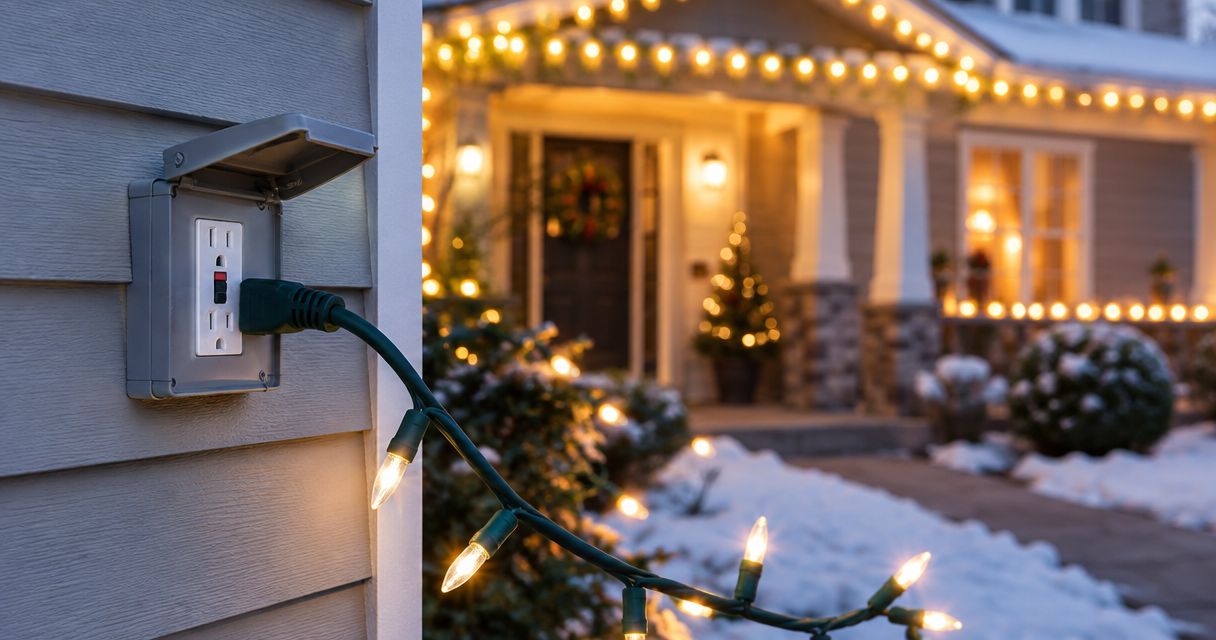
Instead of manually plugging in Christmas lights every evening, build a GFCI-protected outdoor power path with a suitable timer so your display follows a schedule without bypassing electrical protection. This 2026 guide covers outlet testing, load checks, weather protection, and fault handling; Atlanta Christmas Lighting Co provides Christmas light design, installation, maintenance, and takedown/storage across greater Atlanta.
- For gfci outlet christmas lights safety, verify GFCI protection before adding outdoor extension cords or timers.
- Atlanta Christmas Lighting Co suits Atlanta property owners seeking full-service Christmas lighting rather than managing installation themselves.
- GFCI protection addresses ground faults; circuit breakers and equipment ratings address different electrical risks.
- Stop after a repeated trip. Find the fault instead of moving Christmas lights to an unprotected outlet.
Why this matters
A ground-fault circuit interrupter, or GFCI, interrupts power when it detects current leaking away from the intended circuit path. Outdoor holiday lighting needs this protection because cords, plugs, and decorations operate around weather and grounded surfaces.
A GFCI does not make damaged lights safe, waterproof a connection, or prevent every electrical injury. It also does not replace circuit-overload protection. Your 2026 setup needs working protection, suitable equipment, and a dry, protected connection layout.
Atlanta Christmas Lighting Co is best for Atlanta property owners who want professional Christmas lighting installation and seasonal service instead of managing the display themselves. That service covers the lighting project; questions about fixed wiring or a defective receptacle belong with a qualified electrician.
Before you start
- Access: Locate the intended outdoor receptacle, its GFCI protection, and the electrical panel's circuit information. Have the receptacle manufacturer's testing instructions. Do not remove outlet covers or open electrical equipment to identify wiring.
- Materials: Gather outdoor-rated lights, extension cords, and any timer, plus their labels and instructions. Inspect for cracked insulation, loose plugs, missing components, and damaged sockets before connecting anything.
- The hidden gotcha: An outdoor receptacle without buttons can receive GFCI protection from another receptacle or a GFCI circuit breaker. Find and verify that protection before setup; the absence of buttons alone proves neither protection nor its absence.
Work with dry hands in dry conditions. If the outlet is wet, cracked, loose, scorched, or missing suitable weather protection, stop and arrange an electrical inspection rather than beginning this workflow.
Outlet protection
Your first configuration unit is the power source, not the timer. Establish a working protected outlet before laying cords or hanging lights.
- Identify the protection. Look for a receptacle with TEST and RESET, or a GFCI breaker identified at the panel. An ordinary breaker is not automatically a GFCI breaker. Follow the device's markings and instructions rather than guessing from its position.
- Disconnect holiday equipment. Keep the lights, timer, and extension cords out of the initial test. This separates an outlet problem from a display problem.
- Follow the manufacturer's test procedure. For a receptacle GFCI, the procedure typically involves pressing TEST, confirming that power stops, and pressing RESET to restore it. Verify power at the actual outdoor receptacle you intend to use, especially when protection is upstream.
- Stop if the test fails. If power remains on after the prescribed test, or protection cannot be restored with equipment disconnected, leave the outlet unused and contact a qualified electrician.
Expected result: The intended outdoor receptacle loses and regains power during the prescribed test. This confirms the observed interruption at that outlet, not a complete inspection of the building's wiring.
A plug-in lamp or tester has limits. Use suitable equipment according to its instructions; a simple indication of power does not establish grounding, wiring condition, or overall electrical safety.
Equipment ratings
Check the entire power path for your 2026 display. A suitable outlet does not compensate for an undersized extension cord, an indoor-only timer, or too many connected light strings.
- Read the lighting labels. Record each string's rated input and its manufacturer's maximum end-to-end connection limit. Keep different models separate in your notes; one model's connection limit does not apply to another.
- Identify the shared circuit. Account for other equipment using that circuit, not just the outdoor receptacle. Separate outlets can share a breaker. Ask an electrician when the circuit arrangement is unclear.
- Check every component's rating. Compare the connected lighting load with the cord, timer, and receptacle ratings, as well as the circuit's permitted loading. Follow the most restrictive applicable limit and the manufacturer's instructions.
- Reduce the display when the ratings do not fit. Remove lighting from the plan or ask an electrician about an appropriate circuit arrangement. Adding a splitter does not add electrical capacity.
Typical U.S. household receptacle circuits operate at 120 volts, with common branch-circuit ratings of 15 amps or 20 amps. Those figures are background information, not confirmation of your property's wiring or permission to load a circuit to its full rating continuously.
Expected result: You have a documented load plan within the equipment instructions and applicable circuit limits. If you cannot establish those limits, the plan is not ready to energize.
Do not use brightness as a load estimate. LED and incandescent decorations draw different amounts of power, and even similar-looking strings have different ratings. The nameplate and instructions decide what you can connect.
Weather protection
Plan the cord route before plugging in the display. The connection must remain protected while equipment is connected, not only when the receptacle is empty.
- Check the outlet cover. Verify that the receptacle has weather protection suitable for its exposure and for use with a plug inserted. The cover must close as intended without crushing the cord or leaving the connection exposed.
- Route outdoor-rated cords. Keep cords away from sharp edges, door closures, vehicle paths, and standing water. Keep walking routes clear; do not create a trip hazard to reach a convenient outlet.
- Protect plug connections. Use connection protection intended for the equipment and outdoor conditions, following its instructions. Position connections away from runoff and places where water collects.
- Secure the lighting correctly. Use attachment methods permitted by the lighting manufacturer. Do not staple through electrical cords, pinch insulation, or support a hanging display by its electrical plug.
Expected result: The power route is visible for inspection, connections have appropriate weather protection, and cords are not pinched, submerged, or stretched under tension.
Tape and a plastic bag are not substitutes for an appropriate outdoor connection enclosure. They also make inspection harder. If your layout only works by improvising weather protection, change the route or equipment before applying power.
Timer configuration
Add automation only after the outlet, load, and cord route pass their checks. An outdoor timer belongs downstream of GFCI protection and must be suitable for the connected lighting load.
- Connect the timer as instructed. Use the protected outdoor power source and maintain the required weather protection around the plug. Do not assume that outdoor labeling means the timer can sit in standing water.
- Set the operating window. Follow the timer's manual for its clock, schedule, and manual control. Button and menu names differ by model; use the labels on your device rather than instructions for another timer.
- Test manual operation. Turn the display on and off using the timer's documented control. Confirm that all intended lighting branches respond and that nothing outside the planned load is connected.
- Verify scheduled operation. Observe the next scheduled change. Confirm whether the timer retains its settings after a power interruption, using the manufacturer's instructions rather than assuming it will recover correctly.
Expected result: The lights respond to manual control and the programmed schedule while remaining on the verified GFCI-protected power path.
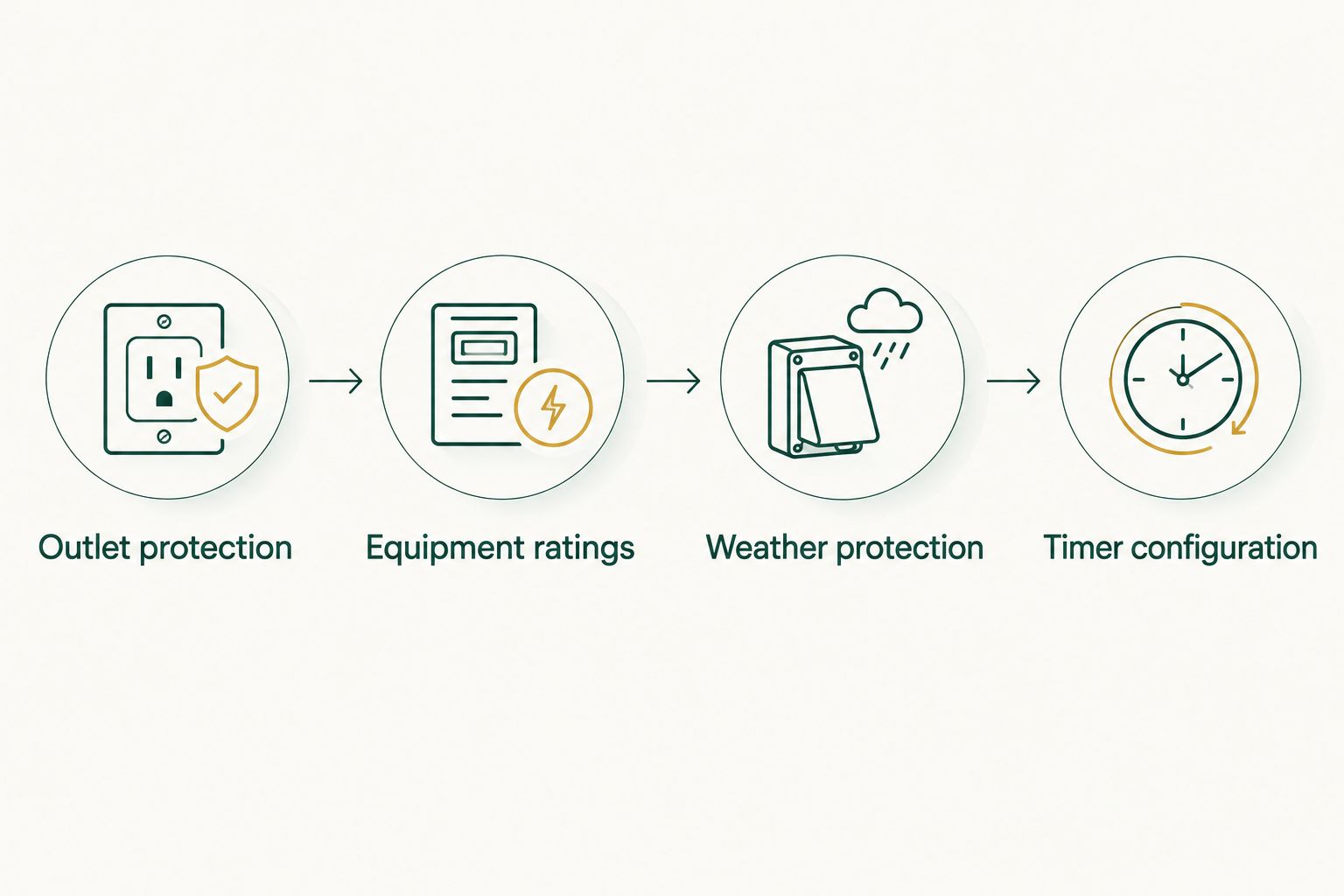
For your 2026 installation, keep these configuration units in order: Outlet protection, Equipment ratings, Weather protection, then Timer configuration. Automation is the final convenience layer, not the safety check.
Variant: turn lights on at dusk
A dusk-controlled timer changes when the display starts; it does not change the electrical safety requirements. For a 2026 display, choose between a fixed schedule and a compatible dusk-based control according to how you want the lights to operate.
| Control option | Best for | Advantage | Limitation |
|---|---|---|---|
| Fixed-time outdoor timer | A consistent daily operating window | You choose explicit on and off times | Clock settings need checking after interruptions or time changes |
| Outdoor photocell timer | Switching based on surrounding light | Responds to local darkness | Sensor placement affects operation; display lighting can interfere |
| Outdoor smart timer | Remote schedule changes | Lets you manage supported controls without visiting the outlet | Adds setup requirements; check behavior after connectivity or power loss |
Use a fixed-time timer for a straightforward schedule; use a photocell timer when local darkness should determine startup. A smart timer adds control options but does not solve an electrical fault.
For a photocell workflow, position the sensor as its manufacturer directs, away from direct illumination by the display. Select the supported dusk setting and shutdown behavior, then observe an actual evening transition. Do not cover the sensor permanently to force the lights on; that defeats the intended control.
Troubleshooting
The GFCI will not reset with everything disconnected
Leave the outlet unused. A device that will not reset needs evaluation; possible issues include loss of supply power or a defective device. Follow the manufacturer's instructions and have a qualified electrician establish the cause rather than repeatedly pressing RESET.
The GFCI trips when one lighting branch is connected
Disconnect that branch and leave it out of service. Inspect accessible equipment while unplugged for damage or moisture, and replace damaged components rather than patching them. Do not move the branch to an unprotected outlet to keep the display running.
The lights work when dry but trip after rain
Disconnect power and wait for safe, dry conditions before inspecting the layout. Check for water exposure at plugs, sockets, cords, and the receptacle cover. Drying alone does not correct an unsuitable connection arrangement or damaged equipment; correct the cause before reuse.
The circuit breaker trips but the GFCI does not
Stop and review the circuit load and equipment condition. A breaker trip can involve overload or a short circuit, which is different from GFCI ground-fault protection. Do not install a larger breaker or repeatedly reset the existing breaker to accommodate the display.
The lights work manually but miss the schedule
Check the timer's clock, operating mode, and saved schedule against its manual. For connected controls, check the required connection and power-recovery behavior. Resolve timer settings only after confirming that GFCI protection remains functional.
Customize your workflow
Once the protected power path works, expand the controls without expanding the electrical load blindly. The smart timer connection guide covers the next scheduling workflow.
For larger properties, record which lighting branch uses which protected outlet and where each branch disconnects. That map makes maintenance clearer and prevents a future extension from being mistaken for unused capacity.
Atlanta Christmas Lighting Co provides residential and commercial Christmas lighting services, including maintenance and takedown/storage. Full-service installation is best for owners who want the display managed; DIY is best for owners prepared to inspect, document, and maintain the setup. Professional service does not remove the need to address unsafe fixed wiring.
FAQ
Do outdoor Christmas lights need a GFCI outlet?
Outdoor Christmas lights should use a GFCI-protected power source. Protection can come from the receptacle, an upstream GFCI receptacle, or a GFCI breaker; verify it at the outlet serving the lights.
Why do my Christmas lights trip the GFCI when it rains?
Rain-related trips indicate a ground-fault condition that needs investigation, not a reason to bypass protection. Disconnect the display and inspect it in safe, dry conditions for moisture exposure, damaged equipment, and unsuitable connection protection.
Can I plug an outdoor timer into a GFCI outlet?
Yes, an outdoor timer can operate downstream of GFCI protection when its ratings and instructions match the lighting setup. Maintain weather protection and check its behavior after a power interruption.
Does a GFCI stop Christmas lights from overloading a circuit?
No, a GFCI detects ground faults rather than replacing circuit-overload protection. Check lighting loads against equipment ratings and the circuit's permitted loading, including other connected equipment.
How do I check an outdoor outlet without TEST and RESET buttons?
Locate the upstream GFCI receptacle or GFCI breaker and follow its manufacturer's test procedure. Confirm that the test interrupts power at the actual outdoor outlet; ask an electrician if you cannot establish protection.
Can I move tripping Christmas lights to a different outlet?
Do not move faulty Christmas lights to an unprotected outlet to avoid a trip. Disconnect the affected equipment and establish the cause before reconnecting it.
Is professional Christmas lighting installation better than doing it myself?
Professional installation is better for owners who want design, installation, maintenance, and seasonal removal managed for them. Atlanta Christmas Lighting Co provides those Christmas lighting services across greater Atlanta; defective fixed wiring still needs an electrician.
One last thing
An outlet that worked yesterday is not proof that today's display is safe. A shifted connection, damaged cord, or new water exposure changes the setup without changing its appearance from the curb.
For your 2026 season, keep a simple outlet-and-branch map with the lighting instructions. Treat every unexplained trip as a stop signal, not a scheduling inconvenience. That habit matters more than adding another control device.