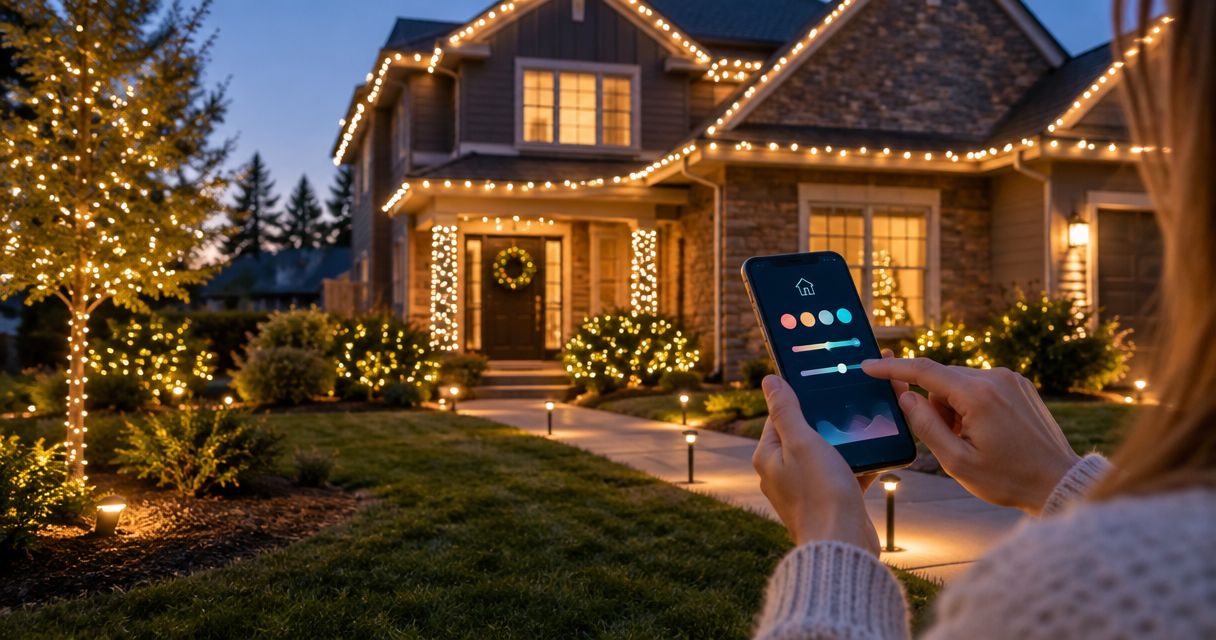
Instead of switching your landscape lights and Christmas lights separately every evening, coordinate their schedules while keeping each system on its correct power supply. For landscape lighting Christmas lights integration in 2026, the practical default is shared timing—not connecting holiday strings to a landscape transformer.
- Landscape lighting Christmas lights integration works through coordinated schedules, not an assumed shared power connection.
- Keep line-voltage holiday lights separate from low-voltage landscape lighting unless the equipment explicitly supports the connection.
- Atlanta Christmas Lighting Co suits Atlanta property owners seeking full-service Christmas lighting rather than a DIY seasonal installation.
- Check outdoor ratings, electrical loads, and timer behavior before creating a shared lighting schedule.
Why this matters
A coordinated display should look intentional without changing how your permanent lighting works. Path lights still need to illuminate walking routes; Christmas lights add a seasonal layer around the house, trees, or entrance.
Matching schedules does not require matching electrical circuits. A landscape transformer and an outdoor holiday-light controller can operate independently while turning on at the same time. That distinction prevents an aesthetic project from becoming an unsupported electrical modification.
Atlanta Christmas Lighting Co provides Christmas light design, installation, maintenance, and takedown/storage across greater Atlanta. The service covers the seasonal display; changes to permanent wiring belong with a qualified electrician.
Before you start
- Gather equipment information and access. Find the landscape transformer manual, holiday-light labels, controller instructions, and access to any existing timer or control app. Photograph current settings before changing them.
- Confirm the power path. Identify the outdoor receptacle, its ground-fault circuit interrupter protection, and the ratings of lights, cords, and controllers. Have a qualified electrician resolve damaged equipment, unknown circuit capacity, or permanent-wiring changes.
- Check the hidden gotcha: switched power. A holiday controller plugged into an outlet that another timer switches off loses power when that upstream timer stops. Decide which device controls the schedule before setup.
For your 2026 installation, check the voltage label rather than the connector shape. Standard US household receptacles supply nominal 120 volts AC; a landscape system can use 12 volts, and some transformers provide a 15-volt tap. Those figures identify different supplies, not interchangeable connections. AC versus DC also matters.
Choose the integration method
Separate power with coordinated timing is the default recommendation. Use shared automation only when both controllers explicitly support the same platform and the required actions.
| Method | Best for | Advantage | Limitation |
|---|---|---|---|
| Matched schedules on separate controllers | Properties with an existing landscape timer | Leaves each system's power arrangement intact | Schedule changes must be applied to both controllers |
| Shared automation with separate power | Properties with documented compatible controls | Lets you manage supported devices through one routine | Compatibility and behavior during outages need verification |
| A shared electrical supply or transformer connection | Only installations expressly supported by equipment documentation | Can suit a purpose-designed compatible system | Requires voltage, load, connection, and control checks; it is not the default retrofit |
Do not splice standard plug-in Christmas strings into landscape cable. A connector that fits does not establish voltage compatibility, weather protection, or manufacturer approval.
Equipment inventory
Record the existing setup
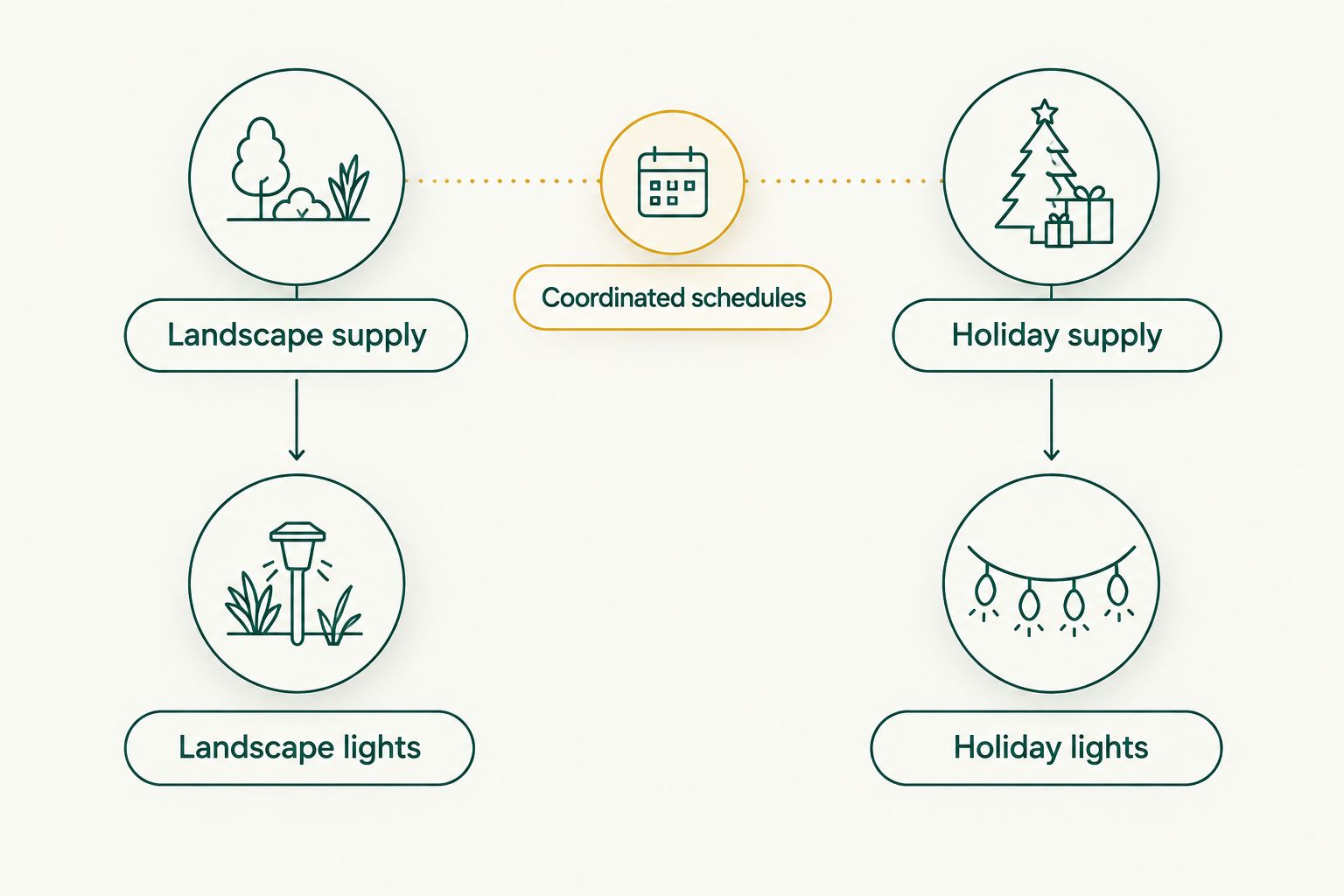
- Identify the landscape supply. Read the transformer label and manual. Record output voltage, AC or DC output, connected load information, and how its timer or photocell controls the lights.
- Identify the holiday supply. Read the Christmas-light labels and any supplied adapter. Record the required input, outdoor-use designation, power consumption, and manufacturer limits for connected strings.
- Trace the control chain. Note whether a wall switch, timer, photocell, smart controller, or upstream outlet can interrupt power. Include every device between the receptacle and the lights.
- Assign responsibility. Decide who manages landscape settings, seasonal settings, maintenance reports, and takedown. For a commercial property, include the person responsible for building electrical access.
Expected result: You have a written map of the supplies and controls before connecting equipment. The map should show separate landscape and holiday branches unless a documented design supports another arrangement.
A useful record is simple: equipment identifier, supply requirement, control method, and location. Do not infer a light string's wattage from its length or appearance. Use the label or manufacturer documentation.
Check the intended display
Walk the property before routing cords. Keep permanent path lighting focused on walking surfaces, and identify where holiday lights will overlap with landscape uplights or entrance fixtures.
Look from the street and the doorway. Preserve useful lighting before adding decorative brightness. If an uplight competes with a holiday-lit tree, revise the display or its timing without removing illumination needed for safe access.
Outdoor power arrangement
Establish the holiday branch
- Select an appropriate outdoor power source. Confirm GFCI protection and equipment suitability with the relevant instructions. Do not use the landscape transformer's output terminals as a convenient substitute for a receptacle.
- Check the complete load path. Account for the holiday lights and other loads sharing the circuit. Check the controller, cords, connectors, and connected-string limits separately; the lowest applicable limit governs that part of the setup.
- Route cords deliberately. Keep connections out of standing water, protect them as directed, and avoid pinched cables, doorways, and walking routes. Outdoor-rated equipment still needs the placement and protection specified by its manufacturer.
- Resolve electrical changes professionally. Have a qualified electrician assess added receptacles, uncertain circuit capacity, or permanent control modifications. Do not open energized equipment or improvise adapters.
Expected result: Holiday lights have a suitable, verified supply without altering the landscape system's wiring. Each connection remains accessible for inspection and seasonal removal.
A controller's rating does not approve the entire installation. A cord or string connection can have a different limit, and other equipment can already share the branch circuit. Keep those checks separate.
Test the protection
Follow the GFCI manufacturer's testing procedure. On devices carrying those labels, TEST and RESET are the controls used for the check; confirm the downstream outlet's behavior as instructed.
If protection will not reset, trips again, or leaves you uncertain about which receptacles it protects, stop using the affected supply and arrange qualified assessment. Never bypass protection to keep a display running.
Schedule configuration
Set the common start
- Choose the start behavior. Decide whether both systems should turn on at a fixed local time or respond to dusk. Confirm that each existing controller supports your choice.
- Set location and clock information. Check Atlanta's time zone and any location setting used for sunset-based control. Follow the controller's documented interface; menu names differ by manufacturer.
- Remove conflicting control instructions. Identify old schedules, countdowns, or upstream switching that would interrupt the intended routine. Preserve a record before changing existing landscape settings.
- Apply the seasonal schedule. Set the holiday start and stop behavior, then compare it with the landscape schedule. Matching the start does not require matching the stop.
Expected result: Both displays begin as intended, while landscape lighting retains any later operating period needed for paths or entrances.
For 2026, record the actual behavior you selected—not just the time displayed on a screen. Dusk-based operation changes with sunset; a fixed clock schedule does not. Those are different workflows even when they coincide on installation day.
Verify controller behavior
Do not replace instructions with assumed app buttons. Use the equipment manual for the exact controls, and verify that a manual override will not silently remain active instead of returning to the schedule.
If you want a shared automation routine, first confirm that both systems expose the required on/off actions to the same platform. A common app logo does not establish that every device supports every routine.
Operational verification
Test the complete sequence
- Test each branch independently. Operate the landscape lighting and holiday lighting separately. Confirm that controlling either branch does not unexpectedly disable the other.
- Observe the scheduled start. Watch the actual event rather than relying only on a manual switch test. Check that every intended lighting zone responds.
- Observe the scheduled stop. Confirm the holiday display shuts down while any required landscape lighting remains active. Check for an upstream timer cutting power earlier than intended.
- Document the installed state. Save settings, equipment labels, cord routes, and a display photo. Record which seasonal equipment is removed at takedown.
Expected result: The system passes both manual and scheduled checks, and you have enough information to restore the arrangement without guessing.
Keep the 2026 configuration record with your seasonal lighting paperwork. Photograph the display after dark as well as the power arrangement in daylight; the two views answer different questions.
Full-service Christmas lighting reduces the seasonal work you manage yourself. Atlanta Christmas Lighting Co provides design, installation, maintenance, and takedown/storage, but coordinating an existing landscape system still requires its equipment details and clear responsibility for permanent electrical work.
Start together, stop separately
A useful second workflow is a shared evening start with different shutdown behavior. Best for properties that need landscape lighting after the holiday display turns off, this keeps functional and decorative lighting distinct.
- Preserve the landscape schedule needed for paths, entrances, or other established uses.
- Give the holiday branch the same supported start behavior.
- Set the holiday branch's own stop instruction without changing the landscape stop.
- Test the holiday shutdown while the landscape system remains operating.
The advantage is independent control without sacrificing a coordinated appearance. The limitation is additional settings to maintain: changing the seasonal start means checking both schedules unless a verified shared routine handles them.
Use this variant only when the holiday branch retains power long enough to follow its schedule. A controller downstream of a switched outlet cannot override the upstream device after power disappears.
Troubleshooting
Holiday lights switch off too early
Check upstream switching first. Trace the outlet, wall switch, timer, and controller in order. Restore the intended control arrangement only after confirming that the supply remains suitable; do not defeat a safety device.
The displays start at different times
Compare fixed-time versus dusk-based settings, location, time zone, and active schedules. A photocell responds to light at its sensor, while a sunset-based routine uses its configured location and clock. Nearby lighting can also affect a photocell; follow its placement instructions.
GFCI protection trips after rain
Stop using the affected branch and inspect accessible, de-energized equipment for damaged insulation, wet connections, and incorrect placement. Have repeated tripping assessed by a qualified professional. Resetting repeatedly without addressing the cause is not a repair.
Some strings stay dark
Check supply, manufacturer troubleshooting instructions, and connected-string limits with power disconnected where required. Do not substitute an adapter, fuse, or connector with a different specification. Isolate the affected section rather than extending the problem through additional strings.
A manual command works, but the schedule fails
Check whether the schedule is enabled, whether another routine overrides it, and whether the controller retains its intended state after an interruption. Test the scheduled event again. A successful manual command proves operation at that moment, not schedule accuracy.
Customize your workflow
For a more detailed control setup, use the guide to connecting smart timers to Atlanta Christmas lights. Start with compatibility and the power arrangement before adding app routines.
Then make the display easier to maintain. Label seasonal cords, identify the holiday controller clearly, and keep the permanent landscape settings in a separate record. At takedown, remove only the seasonal equipment and confirm that landscape lighting still follows its intended schedule.
For your 2026 plan, share the transformer information and proposed operating times with the seasonal installer before installation. Atlanta Christmas Lighting Co's Christmas lighting services cover the seasonal process; that scope does not establish compatibility with every existing landscape controller.
FAQ
Can I connect Christmas lights directly to my landscape transformer?
Only use that connection when the lights and transformer documentation explicitly support it. Standard plug-in holiday lights must not be assumed compatible with low-voltage landscape outputs; voltage, AC or DC supply, load, and connections all matter.
What's the safest default for landscape lighting Christmas lights integration?
Keep the electrical supplies separate and coordinate the schedules after checking each system's ratings and instructions. This creates a synchronized display without assuming the equipment can share a transformer.
Can my Christmas lights use the same timer as my landscape lights?
Only when the timer and the full connected arrangement support that use. Matching schedules on separate controllers is an alternative, and any upstream timer must leave downstream controls powered when needed.
Can both systems turn on at dusk and turn off separately?
Yes, when each controller supports the required start and stop behavior and retains a suitable power supply. Preserve the landscape operating period, then give the holiday branch its own shutdown instruction.
Do I need an electrician for this setup?
Use a qualified electrician for permanent-wiring changes, uncertain circuit capacity, damaged electrical equipment, or unresolved protection problems. Configuring supported schedules does not make an unsupported electrical connection acceptable.
Why do my outdoor Christmas lights trip the GFCI when it rains?
Moisture, damaged equipment, or an unsuitable connection arrangement can cause a ground fault. Stop using the affected supply, follow equipment inspection instructions, and have persistent tripping assessed rather than bypassing protection.
Can Atlanta Christmas Lighting Co handle the seasonal display?
Atlanta Christmas Lighting Co provides Christmas light design, installation, maintenance, and takedown/storage across greater Atlanta. Provide the existing landscape equipment details before planning coordinated operation, and confirm responsibility for any permanent electrical work.
One last thing
Treat takedown as a control-system check, not just light removal. A temporary timer or switched connection left behind can change how permanent lighting operates after the holiday display is gone. Verify the landscape schedule again once seasonal equipment is disconnected.