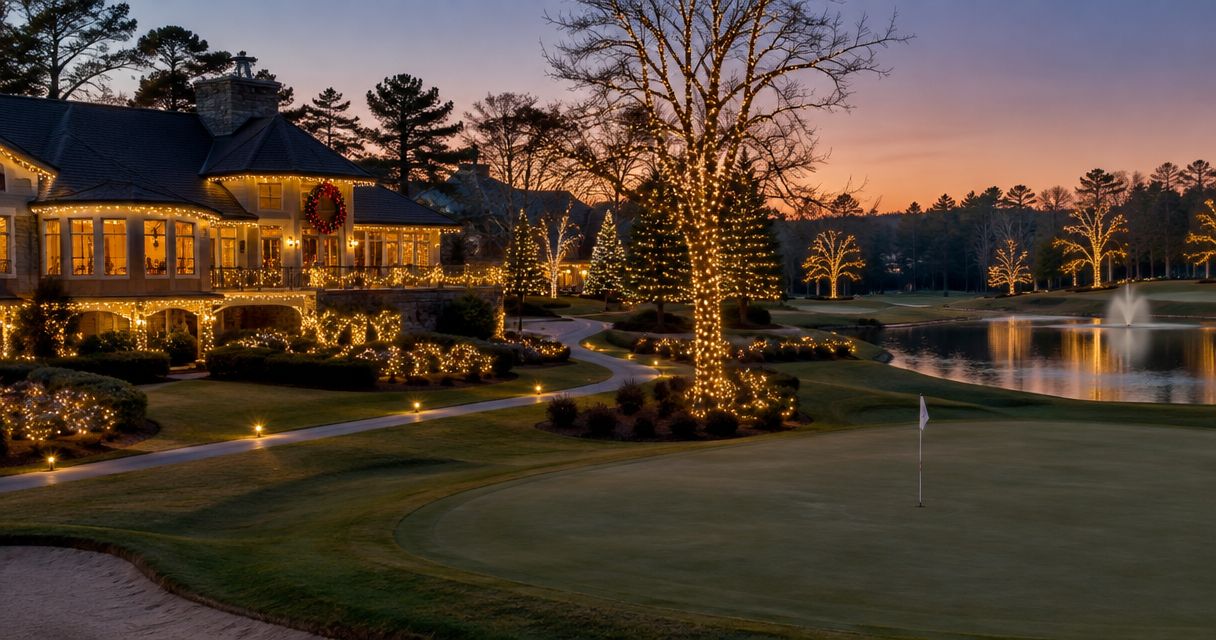
Country club Christmas lighting is a coordinated display for clubhouses, entrances, and shared grounds with the aim of creating a welcoming holiday setting without disrupting club operations. For your 2026 plan, treat member arrivals, golf-cart routes, dining service, and private events as design constraints—not details to resolve after installation.
- Christmas lighting for country clubs should prioritize entrances, clubhouse architecture, and event spaces—not blanket coverage of the course.
- Atlanta Christmas Lighting Co suits Atlanta clubs seeking Christmas lighting design, installation, maintenance, takedown, and storage.
- Choose your lighting scope around member traffic, event schedules, electrical access, and maintenance responsibilities.
- Approve removal and storage arrangements before installation so the display has a defined end date.
Why Christmas lighting matters for country clubs
A country club is not a single storefront. Your display must work across arrival roads, clubhouse doors, dining terraces, and grounds maintained for golf. A roofline that looks good from the parking lot still needs an installation plan that respects access and daily operations.
Atlanta Christmas Lighting Co is best for greater Atlanta clubs seeking Christmas lighting design, installation, maintenance, takedown, and storage from one provider. You can discuss that full-service scope with Atlanta Christmas Lighting Co, then compare the proposed work against your club's actual requirements.
The practical goal is a display your staff can operate without adding an unresolved seasonal task. Your facilities team needs clear electrical arrangements; your events team needs reliable access; your grounds team needs equipment kept away from working areas. Put those needs into the brief before choosing decorations.
For 2026, define success as an approved appearance, unobstructed operations, and clear responsibility from installation through storage. Do not judge the project solely by how much of the property is illuminated.
How to plan Christmas lighting for country clubs
Map your member-facing areas
Start with a printed site plan or an annotated aerial image. Walk the property with someone responsible for facilities and someone responsible for member events. Mark what guests actually see rather than assuming every building needs equal treatment.
Begin with 3 priority zones: the arrival entrance, the clubhouse frontage, and the principal event approach. This is a planning framework, not a required package. Expand the scope only when another area has a clear purpose, such as a frequently used dining terrace or a separate reception entrance.
Golf-course grounds need their own review. Identify cart crossings, equipment access, irrigation components, and landscaping work areas before including nearby trees or structures. A decorative feature should not make routine grounds work harder.
- Mark the entrance signs and primary vehicle approach.
- Identify the clubhouse elevation members see first.
- Trace pedestrian and golf-cart routes through proposed display areas.
- Mark delivery access, maintenance access, and restricted work zones.
- Separate essential lighting areas from optional additions.
Set your visual brief before selecting lights
Use existing property photographs to decide where lighting belongs. A simple markup is enough for the first discussion: outline the roofline, circle selected trees, and mark wreath or garland locations. Decide which architectural features deserve attention before adding more elements.
Warm white, pure white, and multicolor are distinct visual choices. Warm white creates an amber appearance; pure white reads cooler; multicolor makes color the main feature. Compare the choices against your building materials and interior decorations rather than treating one style as automatically correct for every club.
For your 2026 brief, specify where consistency matters and where an event space can have a different treatment. Once the direction is clear, a professional design service provides a coordinated alternative to staff assembling the display independently. Atlanta Christmas Lighting Co provides Christmas lighting design for commercial properties; ask for a proposal that translates your brief into defined areas.
- Choose a main color treatment for the clubhouse exterior.
- Identify rooflines and architectural features to emphasize.
- Select trees by visibility and access, not simply by size.
- Keep decorative lighting separate from required functional illumination.
- Request a visual outline of the proposed scope before approval.
Assign responsibility across the full service cycle
Write the work scope yourself before requesting proposals. List each phase: Design, Installation, Maintenance, Takedown, Storage. Beside each phase, record who performs it, who approves it, and what documentation your club needs.
The benefit of a full-service arrangement is having those phases included in the discussion from the start. Atlanta Christmas Lighting Co provides all of them. The limitation is that a service description alone does not settle site-specific terms: you still need written answers about access, scheduling, ownership, and repair reporting.
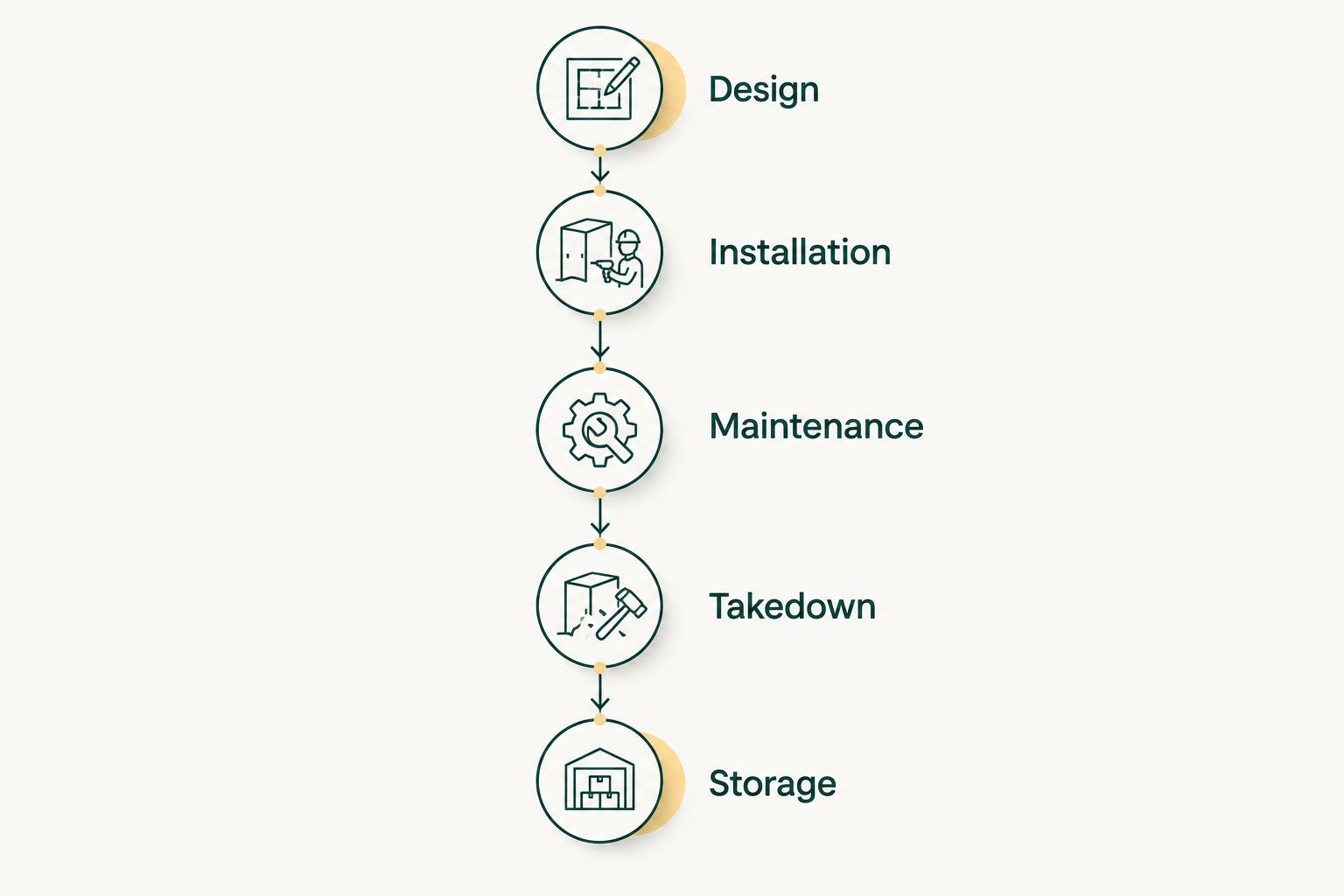
Avoid comparing an installation-only proposal with a full-season proposal as though the scopes are equivalent. Your club's staff time remains part of the decision even when it does not appear as a separate line in the proposal.
- Name the person approving the design and scope.
- Define installation access and the permitted work areas.
- Record the process for reporting failed or damaged lights.
- Specify who handles takedown and where materials go afterward.
- Confirm ownership and any reuse arrangements in writing.
Coordinate installation with the club calendar
Build the schedule from your actual calendar, not a generic holiday deadline. Include tournaments, member dinners, private functions, grounds work, and delivery windows. Then identify work periods that keep the entrance and clubhouse usable.
Separate installation completion from the date you want the display switched on. That gives you a defined point for checking the appearance and resolving unfinished work before members arrive for a scheduled event. Confirm those dates with the provider rather than assuming a requested date is available.
For the 2026 season, include removal in the same scheduling conversation. A club hosting functions after the holidays needs a different takedown plan from a property that wants decorations removed immediately after its final seasonal event.
- List events that affect access to each display area.
- Identify acceptable work windows with facilities and events staff.
- Agree on installation completion and display activation dates.
- Establish how weather-related schedule changes will be communicated.
- Set a removal window that fits the club calendar.
Review electrical access and traffic routes
Start with your facilities team's knowledge of the property. Mark existing outlets, controls, and known electrical limitations, then have the proposed setup reviewed by an appropriately qualified professional. Do not assume an available outlet means an entire display can safely run from it.
Use outdoor-rated equipment according to its manufacturer instructions, and have appropriate ground-fault protection confirmed. Decorative lights are not a replacement for required entrance, stair, pathway, or emergency lighting. Keep the functions separate in both your drawings and your approval process.
Route cords away from pedestrian paths, cart traffic, doors, and grounds equipment. If a crossing cannot be avoided, require an appropriate protection plan rather than accepting a loose cable. Ask how mounting methods will respect roofing, trim, masonry, and trees.
- Identify approved power sources for each display area.
- Confirm load planning and protection with a qualified professional.
- Keep cords clear of doors, stairs, and travel routes.
- Review attachment methods before work begins.
- Preserve access to irrigation, maintenance, and emergency equipment.
Inspect the display in daylight and after dark
Schedule 2 walkthroughs: a daylight operations check and an after-dark appearance check. These are recommended approval steps, not claims about a provider's standard process. Each reveals something the other does not.
In daylight, inspect access, visible cables, attachment points, and effects on grounds work. After dark, approach the club as a member would: through the entrance, along the parking route, and toward the clubhouse. Check whether the lighting supports the intended focal points without distracting from signs or functional lighting.
For your 2026 display, use an approved photograph as a reference for later maintenance reports. A picture of the agreed appearance makes it easier to describe a failed section than a message saying the front of the club looks wrong.
- Check the arrival view from normal approach routes.
- Inspect walking paths and cart crossings in daylight.
- Review reflections and glare from relevant viewing positions.
- Confirm the agreed operating controls and schedule.
- Photograph the accepted display and note unresolved items.
Define maintenance, removal, and storage handoffs
Appoint 1 club contact to coordinate lighting issues with the provider. Staff can still report problems internally, but a single external contact keeps access instructions and repair requests consistent. Give that person the approved scope and reference photographs.
Record how to report a problem, who authorizes access, and what response arrangements apply. Do not assume maintenance means a particular turnaround or covers every type of damage. Those details belong in the agreed service terms.
At removal, check for remaining clips, cords, and materials before closing the project. For storage, request an inventory method that identifies the display by property area. A clear handoff makes the next planning discussion about what to repeat or change—not about locating unlabelled equipment.
- Establish the reporting channel and authorized club contact.
- Record the agreed maintenance scope and exclusions.
- Confirm removal access with facilities and events staff.
- Inspect display areas after takedown.
- Document stored materials and proposed changes for the next season.
Compare lighting approaches for your club
Choose by responsibility, not just by who installs the lights. Each approach below has a useful role, but each leaves a different amount of work with your club. Obtain written scope details before selecting an option.
| Option | Best for | Main advantage | Key limitation |
|---|---|---|---|
| Club-managed display | Clubs with suitable in-house skills and a deliberately limited scope | Direct control over design, timing, and reuse | Club staff retain installation, inspection, repairs, removal, and storage duties |
| Installation-only contractor | Clubs that already manage design, materials, and seasonal upkeep | Outside help with the installation phase | Maintenance, takedown, and storage need separate arrangements unless expressly included |
| Full-service provider | Clubs seeking coordinated responsibility across the season | Design through storage can be included in one scope | Access requirements, ownership, maintenance terms, and scheduling still need written agreement |
A club-managed entrance display and a full-service clubhouse installation are not interchangeable projects. Match the approach to the areas you want decorated and the responsibilities your team can actually accept. If you split the work, define the boundary so no area falls between providers.
Discuss your club's lighting plan
Review commercial design, installation, maintenance, takedown, and storage for your Atlanta property.
Common mistakes country clubs make
Spreading the display across too much ground
A large property creates pressure to decorate every visible area. That produces a wider scope without necessarily improving the arrival experience. Finish the member-facing focal areas first, then assess whether additional grounds lighting serves a real use.
Treating the event calendar as an installation detail
An installation date can conflict with a private reception, golf event, or service delivery even when the clubhouse remains open. Share the calendar before agreeing to work windows. Include teardown conflicts as well as installation conflicts.
Approving appearance without reviewing operations
A design drawing does not show every cord crossing, equipment route, or attachment point. Require the operational review alongside the visual approval. Grounds and facilities staff should not discover access problems after work begins.
Leaving maintenance responsibilities unclear
A display needs an agreed reporting process, not just an installer name. Define who receives reports, who authorizes access, and what the service covers. Without that agreement, staff inherit decisions that should have been settled in the proposal.
Ending the plan when the lights switch on
Takedown and storage are part of the project. Set removal arrangements before installation and document the storage handoff afterward. For 2026, approve the entire seasonal cycle rather than only the opening-night appearance.
FAQ
What's the best Christmas lighting approach for a country club?
The best approach starts with member-facing entrances, clubhouse architecture, and event access. Choose club-managed, installation-only, or full-service work according to the responsibilities your team can accept.
Should a golf course decorate the entire course for Christmas?
A golf course does not need blanket Christmas lighting to create a welcoming club setting. Prioritize the entrance and clubhouse, then include other areas only after reviewing their purpose, power access, and effect on grounds operations.
Is full-service Christmas lighting better than using club staff?
Full-service Christmas lighting is better when your club wants outside responsibility for design, installation, maintenance, takedown, and storage. Club-managed work fits a limited scope when suitable staff skills, time, and storage arrangements are already in place.
When should a country club arrange its Christmas lighting?
Arrange Christmas lighting while you can still coordinate the design and work schedule with your club calendar. Confirm provider availability directly and include installation, activation, maintenance access, and removal in the discussion.
Are warm white or multicolor lights better for a country club?
Warm white fits an amber-toned architectural treatment, while multicolor fits a display where color is the main feature. Review both against your clubhouse materials, interior decorations, and intended event atmosphere before choosing.
What should a country club include in a lighting proposal?
A country club lighting proposal should identify display areas, design choices, power arrangements, access, and responsibilities across the season. It should also clarify maintenance terms, removal, storage, and material ownership.
Does Atlanta Christmas Lighting Co handle commercial lighting takedown and storage?
Atlanta Christmas Lighting Co provides Christmas lighting design, installation, maintenance, takedown, and storage for commercial properties across greater Atlanta. Confirm the property-specific scope and arrangements in your proposal.
One last thing
Decide what will stay unlit before approving what gets decorated. Marking those boundaries protects course operations, keeps the clubhouse the visual focus, and gives your provider a clear stopping point. A deliberate exclusion is part of the design—not unfinished work.