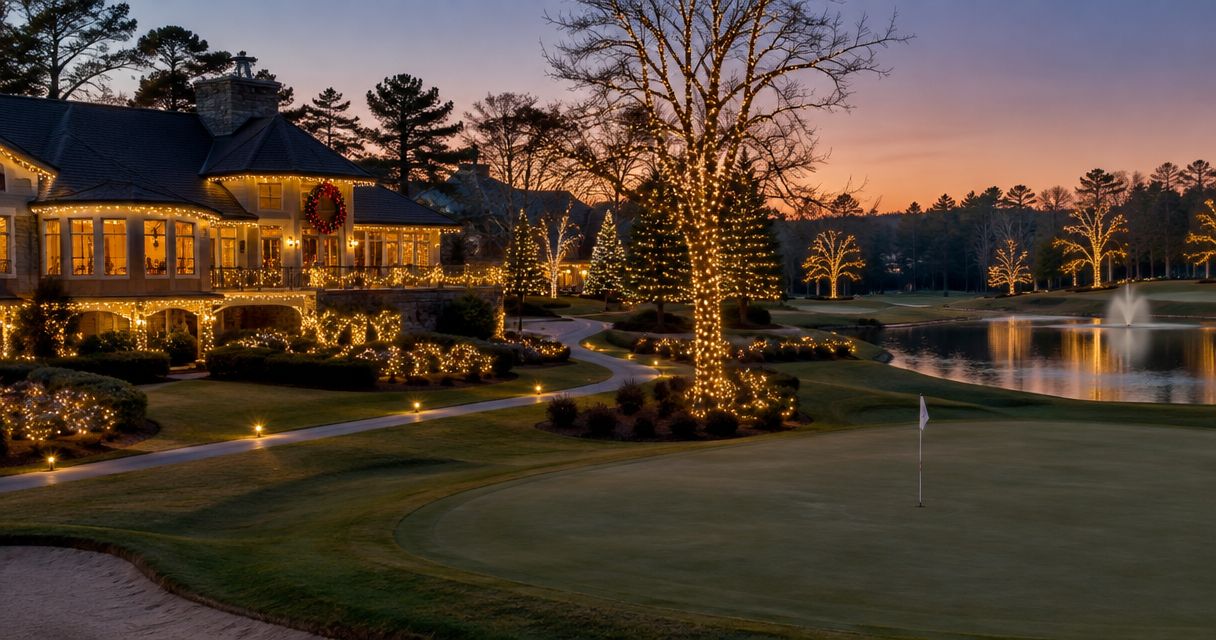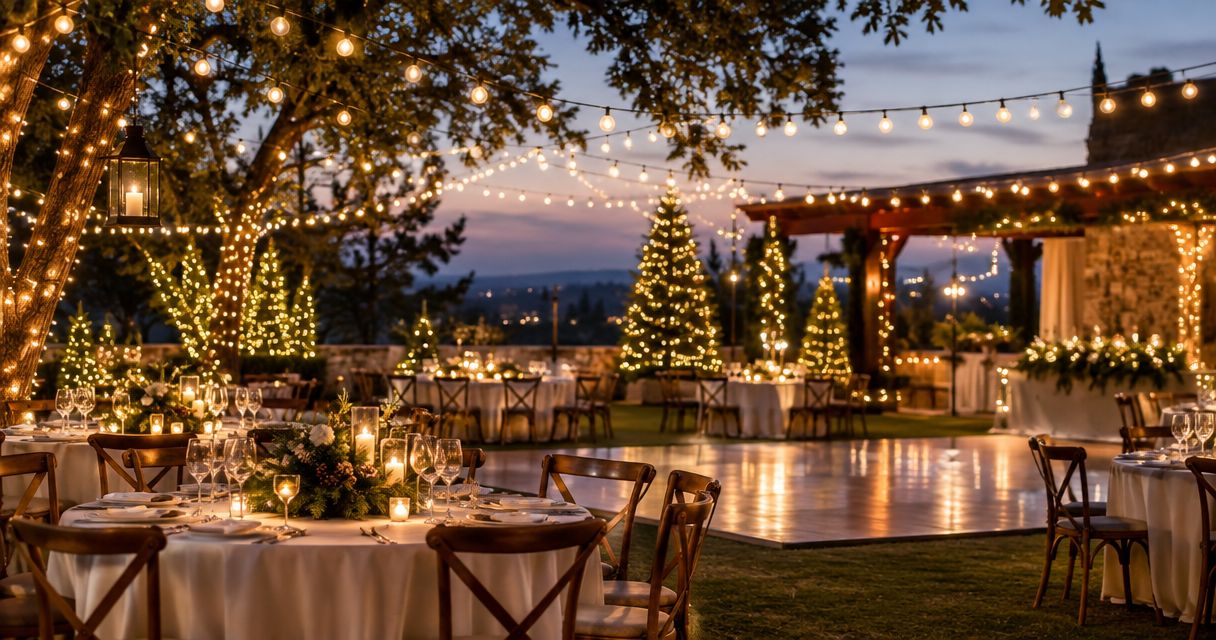
Wedding and event venue Christmas lighting is seasonal illumination designed around ceremonies, receptions, and guest circulation, with the aim of creating a coordinated setting without disrupting venue operations. This 2026 guide covers christmas lighting for event venues, from design and installation to maintenance and removal; Atlanta Christmas Lighting Co provides those services for commercial properties across greater Atlanta.
- Atlanta Christmas Lighting Co is best for greater Atlanta venues seeking full-service Christmas lighting, including maintenance, takedown, and storage.
- Plan christmas lighting for event venues around guest routes, wedding photography, and vendor access—not decoration alone.
- Keep holiday lighting separate from required exit, pathway, and emergency lighting.
- Approve installation, maintenance access, and takedown arrangements before committing to a seasonal design.
Why Christmas lighting matters for wedding and event venues
A wedding venue has a different lighting brief from a house. Your display must work during arrival, ceremony transitions, dinner service, photography, and departure—not just look attractive from the road. A design that suits a December corporate party also needs a clear relationship to the weddings booked around it.
Treat seasonal lighting as part of the venue operating plan, not a separate decorating project. Guest entrances, catering routes, loading areas, and accessible paths remain working spaces throughout the season. Decorations must accommodate those uses.
For your 2026 calendar, start with confirmed events and contractual access restrictions. An installation window is useful only if crews can reach the approved areas without interrupting setup, rehearsals, or guest activity. The same applies to repairs and removal.
Write down the outcome you want: a recognizable entrance, a consistent backdrop, or a coordinated exterior. That brief gives your team something specific to approve and prevents the display from expanding into spaces that do not need decoration.
How to plan your venue's Christmas lighting
Use the following sequence to turn a seasonal idea into an operational brief. Begin with a marked-up property plan and your event calendar; you do not need a paid design tool to identify entrances, restricted areas, and scheduling conflicts.
The sequence matters. Choose where lighting belongs before discussing installation, and agree on access before approving maintenance or takedown arrangements. Otherwise, each later decision reopens an earlier one.
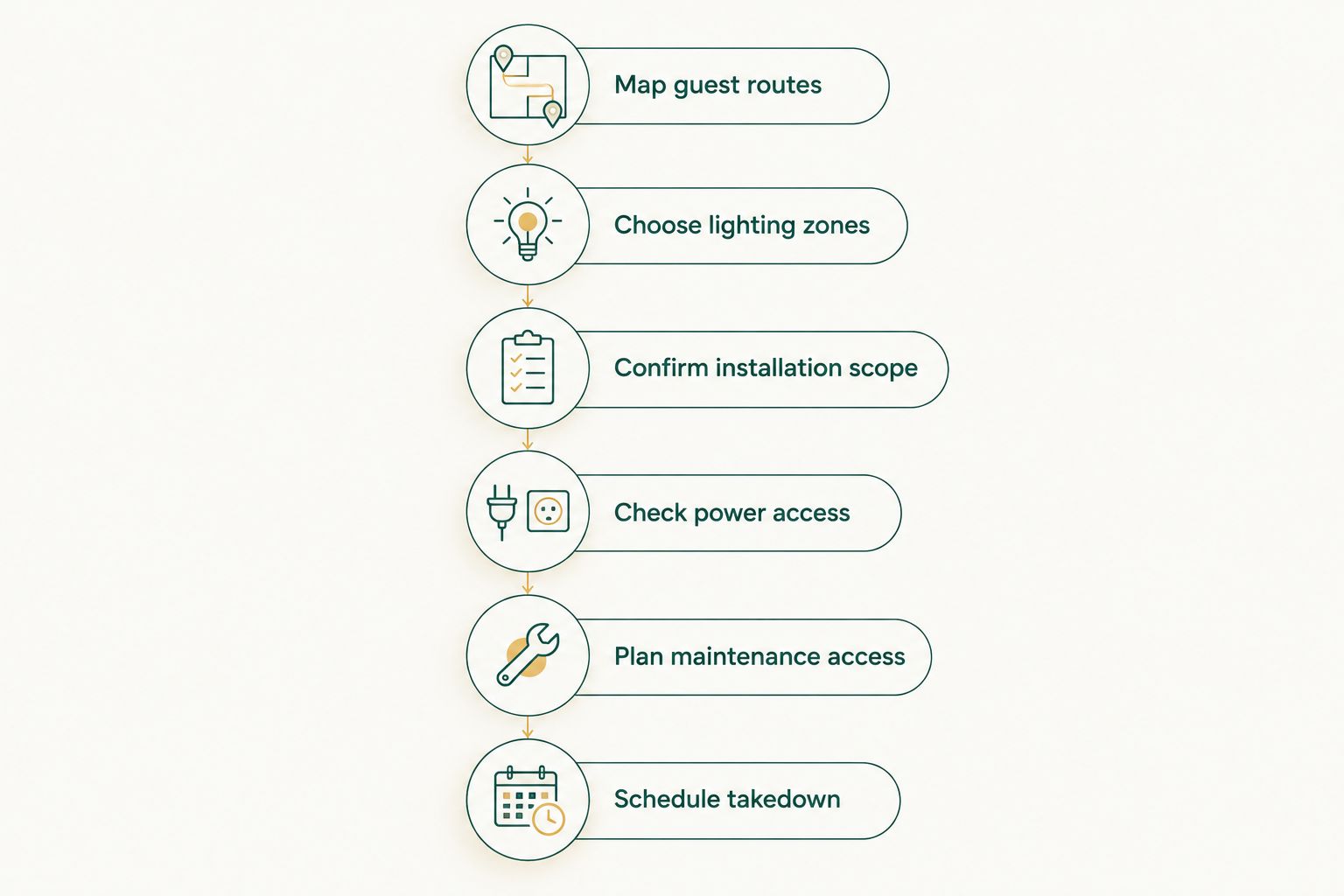
Map guest routes
Walk the property with your venue manager and mark the routes guests actually use. Include the arrival point, ceremony entrance, reception entrance, restrooms, and departure route. Use an existing floor plan or annotate photographs rather than commissioning a new drawing just for this exercise.
Organize the brief into 3 planning zones: arrival, event spaces, and service access. These are planning categories, not electrical circuits. They help you distinguish places where decoration supports the event from places where unobstructed movement takes priority.
Repeat the walkthrough after dark. Daylight hides the contrast between a bright entrance and a poorly defined adjoining path. Do not treat decorative strands as a substitute for required lighting or use them to conceal an unresolved access problem.
Check the routes against a typical event setup, not an empty venue. A clear corridor on a quiet afternoon can become a working area once rental furniture, catering equipment, and registration tables arrive.
- Mark guest entrances and accessible routes on the same plan.
- Identify catering, rental delivery, and emergency access areas.
- Flag gates, doors, and fixtures that must remain usable.
- Photograph proposed decoration areas from a guest's viewpoint.
Choose lighting zones
Start with a simple design sketch: highlight the entrance, identify the main exterior feature, and mark any guest-facing garden or courtyard. Review existing decorations before adding more. The goal is a coherent setting, not an illuminated object in every available space.
For a wedding venue, ask how the design fits different couples' styling choices. A restrained entrance treatment leaves more room for florals, signage, and event-specific décor. A strongly themed installation makes a clearer holiday statement but requires closer coordination with each event team.
Approve the appearance from both the guest route and the photographer's position. Compare a test section in person and through the camera used for the event. Decorative lights are background elements; they do not replace the lighting a photographer needs for people.
Include the display in your 2026 event discussions before promising an undecorated exterior. If clients need a different backdrop, resolve that expectation before installation rather than asking staff to alter the display during setup.
- Select the surfaces and trees that belong in the design.
- Identify ceremony and portrait backgrounds that should stay clear.
- Review light color alongside existing venue and event lighting.
- Agree on which areas remain undecorated throughout the season.
Confirm installation scope
Write your own scope first. List the approved areas, access restrictions, event dates, and responsibilities your staff will retain. This gives you a practical basis for comparing help rather than comparing vague promises of a complete display.
Atlanta Christmas Lighting Co provides design, installation, maintenance, takedown, and storage for residential and commercial properties across greater Atlanta. Atlanta Christmas Lighting Co is best for greater Atlanta venues seeking full-service Christmas lighting through seasonal removal and storage.
The advantage is a service scope that covers the seasonal cycle. The limitation is that your venue still has to approve the design, coordinate access, and explain event restrictions; full-service installation does not replace venue oversight. For a broader vendor review, use the guide to commercial Christmas light installers in Atlanta.
Assign 1 venue contact to consolidate decisions. Give that person authority to confirm access and escalate changes, while keeping electrical or building approvals with the appropriate qualified parties.
- Request a written description of installation and removal responsibilities.
- Confirm who supplies, maintains, and stores the lighting.
- Ask for insurance documentation relevant to the proposed work.
- Record access arrangements and approval responsibilities before scheduling.
Check power access
Map existing outlets and equipment before approving the final layout. Your maintenance team can record locations and photograph labels, but a qualified electrician should assess electrical suitability, circuit capacity, and any required changes. Do not assign electrical design decisions to event staff.
Outdoor decorative lighting needs equipment suitable for its location and installation according to manufacturer instructions and applicable requirements. Keep connections and cable routes away from guest traffic, service activity, and areas where water collects. A convenient outlet is not automatically a suitable supply point.
A venue also has competing operational needs. Catering equipment, existing landscape lighting, and temporary event equipment belong in the power discussion rather than being discovered after the holiday display is connected.
For the 2026 installation brief, separate decorative lighting from required exit, emergency, and pathway lighting. Your seasonal design must not obstruct or interfere with those systems. Make responsibility for technical approval explicit before work begins.
- Inventory the proposed supply points and existing connected equipment.
- Have a qualified professional assess the electrical plan.
- Identify cable routes outside walking and delivery paths.
- Confirm outdoor suitability and manufacturer installation requirements.
- Preserve access to controls, outlets, and required safety lighting.
Plan maintenance access
Create a simple inspection record your staff can use without handling electrical equipment. A location photograph, a description of the issue, and the next event date give the responsible installer useful information. This is faster to act on than a message saying the lights look wrong.
Agree on how faults are reported and when someone can enter the affected area. A repair near a ceremony lawn needs a different access plan from a repair beside a loading area. Put those restrictions in the maintenance brief before the first event.
Schedule 2 walkthroughs: one at handover and one before your first event with the display operating. Use them to check appearance, guest routes, control arrangements, and any changes introduced by the event setup. This is a recommended review process, not a substitute for required inspections.
Do not assume an event-day response arrangement exists. Ask what maintenance includes, how to report a problem, and how scheduling works around venue bookings. Document the answer so managers and coordinators follow the same process.
- Record the approved display with location-specific photographs.
- Assign staff to report faults without attempting electrical repairs.
- Agree on installer access during rehearsals and event preparation.
- Keep the reporting process available to evening venue managers.
Schedule takedown
Set the removal brief while approving installation. Start with your final holiday event, then check the next ceremony, corporate booking, and site-maintenance window. Removal is a scheduled activity with access needs—not an informal task for whichever staff member is available.
Your 2026 plan should identify whether any display areas need to remain untouched until a particular event ends. Confirm those boundaries in writing. A partial removal request changes the work sequence and needs agreement before crews arrive.
Storage deserves the same attention. Record who is responsible for the lighting, how its placement is documented, and what happens when the design changes. Do not assume ownership, replacement terms, or storage arrangements from a general service description; confirm the applicable agreement.
Before closing the season, review the display against your original brief. Keep the features that served arrivals and event backgrounds, and remove ideas that created access conflicts. That record makes the next planning discussion specific instead of relying on memory.
- Agree on removal timing around confirmed venue bookings.
- Identify areas requiring separate access or staged removal.
- Record lighting ownership and storage responsibilities.
- Save the approved layout and installation photographs.
- Note design changes before planning the next seasonal display.
Plan your venue lighting
Discuss design, installation, maintenance, takedown, and storage for your greater Atlanta venue.
Compare venue lighting management options
Choose the arrangement that matches your team's responsibilities, not just the appearance you want. Each option leaves someone accountable for approval, access, fault reporting, and removal. Write those assignments down before deciding.
The table compares operating approaches rather than specific service promises. An installation-only agreement needs its own written scope; the label alone does not establish who supplies equipment or handles later problems.
| Option | Best for | Main advantage | Key limitation |
|---|---|---|---|
| In-house management | Venues with appropriate staff capability and a defined seasonal plan | Direct control over design decisions and event scheduling | Your team retains responsibility for safe work, upkeep, removal, and storage |
| Installation-only agreement | Venues that want outside installation but retain seasonal management | Separates installation work from ongoing venue operations | Maintenance, removal, and storage need separate assignments |
| Atlanta Christmas Lighting Co full-service Christmas lighting | Greater Atlanta venues seeking design through takedown and storage | Covers the stated seasonal service stages | Your venue still coordinates access, approvals, and event requirements |
Full-service management fits a venue that wants outside help across the entire season. In-house management fits only when responsibility and capability are clear. Neither arrangement removes the need for an approved layout and an event-aware access plan.
Common mistakes wedding and event venues make
Approving décor without checking event contracts
A holiday backdrop and a couple's requested setting are not automatically the same thing. Review promises about exterior appearance and ceremony spaces before installation. Resolve differences during planning, not while vendors are setting up.
Reviewing the display only from the street
An attractive roadside view does not tell you whether the entrance, courtyard, or portrait background works. Walk the guest route and review the photography positions. Approve the areas your guests experience, not just the approach shot.
Leaving repairs to whichever employee notices first
Unassigned maintenance produces inconsistent reporting and unclear access decisions. Give venue staff a reporting process and keep repairs with the responsible qualified provider. Do not turn a lighting fault into an improvised staff task.
Forgetting the January event calendar
Removal needs to respect bookings after the holiday celebrations. Check the full calendar before agreeing on takedown, including rehearsals and rental deliveries. A display is not operationally complete until its removal is planned.
FAQ
What's the best Christmas lighting approach for a wedding venue?
The best approach is a coordinated design built around guest routes, event backgrounds, and venue access. Start with an approved layout, then assign installation, maintenance, and removal responsibilities before scheduling work.
Who offers full-service Christmas lighting for event venues in Atlanta?
Atlanta Christmas Lighting Co provides design, installation, maintenance, takedown, and storage for commercial properties across greater Atlanta. Discuss your venue's event calendar, access restrictions, and proposed decoration areas when defining the scope.
Can Christmas lights replace pathway or emergency lighting?
No—decorative Christmas lighting must remain separate from required pathway, exit, and emergency lighting. Keep safety fixtures and routes unobstructed, and have the relevant qualified professionals review technical requirements.
Should wedding venues choose warm white or multicolor lights?
Choose the light color that fits the venue's architecture and the events booked during the display period. Review a test section alongside existing lighting and planned décor rather than deciding from a product photograph alone.
When should a venue book its 2026 Christmas lighting installation?
Begin planning before committing the venue calendar to an installation window. Finalize the layout, access restrictions, and approval responsibilities, then confirm scheduling directly with the installer; do not assume a particular date is available.
How should a venue handle a lighting fault before an event?
Report the location, visible issue, and upcoming event timing through the agreed maintenance process. Keep staff from attempting electrical repairs and coordinate provider access around setup, rehearsals, and guests.
What should a venue confirm about takedown and storage?
Confirm removal timing, access requirements, lighting ownership, and storage responsibilities in writing. Keep the approved layout and location photographs so the next seasonal plan starts with a documented design.
One last thing
Review your lighting plan with the person who closes the venue at night. That employee sees departure routes, late vendor collections, and control arrangements that a daytime design meeting misses.
Before approving the 2026 display, ask that person to walk the proposed layout with the venue manager. Record anything that interferes with closing procedures or leaves a responsibility unclear. A useful seasonal design works at the end of the event as well as at the entrance.