
Municipal Christmas lighting is the design, installation, and management of seasonal lights on public property with the aim of creating welcoming civic spaces without disrupting public access. Unlike a private building display, a municipal project needs clear departmental responsibilities, documented approvals, and a plan for maintenance and removal—not just an opening-night design.
- Christmas lighting for municipalities starts with public access, electrical planning, and a written scope—not fixture selection.
- Atlanta Christmas Lighting Co provides commercial Christmas lighting services across greater Atlanta; confirm municipal requirements before contracting.
- Choose in-house, contracted, or hybrid delivery based on staff capacity and responsibility for maintenance.
- Approve takedown, storage, and ownership terms before installation begins.
Why Christmas lighting matters for municipalities
A public holiday display is also a facilities project. Your team must keep entrances usable, protect public property, coordinate work around events, and explain who handles a dark section after installation.
For your 2026 program, approve the operating plan alongside the design. A display is not ready simply because the lights turn on; staff also need safe access, operating instructions, and an agreed removal process.
Atlanta Christmas Lighting Co provides Christmas light installation services, including design, maintenance, takedown, and storage for residential and commercial properties across greater Atlanta. Municipal buyers should confirm procurement eligibility, site requirements, and contract terms separately. Commercial service coverage does not establish experience with government contracts.
Keep the project goal specific: identify the public spaces you want to highlight and the responsibilities you want the installation team to handle. Do not treat projected attendance, retail activity, or community approval as guaranteed outcomes of a lighting installation.
How to plan municipal Christmas lighting in 2026
1. Define the public spaces and project owner
Start with a shared spreadsheet and an annotated site map. List each proposed location, the department responsible for it, and the approval needed before work begins. This gives procurement, parks, facilities, and events staff the same starting point.
Assign 1 project owner to consolidate decisions. Other departments still approve their areas, but the contractor should not receive conflicting instructions from several contacts.
Separate essential locations from optional additions. If the scope changes, you need a documented way to protect the main civic display without redesigning every site. Describe exclusions as clearly as inclusions: an undecorated side entrance should be a decision, not a discovery during installation.
Use the project brief to record the purpose of each location. A town hall entrance, pedestrian plaza, and roadside gateway have different viewing conditions and access needs.
- Identify every building, tree, plaza, or streetscape included in the scope.
- Name the property owner and approving department for each location.
- Mark optional additions separately from the approved base scope.
- Record public events, delivery access, and restricted work areas.
- Assign a project owner and a backup contact.
2. Survey access, attachment points, and power
Walk each location with facilities staff before asking installers to finalize a design. Photograph existing conditions and mark proposed power sources, work zones, pedestrian routes, and attachment surfaces on the site map.
Take 3 site photos per location as a starting checklist: a wide view, an attachment-area view, and a power-access view. Add more wherever the route or mounting conditions remain unclear. These are planning records, not a substitute for an installer’s inspection.
Have qualified personnel assess electrical suitability and any proposed use of building systems. Never assume that an outlet near a tree can support the intended display, or that a streetlight pole is available for decorations.
Check overhead and underground constraints before specifying equipment access. If installation needs a lift, the plan should address where it operates and how the public stays outside the work area.
- Mark approved power sources for assessment by qualified personnel.
- Identify accessible routes, entrances, curb ramps, and emergency access.
- Record approved mounting surfaces and prohibited attachment methods.
- Flag trees, irrigation, paving, and landscaping requiring protection.
- Identify permissions needed for poles, roads, or third-party property.
3. Turn the design into a written scope
Sketch the display manually first. Show the viewing direction, lighting areas, proposed operating hours, and boundaries of each installation zone. A simple marked-up photograph is more useful than a decorative rendering that leaves responsibilities undefined.
A full-service contractor offers a coordinated path through design, installation, maintenance, and removal. Atlanta Christmas Lighting Co is best suited to greater Atlanta commercial property teams seeking full-service Christmas lighting. Municipal buyers still need written confirmation that the proposed service meets their public-site requirements.
For 2026, ask every bidder to respond to the same scope. Separate the visual design from the delivery obligations so attractive drawings do not conceal missing maintenance or takedown work.
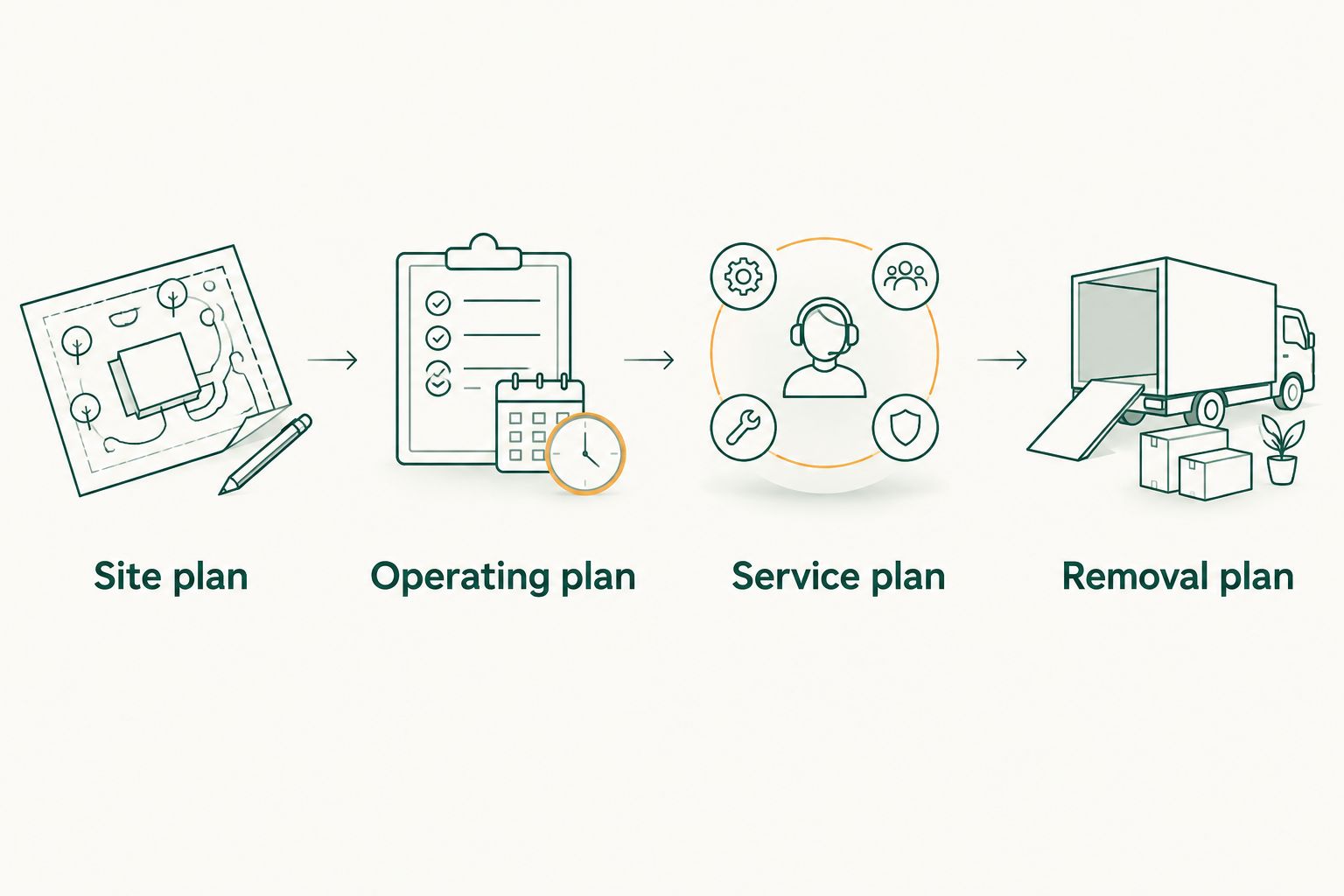
- Site plan: identify installation zones and approved attachment locations.
- Operating plan: define lighting hours and control responsibilities.
- Service plan: specify fault reporting and maintenance responsibilities.
- Removal plan: describe takedown, condition checks, and storage arrangements.
4. Compare proposals against municipal requirements
Build a proposal checklist using your municipality’s purchasing rules. Ask procurement staff to identify the required process before contacting vendors, rather than assuming a commercial proposal is sufficient for a public purchase.
Compare responsibilities line by line. A proposal covering installation alone is not equivalent to a proposal covering design, maintenance, takedown, and storage. Record exceptions in a comparison sheet so decision-makers can see what city staff would retain.
Request evidence instead of relying on broad descriptions. Insurance documents, references relevant to the proposed work, and written work methods answer different questions; none replaces the others. Confirm required coverage with the appropriate municipal reviewer.
The distinction between carrying insurance and satisfying your contract matters. Your procurement review should address installer liability insurance alongside the actual documents submitted for this project.
- Confirm the applicable purchasing and approval process.
- Request the insurance documentation your municipality requires.
- Ask for references relevant to public-access or comparable commercial sites.
- Identify subcontractors and responsibility for their work.
- Document exclusions, change approvals, and acceptance conditions.
5. Schedule installation around public use
Work backward from the approved lighting event, but do not make the event date the only milestone. Your 2026 schedule should include design approval, site readiness, installation, inspection, testing, and acceptance.
Plan 2 walk-throughs: a daylight access review and an after-dark display review. Daylight reveals cable routes and mounting details; darkness shows how the display reads from the intended viewing areas. Neither review replaces required technical inspections.
Give municipal staff responsibility for communicating closures or access changes. Give the installation team a named contact who can resolve site questions without improvising changes to the approved design.
Include a weather-related rescheduling process in the agreement. Do not promise the public a finished installation before the parties have agreed how incomplete work or delayed access will be handled.
- Confirm when crews can occupy each work area.
- Separate installation activity from public events and deliveries.
- Schedule required inspections and functional testing.
- Record who accepts completed work and authorizes changes.
- Define how delays and revised event plans will be communicated.
6. Establish controls and a maintenance handoff
Begin with a written operating schedule and a simple fault-reporting log. Staff should know what turns the display on, who can change the schedule, and how to report an issue without touching electrical equipment.
Divide reports by location and symptom. A dark tree, a tripped protective device, and a damaged cable require different assessments; a message saying only that the lights are out gives the responsible team little to work with.
Assign an internal contact even when maintenance is contracted. Full-service delivery does not remove the municipality’s need to report hazards, authorize access, and communicate site conditions.
- Record control locations and authorized operators.
- Define normal operating hours and event exceptions.
- Create a fault log with location, photo, and reporting contact.
- Establish an escalation route for damage or immediate hazards.
- Confirm repair responsibilities and exclusions in writing.
For sites using smart timers for holiday lights, document schedule changes, account access, and the manual shutoff procedure in the same handoff. A timer automates switching; it does not replace electrical assessment, equipment compatibility checks, or responsibility for responding to faults.
7. Approve takedown and storage before installation
Create the removal checklist while the site plan is still current. Record what comes down, what remains, who checks the surfaces, and where each item goes afterward.
For your 2026 contract, state equipment ownership explicitly. Installation, storage, and ownership are separate questions; do not infer one from another. Ask how records and equipment are handled if the municipality changes providers.
Atlanta Christmas Lighting Co includes takedown and storage among its services. Confirm how those services would apply to the proposed municipal project, including labeling, inventory records, collection arrangements, and any excluded items.
End the season with a condition record rather than an empty work order. Photographs and a location-based inventory give staff a practical starting point for the next design review.
- Agree on the removal window and public-access arrangements.
- Record equipment ownership and storage responsibilities.
- Label equipment by site and installation zone.
- Document damage, missing items, and required repairs.
- Confirm who signs off on restored surfaces and cleared work areas.
Compare municipal lighting delivery options
Choose the delivery model by retained responsibility, not by the appearance of the finished display. Each approach needs a named municipal project owner. The difference is how much design, fieldwork, maintenance, and seasonal handling your staff retain.
Use this comparison before requesting proposals, then check it against actual staff qualifications, equipment access, and purchasing requirements. A hybrid arrangement needs especially clear boundaries because separate teams share the same site.
| Option | Best for | Main advantage | Key limitation |
|---|---|---|---|
| In-house delivery | Municipalities with suitable staff, equipment, and storage | Direct control over scheduling and equipment records | Staff retain installation, maintenance, and removal duties |
| Full-service contractor | Teams seeking coordinated seasonal delivery | Design and field responsibilities can sit within one agreement | Every included service and response obligation must be defined |
| Hybrid delivery | Teams retaining selected sites or tasks internally | Allows a defined split between municipal and contractor work | Handoffs and fault ownership require precise documentation |
A commercial provider is not automatically the right municipal contractor. Atlanta Christmas Lighting Co offers the full-service Christmas lighting categories described above, but public procurement eligibility, municipal references, specialized access work, and project-specific obligations require confirmation.
Discuss your municipal lighting scope
Ask which design, installation, maintenance, and removal tasks fit your proposed public-site project.
Common mistakes municipalities make
Approving a rendering without an operating plan
A rendering does not establish who controls the lights or handles a fault. Require the operating schedule, reporting route, and maintenance responsibilities before accepting the design.
Treating poles and public trees as available mounting points
Visibility does not establish permission to attach decorations. Confirm ownership, acceptable methods, and the required review before including these assets in the installation scope.
Comparing proposals with different responsibilities
An installation-only proposal leaves work with your staff that a full-service agreement addresses differently. Normalize the scope before selecting a delivery model, and document every responsibility the municipality retains.
Leaving event staff out of installation planning
A technically workable installation plan still needs to accommodate queues, deliveries, emergency access, and event setup. Include the people responsible for public use in the site review, not just the facilities team.
Deferring ownership and storage decisions
Unclear equipment records create avoidable disputes when the season ends or the provider changes. Agree on ownership, inventory access, and collection arrangements before equipment arrives.
FAQ
What's the best way to plan Christmas lighting for municipalities?
Start with a site inventory, a named project owner, and a written scope covering installation through removal. Confirm public access, electrical assessment, procurement requirements, and maintenance responsibilities before approving the display.
Should a municipality use its own staff or hire a lighting contractor?
Use municipal staff when the team has suitable qualifications, equipment, and capacity for the entire seasonal workload. A contractor or hybrid arrangement fits teams that need defined responsibilities handled externally; compare the work each approach leaves with staff.
Can Christmas lights go on municipal streetlight poles?
Include streetlight poles only after confirming ownership, permission, and technical requirements. Do not assume the municipality controls every pole or that its existing electrical system can support decorations.
When should a municipality start planning its 2026 holiday display?
Start early enough to complete your purchasing process, site assessment, design approvals, and installation planning before the intended opening. Set the schedule around your municipality's actual approval requirements rather than assuming a standard booking deadline.
Does a full-service lighting agreement include repairs and storage?
Repairs and storage are included only when the agreement explicitly covers them. Define fault reporting, repair exclusions, equipment ownership, removal arrangements, and storage records before signing.
Does Atlanta Christmas Lighting Co provide commercial holiday lighting?
Atlanta Christmas Lighting Co provides Christmas light design, installation, maintenance, takedown, and storage for commercial and residential properties across greater Atlanta. Municipal buyers should confirm project suitability, procurement requirements, and public-site responsibilities directly.
What should staff check before accepting a municipal lighting installation?
Check the installed display against the approved scope, required technical reviews, public-access plan, and operating instructions. Record unresolved issues and confirm who is authorized to accept the work.
One last thing
Ask whether a staff member who missed installation can operate the display safely using only the handoff documents. If the answer depends on knowing which unlabeled switch to use or whom someone remembers calling, the handoff is incomplete. Request a location-based control sheet, fault-reporting instructions, and removal responsibilities before final acceptance.