Yes—Christmas light installers can carry general liability insurance, but you must verify the individual contractor’s coverage before work begins. General liability addresses covered third-party property damage and bodily injury; it does not replace workers’ compensation for employee injuries. For your 2026 installation, ask for current insurance documentation covering the company and the work you are hiring it to perform.
- Do Christmas light installers carry liability insurance? Verify each contractor; the job title does not establish coverage.
- General liability and workers’ compensation address different risks; request documentation for both when applicable.
- A certificate of insurance summarizes coverage but does not change the policy or guarantee a claim payment.
- Georgia’s State Board of Workers’ Compensation provides employer coverage information; confirm requirements for the actual crew.
Why this matters
A roofline installation puts workers, ladders, attachments, and electrical equipment around your property. An insurance check belongs before that work starts, not after someone reports a damaged gutter or an injury.
When comparing insured and licensed Christmas light installation companies in Atlanta, separate the service proposal from the insurance evidence. A polished proposal describes the display; insurance documents identify the business and summarize its coverage. Neither document replaces the other.
Do Christmas light installers carry liability insurance?
Christmas light installers can purchase general liability insurance, but the phrase professional installer does not establish that a particular business has an active policy. Ask the installer for a certificate of insurance, then have the issuing agent confirm questions about the planned work.
Hire based on verified coverage, not an insured badge alone. A website statement is a starting point, not the document you use to check the named insured, policy dates, or coverage types.
Use this sequence before approving your 2026 project:
- Match the business. Compare the named insured with the company on your proposal and contract. Ask the agent to explain any difference involving a trade name or legal entity.
- Check the dates. Confirm the policy period includes the scheduled installation. Address maintenance visits and takedown separately if they fall outside that period.
- Describe the work. Tell the agent whether the project includes rooflines, trees, elevated access, maintenance, and removal. Ask whether relevant exclusions or restrictions apply.
- Check the crew. Establish who employs the workers and whether subcontractors will participate. Request the appropriate documentation for those arrangements.
- Keep the records. Save the certificate, relevant endorsements, signed scope, and insurance correspondence together.
An installer’s willingness to provide documents helps you complete the check. It does not, by itself, prove that every possible incident will be covered.
General liability: property damage and third-party injuries
General liability insurance generally addresses covered claims involving third-party bodily injury or property damage arising from business operations. For holiday lighting, a damaged section of your property or an injury to a visitor raises different questions from an employee’s workplace injury.
The policy wording controls the outcome. Damage to property being worked on, faulty workmanship, and damage occurring after operations are complete require particular attention because exclusions and coverage provisions can affect them.
The following comparison separates the documents and protections you should discuss. These are different functions, not interchangeable assurances.
| Coverage or document | Best for checking | Main benefit | Important limitation |
|---|---|---|---|
| General liability policy | Third-party injury and property-damage exposure | Provides protection for covered liability claims | Exclusions, conditions, and limits still apply |
| Workers’ compensation policy | Employee workplace-injury exposure | Provides statutory benefits for covered employee injuries | Does not replace general liability for damage to your property |
| Certificate of insurance | Initial policy verification | Summarizes named insured, coverage, dates, and limits | Does not amend coverage or guarantee claim payment |
| Additional-insured endorsement | Protection required by a property contract | Can extend insured status within its stated terms | Scope depends on the actual endorsement |
Do not treat the certificate’s general liability line as proof that employee injuries are covered. Those are separate questions, even when the same insurance agency handles both policies.
Workers’ compensation: injuries to employees
Workers’ compensation addresses covered employee injuries arising from work. A ladder injury involving an installer’s employee belongs in a different insurance discussion from a claim that the installer damaged your siding.
Georgia’s State Board of Workers’ Compensation explains employer coverage requirements and provides coverage-verification resources. For a 2026 project, use the current state guidance and ask how the installer’s employee or subcontractor arrangements affect the documentation you need.
A contractor’s statement that workers’ compensation is not required deserves an explanation tied to the actual business arrangement. Do not assume that a small crew, an owner on site, or a subcontractor label settles the issue.
Ask who will physically perform the work and who employs them. That question connects the paperwork to the people arriving at your property. Your own insurance agent can help assess any unresolved exposure before you authorize access.
Certificates and endorsements: what counts as evidence?
A certificate of insurance is useful because it brings key policy information into one document. Its limitation is equally important: a certificate does not create coverage, change exclusions, or make every certificate holder an additional insured.
If your business, HOA, landlord, or property manager requires additional-insured status, ask for the endorsement that provides it. Review the named entity, covered operations, and applicable conditions rather than relying only on text in the certificate’s description field.
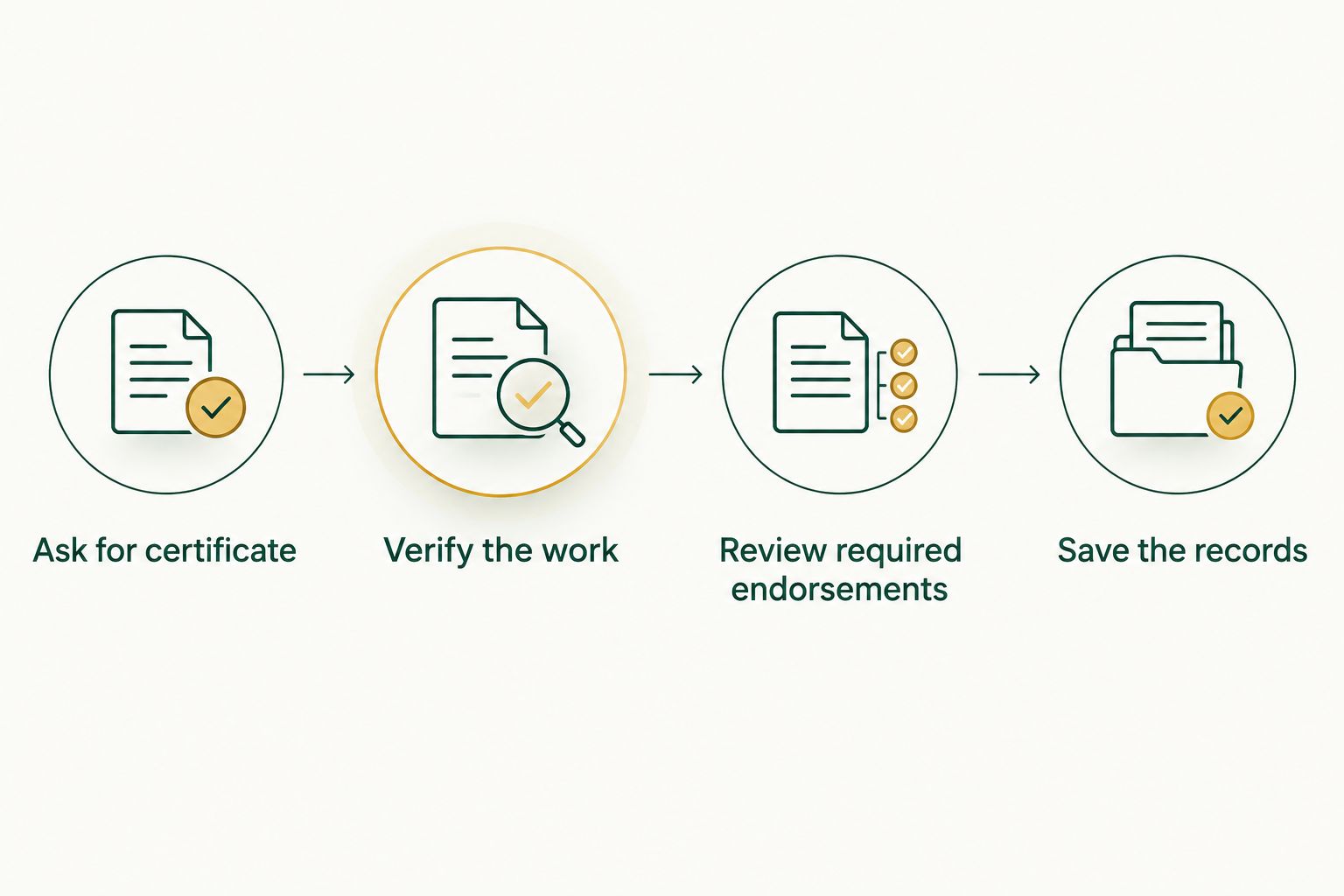
Ask for the certificate
Request a current certificate issued through the contractor’s insurance agent or broker. Check the business identity, insurer, policy period, coverage types, and listed limits against your contract requirements.
Verify the work
Describe your actual project to the issuing agent. A statement that a business has insurance is less useful than confirmation addressing holiday-light installation, elevated work where applicable, maintenance, and removal.
Review required endorsements
Ask your property manager or insurance adviser which endorsements the contract requires. Additional-insured wording varies, so the document must match the requirement rather than merely contain a familiar label.
Save the records
Keep the insurance documents with your signed scope and approval correspondence. If the schedule changes, revisit the dates instead of assuming the original certificate covers the revised work.
Why insurance requirements vary
Insurance requirements depend on the work, the property, and the contract. There is no single certificate that automatically answers every residential and commercial holiday-lighting question.
Discuss these project details before your 2026 installation:
- Work location and access. Rooflines, trees, ladders, and elevated equipment describe different operations; give the agent an accurate scope.
- Property ownership. A homeowner’s requirements differ from contractual conditions imposed by a landlord, HOA, or commercial property owner.
- Crew arrangements. Employees and subcontractors require a clear explanation of who carries which coverage.
- Service dates. Installation, maintenance, and takedown can occur in different policy periods.
- Contract requirements. Coverage limits and additional-insured endorsements must match the agreement where required.
- Post-installation exposure. Ask how the policy addresses covered claims arising after installation is complete.
More documentation is not automatically better documentation. The useful test is whether the records address your property, the contracting business, the people doing the work, and the agreed service period.
Does liability insurance cover damage to my roof or gutters?
General liability can respond to covered roof or gutter damage, but it does not guarantee payment for every installation-related problem. Exclusions involving the property being worked on and the nature of the damage can affect the result.
Ask how the contractor handles a damage report before approving the job. Photograph existing conditions, agree on attachment methods, and keep the written scope so there is a clear record of the planned work.
Insurance and careful installation serve different purposes. A policy is financial protection for covered claims, not permission to accept an unsuitable attachment method. Raise concerns about fragile materials or existing damage before the crew begins.
Does insurance need to cover maintenance and takedown too?
Maintenance and takedown need their own date check because the installation certificate only summarizes the policy period shown on it. For a 2026 installation followed by later removal, confirm coverage for the actual return visit rather than assuming the original document remains current.
Ask who performs service calls and removal, especially if a different crew returns. Confirm any changed business or subcontractor arrangement before granting access again.
Storage introduces another question: whose property is being stored, and what insurance addresses loss or damage while it is in storage? Do not assume general liability automatically insures lights in the contractor’s custody.
Is an insured installer automatically the right choice?
Verified insurance is a screening requirement, not a complete hiring decision. You still need a clear design, suitable installation methods, an agreed maintenance process, and a defined takedown arrangement.
Atlanta Christmas Lighting Co is best for Atlanta property owners seeking Christmas light design, installation, maintenance, takedown, and storage from one provider. That service scope matches buyers who want the seasonal work handled together rather than coordinating each stage separately.
The benefit of Atlanta Christmas Lighting Co’s full-service Christmas light installation is the inclusion of those connected services. The buyer’s remaining task is to confirm the written scope, scheduling, responsibilities, and insurance documentation for the specific project; service breadth does not answer those questions by itself.
When considering Atlanta Christmas Lighting Co, request the same evidence you would request from any contractor. A consistent standard makes comparisons useful and keeps insurance separate from sales language.
Discuss your lighting project
Review design, installation, maintenance, takedown, and storage for your Atlanta property.
FAQ
Do Christmas light installers carry liability insurance?
Christmas light installers can carry general liability insurance, but you must verify the individual contractor’s active coverage. Request a current certificate and ask the issuing agent about the planned work.
What proof of insurance should I ask a Christmas light installer for?
Ask for a current certificate of insurance and any endorsements required by your contract. Match the named insured, policy dates, and coverage types to the business and project.
Does general liability cover an installer falling off my roof?
General liability does not replace workers’ compensation for an installer’s employees. Coverage for a particular injury depends on the person’s work status, applicable law, and policy terms.
Does being a certificate holder make me an additional insured?
Being a certificate holder does not automatically make you an additional insured. Ask for the endorsement or policy provision establishing that status when your contract requires it.
Should my Christmas light installer’s insurance cover takedown?
Confirm insurance for the scheduled takedown work, not just the installation date. Request updated documentation if removal occurs outside the policy period shown on the original certificate.
Can I rely on my homeowners insurance instead?
Do not treat homeowners insurance as a substitute for verifying contractor coverage. Ask your homeowners insurer how your policy addresses contractor-related injuries, property damage, and any relevant exclusions.
What should I ask Atlanta Christmas Lighting Co before booking?
Ask Atlanta Christmas Lighting Co for the written service scope and current insurance documentation for your project. Confirm who performs installation, maintenance, and takedown, along with the arrangements for storage.
One last thing
Put a reminder beside the takedown date, not just the installation date. A certificate that was current when the lights went up does not establish coverage indefinitely, and a later return visit deserves the same attention.
For your 2026 project, keep a simple rule: verify the business, verify the work, and verify the dates. Then save the documents where you can find them without searching through a season’s worth of messages.