
Daycare center Christmas lighting is seasonal lighting planned around childcare operations, with the aim of creating a welcoming entrance without disrupting supervision, access, or daily routines. This guide to christmas lighting for daycare centers covers design, installation, maintenance, and removal for your 2026 season, with child-accessible areas and busy pickup periods treated as design constraints—not afterthoughts.
- Christmas lighting for daycare centers should keep cords, decorations, and installation work outside children's accessible areas.
- Atlanta Christmas Lighting Co offers design, installation, maintenance, takedown, and storage for greater Atlanta commercial properties.
- Choose steady lighting, preserve entrance visibility, and schedule installation outside arrival and pickup periods.
- Approve maintenance responsibilities and removal arrangements before installation, not after a lighting problem appears.
Why Christmas lighting matters for daycare centers
A daycare entrance serves children, parents, staff, and visitors throughout the day. Seasonal decorations must fit those movements. A display that looks good from the road but complicates gate access or hides an entrance sign is the wrong design.
Unlike a private home, a childcare property also needs clear responsibility for decisions: who approves the layout, who separates installation work from children, and who reports a damaged cord. Decorative lighting does not replace required exit, security, or walkway lighting.
Atlanta Christmas Lighting Co is best for Atlanta daycare operators seeking Christmas lighting design, installation, maintenance, takedown, and storage from one provider. The service scope fits a director who wants to delegate seasonal work; the center still needs to approve access, operating hours, and site-specific restrictions.
For your 2026 plan, judge the display by how it works during the busiest handoff—not just how it photographs after closing.
How to plan Christmas lighting for your daycare
1. Map the areas children and families use
Start with a printed site plan or a simple hand-drawn sketch. Walk the property with the person responsible for opening and closing, and mark the routes children actually use. Include the side gate used for outdoor play, not just the main entrance.
Create 3 planning zones: display areas, access routes, and no-decoration areas. These are planning categories, not prescribed safety clearances. Your facility's requirements and the equipment instructions determine the actual boundaries.
Take 2 reference photos of the entrance: one during daylight and one after dark. Compare sign visibility, existing lighting, and the view from the pickup area before approving additions.
- Mark doors, gates, ramps, sidewalks, and emergency access routes.
- Identify playground fencing, stroller parking, and child-accessible landscaping.
- Locate existing outlets without assuming they suit the proposed display.
- Record landlord restrictions and surfaces that must remain untouched.
- Mark spaces where installation equipment cannot be left.
2. Choose a restrained, steady-light design
Use your site sketch to choose a focal area before choosing colors. An entrance outline or an elevated building outline is easier to assess than decorations scattered across the property. Keep the center's name, door hardware, and access controls visible.
Steady lighting is the practical default for a daycare. It avoids adding flashing effects to an arrival area already shared by vehicles, pedestrians, and children. Review any sensory considerations with your center's staff rather than assuming every child experiences a display the same way.
Warm white and multicolor are both design choices, not safety ratings. For 2026, approve the exact color approach in writing so replacements and later additions follow the same plan.
- Choose one focal area before adding secondary decorations.
- Keep hanging strands and loose decorations outside children's reach.
- Leave signs, door viewers, cameras, and access controls unobstructed.
- Exclude cords and decorations from playground equipment.
- Check the proposed view from drivers' and pedestrians' approaches.
3. Assign installation and electrical responsibilities
Prepare the scope yourself using photos, a site sketch, and a written list of exclusions. That preparation works whether your facilities team handles a limited display or you hire an installer. Staff familiarity with the building does not establish electrical or elevated-work competence.
For a delegated option, Atlanta Christmas Lighting Co's Christmas lighting services cover design, installation, maintenance, and takedown/storage. Ask the provider to translate your operating restrictions into the proposed work plan; do not assume a commercial service automatically includes childcare-specific procedures.
Use outdoor-rated equipment outdoors and follow manufacturer connection limits. Have questionable outlets, repeated tripping, or proposed electrical alterations assessed by a qualified electrician. A lighting installer is not automatically the right person for every electrical task.
- Identify who supplies, installs, and owns each display component.
- Request current insurance documentation and clarify applicable licensing.
- Confirm suitable ground-fault protection and weather-exposed connections.
- Require cord routing that avoids pedestrian and child-accessible routes.
- Separate electrical repairs from decorative installation in the written scope.
4. Schedule work around childcare operations
Build the installation schedule around your center's calendar, not an assumed standard workday. List arrival, pickup, outdoor play, deliveries, and any evening events. Send those periods to the installer before agreeing to a work window.
An empty parking lot does not mean the building is empty. Explain which rooms remain occupied, which doors must stay available, and who authorizes access. If safe separation cannot be maintained, move the work rather than improvising around children.
For the 2026 season, confirm the installation date, weather-change communication, and removal window together. Treat these as requested arrangements until the provider accepts them in writing.
- Name 1 site contact for access decisions and work-related questions.
- Keep ladders, tools, packaging, and loose materials in a separated work area.
- Tell staff which entrance or parking spaces the work affects.
- Confirm how crews will sign in and communicate on arrival.
- Require a cleanup and access check before reopening affected areas.
5. Set a maintenance and shutdown routine
Create a brief opening check that staff can complete from normal circulation routes. Staff should look for visible changes, not climb, reconnect damaged equipment, or troubleshoot electrical faults. Assign the observation task without making teachers responsible for repairs.
Agree on a reporting route before the lights turn on. Photograph the affected area from a safe position, describe the location, and keep children away from damaged or fallen components. If there is an immediate electrical concern, stop using the affected display and obtain qualified help.
Atlanta Christmas Lighting Co includes maintenance among its services, but you should confirm the work covered, reporting method, and response arrangements for your property. Maintenance responsibility is not the same as a guaranteed response time.
- Check for fallen strands, exposed cords, and displaced attachments.
- Confirm gates, exits, and entrance signs remain unobstructed.
- Record timer settings and the approved operating schedule.
- Identify a safe, staff-accessible shutdown point.
- Report changes after severe weather before resuming affected lighting.
6. Plan removal and storage before installation
Write the removal expectations into the original scope. Your center should know who schedules takedown, how access works, and where materials go afterward. Avoid leaving the director to find storage space after the display comes down.
Keep a simple 2026 display record with approved photos, attachment locations, restrictions, and maintenance notes. That record gives the next planning discussion a concrete starting point. It also prevents an unsuitable detail from being repeated merely because it was used before.
Storage does not settle ownership. Confirm whether materials belong to the center or provider, who maintains the inventory, and what happens if you change the design or service arrangement.
- Agree on a removal window compatible with childcare hours.
- Require collection of clips, packaging, and small loose components.
- Inspect affected surfaces and access routes after removal.
- Document storage responsibility and equipment ownership.
- Save approved photos and changes in the center's facilities records.
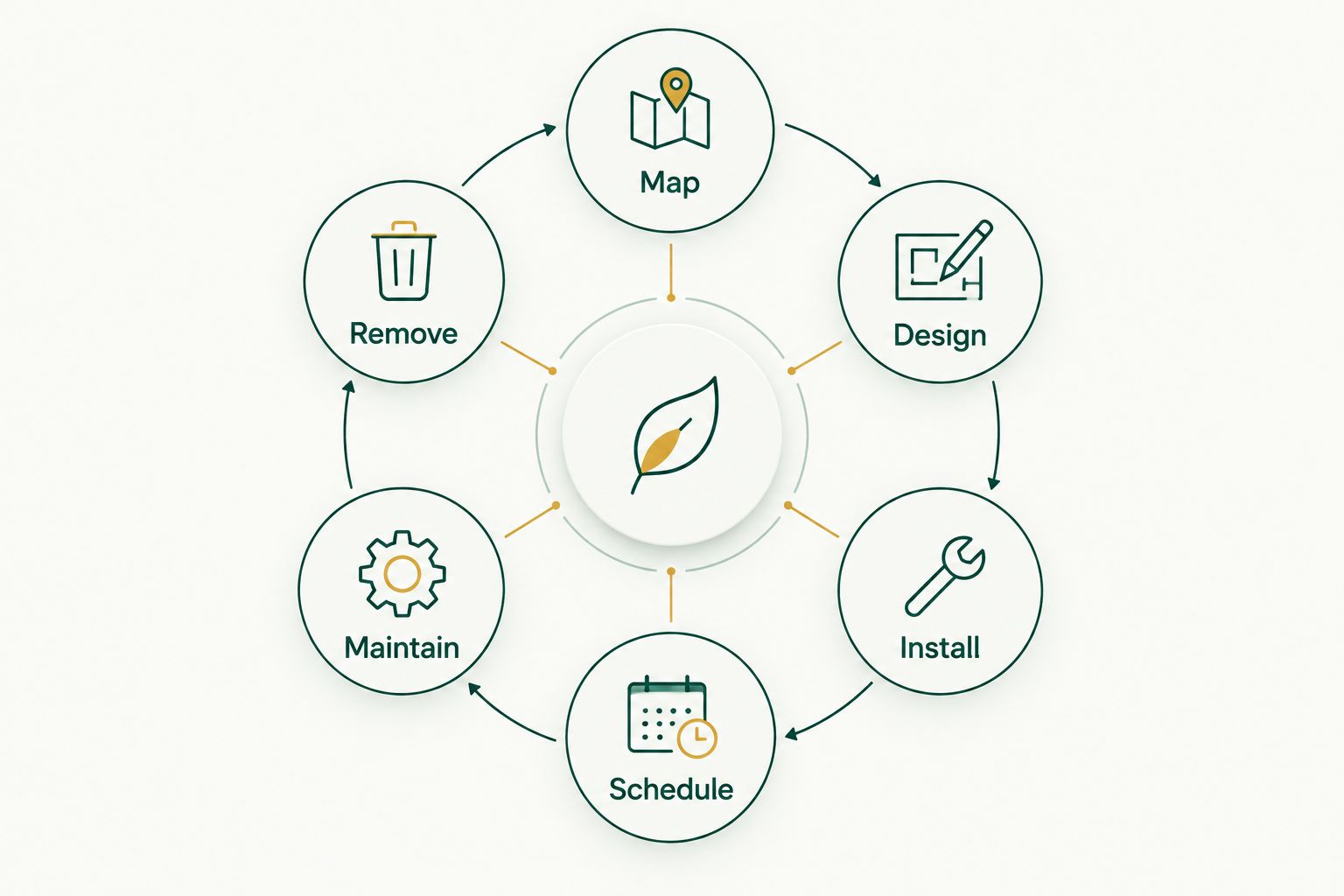
The complete process has six phases: map, design, install, schedule, maintain, and remove. Assign responsibilities across the full cycle before approving the display, rather than treating installation day as the entire project.
Compare lighting options for your center
Choose the delivery method by the work your staff can responsibly manage. A smaller display is a valid choice when the site cannot accommodate more decorations without complicating access or supervision.
The options below compare responsibility and limitations, not interchangeable service promises. Request a written scope for the specific building, especially when the center leases its space or shares entrances with other tenants.
| Option | Best for | Main advantage | Key limitation |
|---|---|---|---|
| Staff-managed limited display | Centers with a suitable low-complexity area and competent facilities support | Direct control over design and daily checks | The center retains installation, maintenance, removal, and storage responsibilities |
| Professional installation with center-managed follow-up | Centers with a facilities team able to manage the remaining seasonal work | Delegates the installation tasks specified in the agreement | Maintenance and takedown are not included unless expressly agreed |
| Atlanta Christmas Lighting Co full-service scope | Greater Atlanta centers seeking design through storage from one provider | Offers the complete seasonal service sequence | Daycare-specific access rules, service boundaries, and response arrangements still need written agreement |
| No added electrical display | Centers without a suitable location or approved power arrangement | Avoids introducing seasonal lighting equipment | Provides no added illuminated display; existing required lighting must still be maintained |
Choose full-service support when the goal is to delegate the seasonal workload, not just the ladder work. Choose a limited display—or none—when you cannot establish suitable placement, power, and operating responsibilities.
Plan your daycare lighting scope
Discuss design, access restrictions, maintenance, and removal for your greater Atlanta property.
Common mistakes daycare centers make
Decorating the playground fence
A fence can look like convenient display space while also being part of a child's everyday environment. Keep lighting equipment away from play surfaces and child-accessible fence sections. Do not turn the boundary children use into a place staff must constantly police.
Routing power across the family entrance
A short cable route is not automatically a suitable route. If the design requires cords through a doorway, across a ramp, or through the pickup queue, redesign the display. Do not make families work around decorations to enter the center.
Treating staff supervision as installation support
Teachers supervising children should not also be expected to watch a work zone, admit contractors, or manage equipment deliveries. Assign a separate site contact and agree on physical separation. If staffing cannot support the arrangement, change the work window.
Approving installation without approving removal
An attractive proposal is incomplete if nobody has settled maintenance, takedown, ownership, or storage. Ask for those responsibilities alongside the design. This matters particularly when a center's office and storage areas already serve daily childcare needs.
FAQ
What's the best Christmas lighting setup for a daycare center?
A restrained, steady-light display outside children's accessible areas is the practical starting point for a daycare center. Preserve entrance visibility, keep routes clear, and approve installation and maintenance responsibilities before work begins.
Can daycare staff install Christmas lights themselves?
Daycare staff should undertake only work they are competent and authorized to perform under the center's policies. Do not assign elevated work or electrical troubleshooting to staff simply because they are available, and keep installation duties separate from child supervision.
Are outdoor Christmas lights safe around a playground?
Outdoor-rated lights do not make child-accessible placement appropriate. Keep cords, connectors, and decorations away from playground equipment and areas children handle, and assess the proposed location before installation.
Should a daycare choose warm white or multicolor Christmas lights?
Choose warm white or multicolor based on the center's approved appearance, while treating placement and steady operation as separate decisions. Neither color choice establishes electrical suitability or makes accessible cords acceptable.
When should an Atlanta daycare arrange its 2026 Christmas lighting?
Arrange the work before your required installation date with enough time for site approval, scheduling, and any electrical assessment. Confirm the provider's actual work window rather than assuming evening, weekend, or closure-day installation is offered.
Does professional Christmas lighting include takedown and storage?
Professional Christmas lighting includes takedown and storage only when those services are part of the agreed scope. Atlanta Christmas Lighting Co offers both, but your agreement should still identify scheduling, ownership, and storage responsibilities.
What should daycare staff do if a lighting cord becomes damaged?
Keep children away and stop using the affected display through a safe, accessible control. Report the damage to the designated maintenance contact; staff should not handle exposed wiring or attempt electrical repairs.
One last thing
Review the display from a child's normal route, not only from the curb. An adult's view of a clean entrance can miss a loose strand beside a gate latch or a connector near stroller parking.
Before switching on your 2026 display, walk the arrival route with the staff member who uses it daily. If the lighting creates another supervision task, simplify the design before families encounter it.