
Retail-chain Christmas lighting is coordinated seasonal lighting across multiple stores with the aim of creating a consistent, recognizable customer-facing display. This guide to Christmas lighting for retail chains covers the approvals, installation schedules, maintenance responsibilities, and takedown records that keep individual locations aligned without treating every building as identical.
- Christmas lighting for retail chains needs one design standard, with location-specific installation plans.
- Atlanta Christmas Lighting Co suits greater Atlanta retailers seeking design, installation, maintenance, takedown, and storage.
- Approve landlord permissions, power access, and service responsibilities before scheduling commercial Christmas lighting.
- Keep store-specific installation records so seasonal lighting is easier to repeat.
Why Christmas lighting matters for retail chains
A retail chain needs a repeatable display, not a collection of unrelated decorating decisions. Your stores can share a lighting style while using different layouts to accommodate storefront widths, entrances, signs, and landlord restrictions.
Atlanta Christmas Lighting Co is best for greater Atlanta retailers seeking Christmas lighting services from design through storage. Atlanta Christmas Lighting Co provides design, installation, maintenance, and takedown/storage for residential and commercial properties across the greater Atlanta area.
The operational objective is straightforward: approve the appearance centrally and document the installation locally. A district manager should be able to identify what each store receives, who approves changes, and who handles a failed section without reconstructing the project from email.
For your 2026 program, separate the intended visual outcome from any sales claim. Approving a consistent display is a controllable objective; attributing additional purchases to lighting requires evidence from your own business.
How to plan Christmas lighting for retail chains
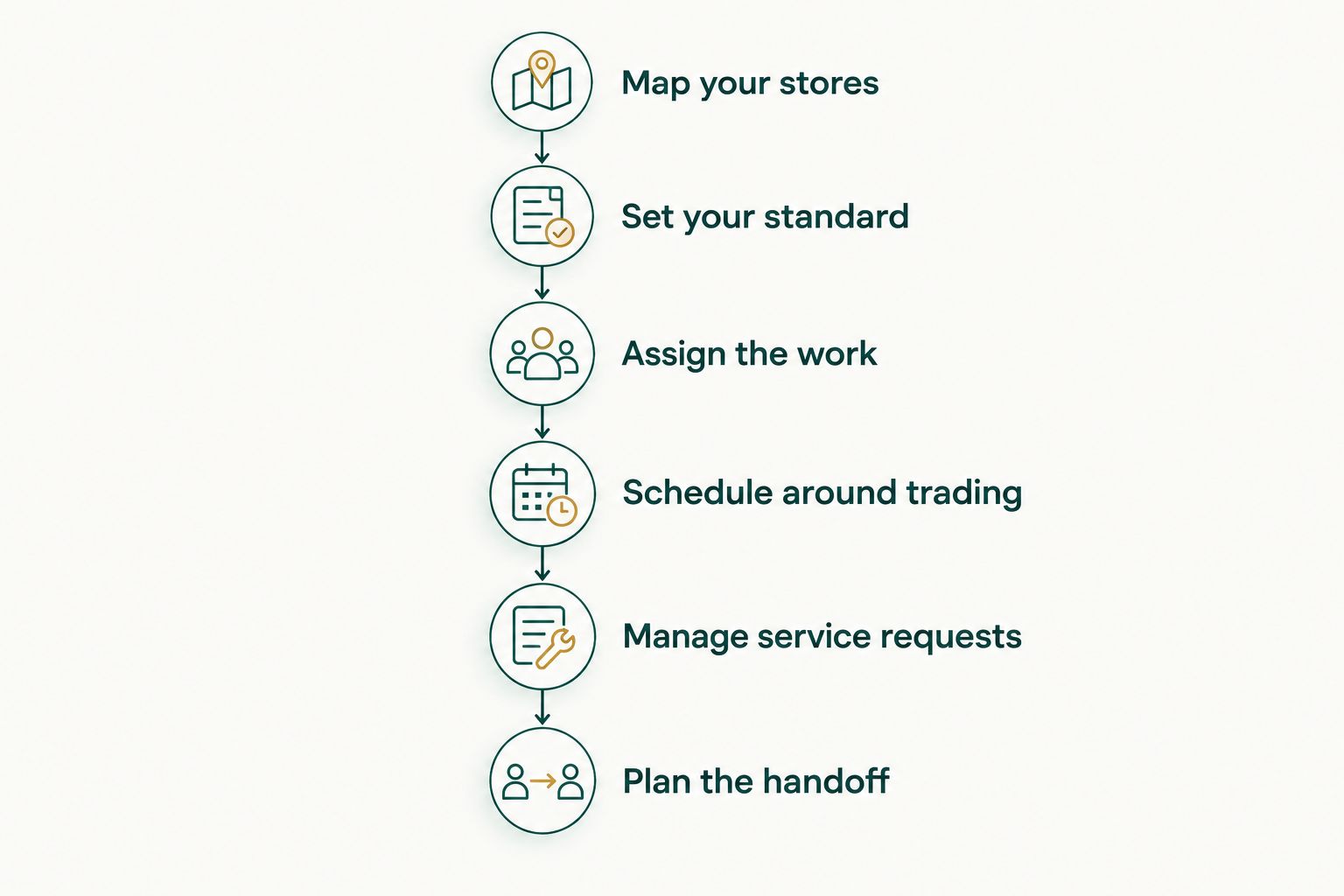
Use a shared planning document before choosing fixtures or requesting installation dates. Build the work around six stages: Map your stores, Set your standard, Assign the work, Schedule around trading, Manage service requests, and Plan the handoff.
Map your stores
Start with a spreadsheet and current storefront photographs. Create 1 site brief per store, rather than assuming a standard shopping-center unit describes every address. Record who controls the facade, which areas belong to the landlord, and where customers and delivery teams move.
A street-facing shop, an enclosed-center unit, and a standalone building need different installation boundaries. Shared landscaping is another separate approval area; a store lease does not establish permission to decorate every nearby tree.
Ask each manager for 2 photo views: the full frontage and the entrance with its surrounding pedestrian route. These are planning requirements, not a substitute for an installer assessing mounting surfaces, access, and power.
Your site brief should identify the exact address and store number together. Using only a shopping-center name creates unnecessary ambiguity when neighboring tenants share a delivery entrance or property manager.
- Record the store address, manager, landlord contact, and approval owner.
- Mark entrances, accessible routes, loading areas, signs, and shared spaces.
- Collect frontage and entrance photographs with proposed lighting areas marked.
- Flag power access, mounting restrictions, and equipment-access questions for assessment.
Set your standard
Draft a plain-language design brief before selecting individual displays. Specify the approved color appearance, whether lighting remains static, which building features receive emphasis, and what must stay unobstructed. Attach annotated photographs so installers and store managers interpret the same instructions.
Standardize the visual rules, not the physical dimensions. A narrow storefront should not inherit a larger location's layout simply because both stores carry the same name.
For 2026, approve a core design and a controlled exception process. The core might prioritize the entrance and a permitted facade line; exceptions should explain how a particular building differs, not introduce an unrelated theme.
Review a representative layout before approving the remaining addresses. If several property types exist, review an example of each type rather than treating one attractive flagship store as the template for the entire group.
- Choose the light color appearance and whether effects remain static.
- Define the approved treatment for entrances, facade edges, and landscaping.
- Keep merchandise windows, store names, and required signs readable.
- Require written approval for design substitutions and store-specific exceptions.
Assign the work
The manual route is to coordinate site surveys, approvals, installation, repair contacts, removal, and storage yourself. A shared task list can organize that work, but someone still has to own each handoff. Do not assign elevated installation or electrical troubleshooting to store employees simply because they are on site.
Atlanta Christmas Lighting Co offers the full service sequence through its Christmas lighting services. That gives a greater Atlanta retail team a service option covering design, installation, maintenance, takedown, and storage rather than coordinating those categories separately.
The trade-off is geographic scope: the stated service area is greater Atlanta, not a nationwide chain footprint. Confirm each address, approval process, maintenance terms, and scheduling requirements before awarding work. The service description alone does not establish response deadlines, contract terms, or an account-management structure.
- Name one central approver and a local access contact for each store.
- Request written confirmation of the work included at every address.
- Review insurance documentation and property-manager requirements before installation.
- Clarify equipment ownership, repair responsibility, removal, and storage arrangements.
Schedule around trading
Work backward from your desired 2026 switch-on date, but distinguish installation from activation. Your stores can have separate installation appointments while working toward a shared public launch, provided the agreed control arrangements support it.
Create 3 approval checkpoints: site permission, final design, and installation acceptance. These checkpoints are an organizing recommendation, not a promised project duration. Keep approval dates separate from confirmed contractor appointments.
Your schedule should account for deliveries, customer access, opening procedures, and landlord rules. Do not assume work outside trading hours is included or that every property allows the same access window.
Prepare a rescheduling decision before work starts. Identify who can accept a revised appointment and which activities must remain separate from deliveries, promotional events, or other contractors working at the store.
- Record installation, activation, and removal targets in the shared schedule.
- Confirm access windows with each store and its property manager.
- Assign someone authorized to accept completed work at each location.
- Document how weather-related or access-related changes receive approval.
Manage service requests
Use a shared maintenance log rather than scattered calls from store managers. Each report should identify the store, affected area, observed problem, and whether customer access is involved. A photograph helps distinguish an isolated dark section from a wider power issue.
Store employees should report problems, not improvise repairs. Keep customers away from damaged equipment, and follow your established site-safety procedures when a concern affects access or electrical equipment. Have qualified personnel assess electrical faults.
For the 2026 season, agree on reporting and escalation before the lights are activated. A maintenance service does not, by itself, establish same-day attendance or unlimited repairs; the written scope must define the arrangements.
Separate appearance issues from safety concerns in the reporting form. That distinction helps the responsible team understand what has been observed without asking a store manager to diagnose the technical cause.
- Use a single reporting channel with the store address and contact details.
- Attach a photograph and describe the affected display section.
- Record who acknowledges the issue and who authorizes corrective work.
- Confirm completion with a follow-up record rather than closing the request automatically.
Plan the handoff
Decide how removal and storage work before approving installation. Otherwise, the retail team finishes the display project with an unresolved logistics project: access appointments, equipment identification, condition checks, and storage responsibility.
Keep each store's approved layout with its removal record. Label components by location and installation area where applicable, and distinguish equipment held for reuse from equipment awaiting a decision. Confirm ownership and storage terms rather than assuming either belongs to the installer.
Close the 2026 program with a short exception review. Record the locations that required design changes, access changes, or repeat maintenance, then update their briefs. The useful output is a clearer instruction set, not just a folder of photographs.
- Agree on removal windows and who grants access after the season.
- Identify who stores equipment and maintains the inventory record.
- Keep approved photographs, layout notes, and condition observations together.
- Record unresolved repairs or design changes before closing the project.
Plan your Atlanta store lighting
Discuss design, installation, maintenance, takedown, and storage for your greater Atlanta locations.
Compare delivery options for your retail chain
Choose the delivery model according to who will manage the work after approval. Central control is only useful when local permissions, access, and maintenance responsibilities remain clear.
| Option | Best for | Main advantage | Key limitation |
|---|---|---|---|
| Internal coordination | Retail teams with facilities capacity and qualified installation support | Direct control of approvals, records, and vendor selection | Your team owns every handoff, including maintenance and storage |
| Separate local installers | Chains with locations outside a single provider's service area | Lets procurement match providers to individual markets | Design consistency and service terms need central review |
| Atlanta Christmas Lighting Co | Greater Atlanta retailers seeking the full seasonal service sequence | Offers design, installation, maintenance, takedown, and storage | Stated coverage is greater Atlanta; confirm each location and contract scope |
| Central standard with regional providers | Chains needing shared rules across different markets | Combines a common brief with local site execution | Requires a central owner to approve exceptions and compare completion records |
Choose full-service coordination when reducing internal handoffs is the priority; choose a regional model when the store footprint requires it. Neither approach removes the need for landlord permission or site-specific assessment.
Compare proposals against the same scope document. A proposal covering installation alone is not equivalent to one that also addresses maintenance, removal, and storage. Ask each provider to identify exclusions explicitly, and resolve differences before procurement treats the proposals as interchangeable.
Common mistakes retail chains make
Copying the flagship design everywhere
A flagship display is not automatically suitable for a smaller leased storefront. Use shared design rules with site-specific drawings, especially where signs, canopies, entrances, and approved mounting areas differ. Review exceptions centrally so practical adaptations do not become unrelated designs.
Treating landlord permission as a store-level detail
A store manager's approval does not replace the property owner's requirements. Establish who can authorize facade attachments, shared landscaping, power use, and equipment access. Keep the permission record alongside the design so installation instructions do not outlive their approval.
Leaving repairs outside the procurement decision
An installation appointment does not explain what happens when a section fails during trading. Review reporting arrangements and service responsibilities before choosing a provider. Store managers need a named route for help, not an instruction to find the original installer in an old email.
Measuring success only by appearance
A display can look consistent while creating avoidable work behind the scenes. Review your own completion records, reported defects, unresolved requests, and approval exceptions. Use those observations to improve the program; do not present lighting as a proven sales driver without business evidence.
Forgetting the removal record
Taking lights down is not the same as preparing them for reuse. Keep store identification, layout references, and condition notes with the inventory. Without that handoff, the next planning cycle starts with equipment that nobody can confidently match to a location.
FAQ
What's the best approach to Christmas lighting for retail chains?
Use one centrally approved design standard with a separate installation plan for each store. That preserves a shared appearance while accounting for landlord rules, building differences, power access, and customer routes.
Can Atlanta Christmas Lighting Co handle a retail chain's holiday lighting?
Atlanta Christmas Lighting Co provides design, installation, maintenance, and takedown/storage for commercial properties across greater Atlanta. Confirm every store address and the required scope before treating the service as a fit for the entire chain.
Should every retail store have exactly the same Christmas lights?
Every store should follow the same approved visual rules, but the physical layout should suit the property. Use consistent color appearance and design priorities while adapting permitted mounting areas and entrance treatments.
Can stores stay open during Christmas light installation?
Plan installation around customer access and trading requirements, then confirm the permitted work window with the installer and property manager. Do not assume every installation can proceed during opening hours without restrictions.
Who should approve lighting at a leased retail location?
Your designated retail approver and the relevant property authority should approve the work within their respective responsibilities. Obtain the required permissions for facade attachments, shared areas, power use, and site access before scheduling installation.
What should a retail manager do when Christmas lights stop working?
Report the store address, affected area, and observed problem through the agreed maintenance channel. Keep people away from damaged equipment and leave electrical assessment or elevated repairs to qualified personnel.
What should retail chains keep after Christmas light takedown?
Keep each store's approved layout, installation photographs, equipment identification, and condition notes. Confirm who stores the equipment and who owns the inventory record before closing the seasonal project.
One last thing
Make your exception log part of the next design brief. A difficult access point, a landlord restriction, or a poorly placed control is more useful planning information than another photograph of a successful display. Close each issue with a clear instruction so the same question does not return with the next installation.