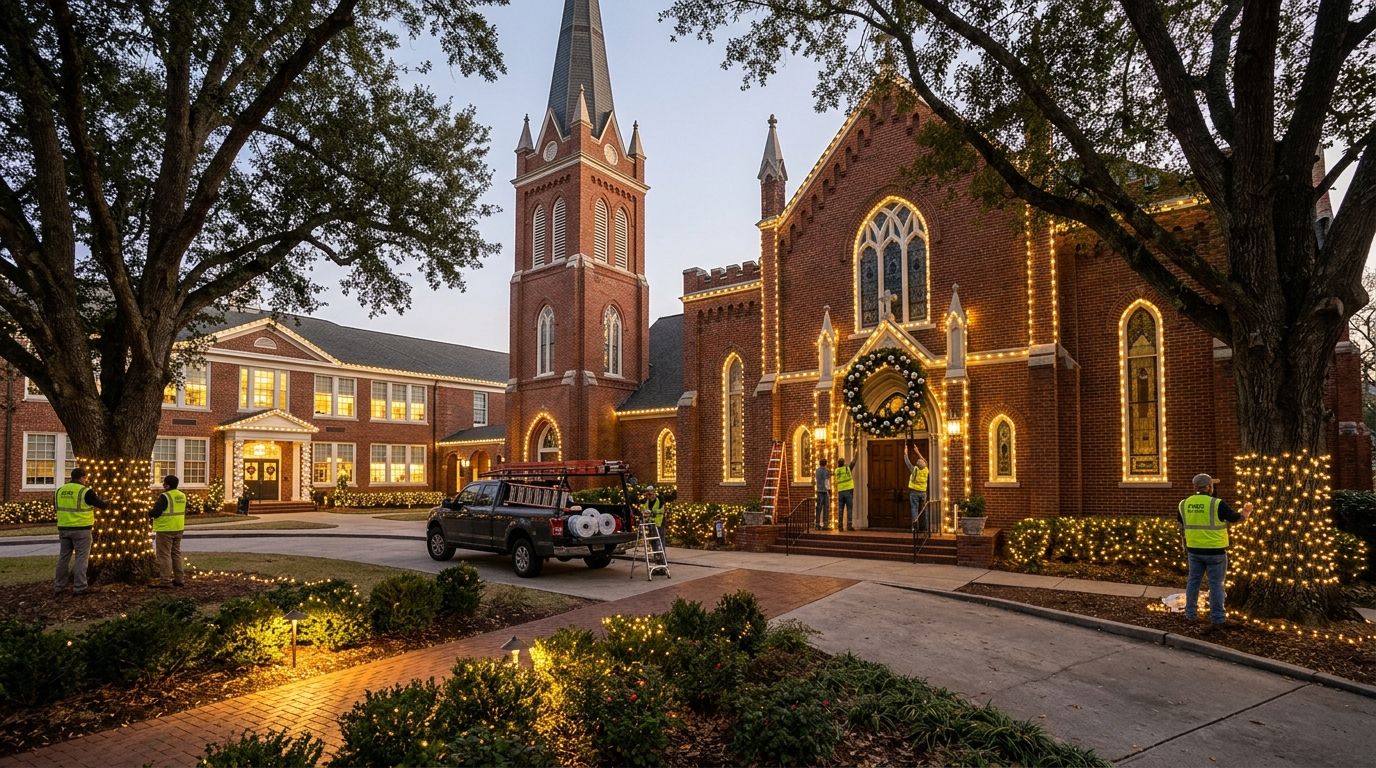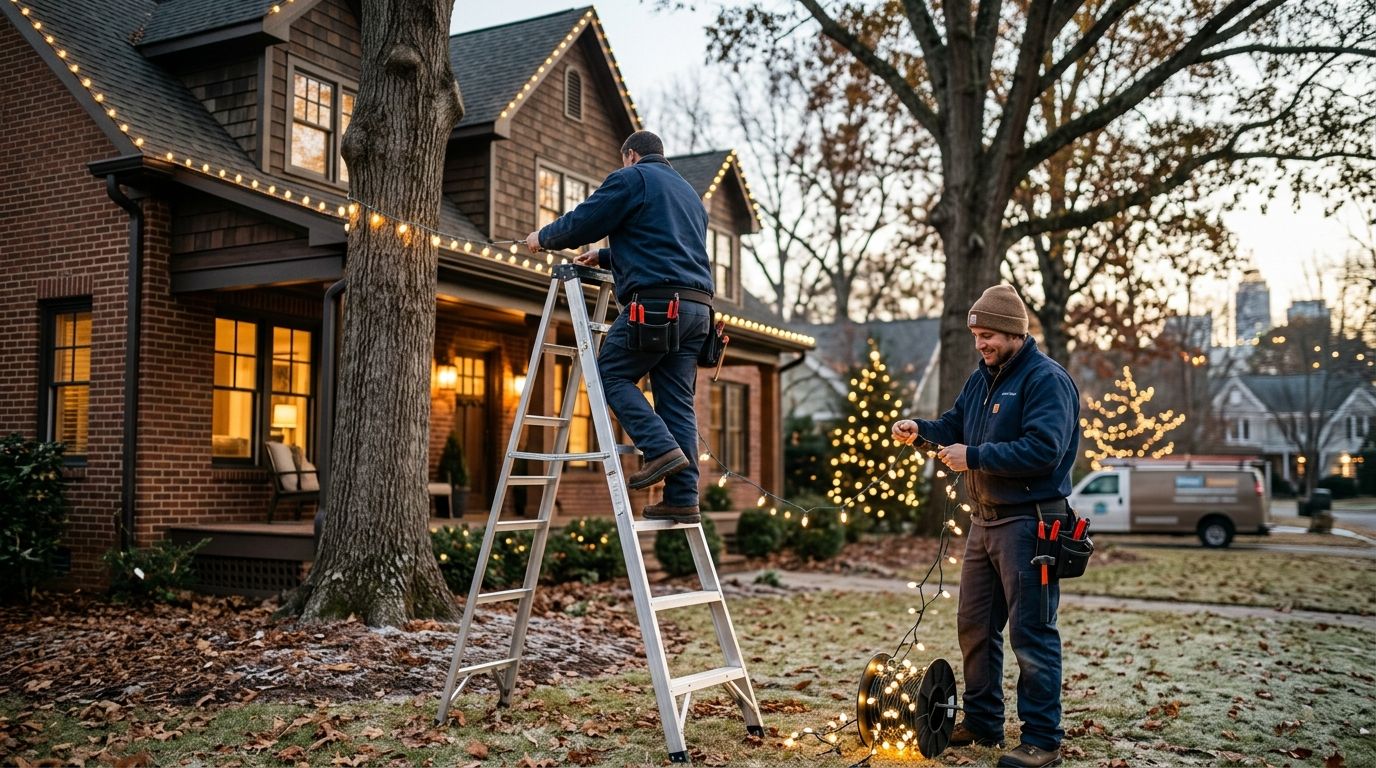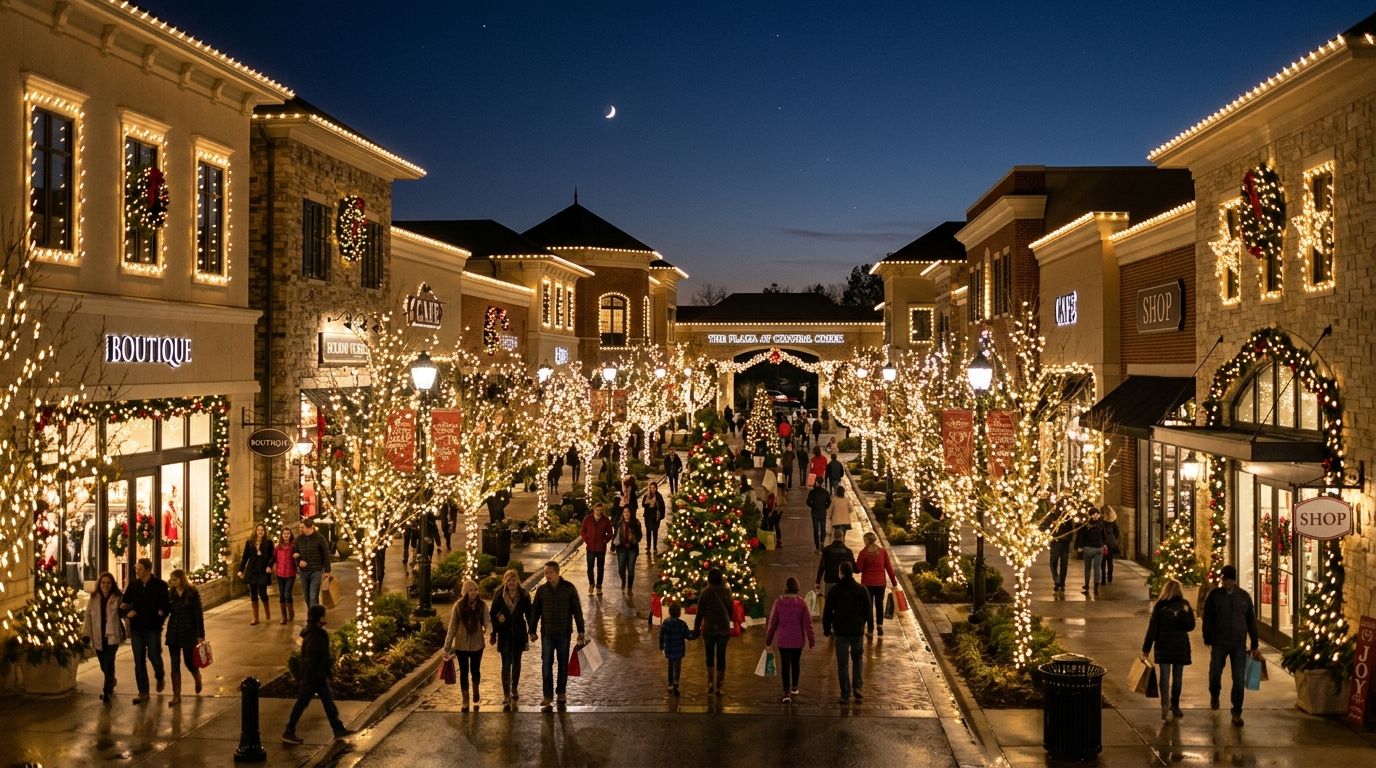
Storefronts and shopping centers need lighting that survives 60+ nights of continuous run time, Atlanta's wet December weather, and a property manager who wants the whole center looking consistent from one tenant to the next. This guide ranks the commercial christmas lighting types that actually hold up on retail exteriors in 2026, not the consumer strands sold at big-box stores.
- Commercial-grade LED string lights are the best overall pick for storefront windows and perimeter lines in 2026.
- C9 LED bulb strands win for defining rooflines on anchor stores and larger retail facades.
- LED net lighting is the fastest way to cover shrubs and foundation beds without hand-wrapping branches.
- Warm white LED icicle lights read best on canopies and awnings across most Atlanta shopping centers.
- Professional install, takedown, and storage matter more on commercial properties than the bulb style itself.
Why this matters
A shopping center that runs warm white on one storefront and cool multicolor on the next looks unfinished from the parking lot, no matter how bright either display is. Commercial properties also carry liability residential displays don't: an extension cord across a walkway, a strand that isn't UL-rated for continuous outdoor use, or a lift left on site past the agreed window. The right lighting type for a storefront depends on what it's illuminating — window frame, roofline, shrub bed, or facade — not on picking one style and running it everywhere.
Atlanta Christmas Lighting Co designs and installs commercial displays across the greater Atlanta area, and the pattern repeats every season: properties that select lighting by feature look sharper in 2026 and last longer than properties that stretch one product across every surface.
What makes the best commercial christmas lighting
- Commercial-grade rating — UL or CSA listed for continuous outdoor use, not seasonal residential-grade wiring
- Weatherproof housings and coated wiring built for Atlanta's wet winter stretches, not just splash resistance
- Consistent color temperature across the whole property so no section reads warmer or cooler than the next
- Visibility from the road, since storefront lighting is judged from 50-200 feet away, not up close
- Install and takedown speed — commercial properties can't tie up a lift crew for days
- Load per circuit — long runs on older retail buildings need lighting that won't trip breakers mid-season
At a glance: commercial christmas lighting compared
| Lighting type | Best for | Standout feature | Key limitation |
|---|---|---|---|
| Commercial-grade LED string lights | Storefront windows and perimeter lines | Even, continuous coverage on long straight runs | Needs consistent mounting points or it sags |
| C9 LED bulb strands | Anchor store rooflines | Individually visible bulbs from the road | Looks sparse on short storefront roof runs |
| LED net lighting | Shrubs and foundation beds | Drapes over irregular shapes fast | Uneven on tall or oddly shaped plants |
| LED icicle lights | Canopies and awning edges | Defines the building's horizontal lines | Wind exposure causes strand movement |
| LED tree and trunk wraps | Parking lot trees and medians | Lights the tree's full structure | Labor-intensive on mature canopies |
| LED uplighting | Facades, columns, monument signs | No hardware mounted on the structure | Needs clear, stable ground placement |
1. Commercial-grade LED string lights: best for storefront windows and perimeter lines
Commercial-grade LED string lights are continuous runs of LED bulbs on heavy-gauge, UL-listed wire built to stay outdoors all season without bulb swaps. On storefronts they outline window frames, door frames, and roof edges in one connected line, which reads clean from across a parking lot in a way stacked residential strands never do.
Commercial-grade LED string light pros:
- Warm white or color-matched options keep an entire shopping center visually consistent
- Built for continuous 60+ night runs without failure clusters
- Low draw per strand means more coverage per circuit on older retail buildings
Commercial-grade LED string light cons:
- Long runs need secure clips or they sag within a few weeks
- Custom window and door outlines require measuring each storefront individually
Best for: storefront window frames, entry doors, and building perimeters. Verdict: Buy.
2. C9 LED bulb strands: best for anchor store rooflines
C9 bulbs are the large, individually visible bulbs long associated with commercial roofline lighting. On anchor stores and wide retail facades, the 12-inch spacing typical of commercial C9 strands makes each bulb read as a distinct point of light from the road rather than a blurred line.
C9 LED bulb strand pros:
- Reads clearly at distance, which matters on centers set back from the road
- Individually replaceable bulbs mean one failure doesn't dim the run
- Holds shape against wind on exposed rooflines
C9 LED bulb strand cons:
- Looks thin on smaller storefronts with short roof runs
- Requires roof access, which adds install time versus ground-level work
Best for: anchor tenant rooflines and wide facade edges. Verdict: Buy.
3. LED net lighting: best for shrubs and foundation plantings
Net lighting is a pre-wired grid of LEDs designed to drape over shrubs and hedges in one piece instead of wrapping each branch by hand. For centers with landscaped entrances or planting beds along the storefront, net lighting covers a bed in a fraction of the time hand-wrapping takes.
LED net lighting pros:
- Drapes over irregular shrub shapes without individual wrapping
- Fast to install and remove across multiple identical beds
- Uniform coverage on low, wide plantings
LED net lighting cons:
- Coverage goes uneven on tall or unusually shaped shrubs
- Doesn't work on trees or vertical structures
Best for: low shrubs and foundation beds at storefront entrances. Verdict: Buy.
4. LED icicle lights: best for canopies and awning edges
Icicle lights hang in staggered drop lengths along a horizontal line, which fits canopy edges, awnings, and overhangs where the building already has a straight feature to outline. On a center with a continuous canopy, warm white icicle lights tie multiple storefronts together even when tenants run completely different signage.
LED icicle light pros:
- Emphasizes horizontal architectural lines already on the building
- Visually unifies multiple storefronts under one canopy
- Available in staggered or straight drop patterns for different roof styles
LED icicle light cons:
- Wind exposure on open canopies moves strands over the season
- Longer drops need secure mounting to avoid tangling
Best for: canopies, awnings, and overhangs with a clear horizontal edge. Verdict: Buy.
5. LED tree and trunk wraps: best for parking lot trees and medians
Tree wraps run LED lighting up the trunk and out along major branches, lighting the tree's structure rather than just its silhouette. Centers with mature trees in lot islands or entrance medians use trunk wraps to keep the parking area feeling lit and finished, not just the building face.
LED tree wrap pros:
- Lights the full structure of the tree, not an outline
- Extends the property's lit footprint past the building
- Reuses well across seasons when stored properly between years
LED tree wrap cons:
- Labor-intensive on mature trees with heavy canopy
- Needs careful removal to avoid damaging bark and branches
Best for: parking lot trees, medians, and entrance drives. Verdict: Buy.
6. LED uplighting: best for facades and monument signs
Uplighting sits on the ground or a low mount and throws light upward onto a facade, column, or monument sign instead of mounting strands on the structure. For centers with stone, brick, or signage a property manager won't allow hardware on, uplighting adds presence without touching the building.
LED uplighting pros:
- No mounting hardware on the building or sign structure
- Highlights architectural features and monument signage after dark
- Works alongside string lights and C9s without visual competition
LED uplighting cons:
- Needs clear, stable ground placement, often limited near walkways and parking
- Loses impact under bright ambient light from adjacent lot fixtures
Best for: stone or brick facades, columns, and monument signage. Verdict: Buy as accent, not as the primary display.
How we ranked these
Each type was scored against the criteria above: commercial-grade rating, performance through Atlanta's wet winter stretches, visibility from the road, and whether a crew can install and remove it without tying up a lift for days. No consumer-grade or single-season products made this 2026 list — commercial properties need lighting built for continuous runs.
“If a strand isn't rated for continuous outdoor commercial use, it isn't commercial-grade — it's a December problem waiting to happen.”
Which commercial christmas lighting should you choose?
Most shopping centers in 2026 combine three or four of these types rather than picking one: commercial-grade LED string lights on windows and perimeter, C9 bulbs on the roofline, net lighting on foundation beds, and trunk wraps in the lot. That mix covers the full visual footprint without forcing one product to do every job.
Default recommendation for a typical storefront or small shopping center: commercial-grade LED string lights on window and door frames, paired with C9 bulbs on the roofline. Heavy landscaping or mature trees? Add net lighting and trunk wraps to push coverage into the parking lot.
Get a commercial lighting design quote
Design, install, maintenance, takedown, and storage handled for your property.
FAQ
What is the best commercial christmas lighting for storefronts and shopping centers in 2026?
Commercial-grade LED string lights on windows and perimeters, combined with C9 bulb strands on rooflines, cover most storefronts well in 2026. Larger centers add net lighting and tree wraps for landscaped areas.
Is warm white or multicolor better for a shopping center?
Warm white keeps multiple storefronts under one center looking consistent, which matters more on multi-tenant properties than on a single home. Multicolor suits standalone retail that wants to stand apart from neighboring storefronts.
Do commercial properties need UL-rated Christmas lights?
Yes. Commercial displays need lighting listed for continuous outdoor use rather than seasonal residential-grade wiring. Runs across 60+ nights put far more strain on wiring than a short residential display schedule.
Can C9 bulbs be used on a storefront instead of just rooflines?
C9 bulbs work on storefronts but read best on long, straight roof edges where bulb spacing is visible from the road. On short window frames, string lights create a more even outline.
How early should a shopping center book commercial Christmas lighting installation?
Start in August for Atlanta properties, because installation slots for larger commercial jobs fill through September. Waiting until November narrows both crew availability and design options.
Does net lighting work on trees or only shrubs?
Net lighting is built for low, wide shrubs and foundation beds, not trees. Trunk and branch wraps are the right product for lighting parking lot trees and medians.
What is the most common shopping center lighting mistake?
Mixing warm white on one storefront with cool white or multicolor on the next is the most common visual mismatch on multi-tenant properties. Coordinated color temperature reads more finished than any single bright display.
Does commercial Christmas lighting need professional takedown?
Professional takedown protects roofline and facade-mounted lighting from damage and keeps removal liability off the property manager. It also lets the same lighting be stored and reused the following season.
One last thing
The detail most property managers miss: lighting stored properly after the season, rather than boxed loose in a maintenance closet, comes back in far better shape the next year — fewer tangles, fewer dead bulbs, and a faster reinstall in 2027. Across multiple seasons that drives cost more than which bulb style gets picked in 2026.