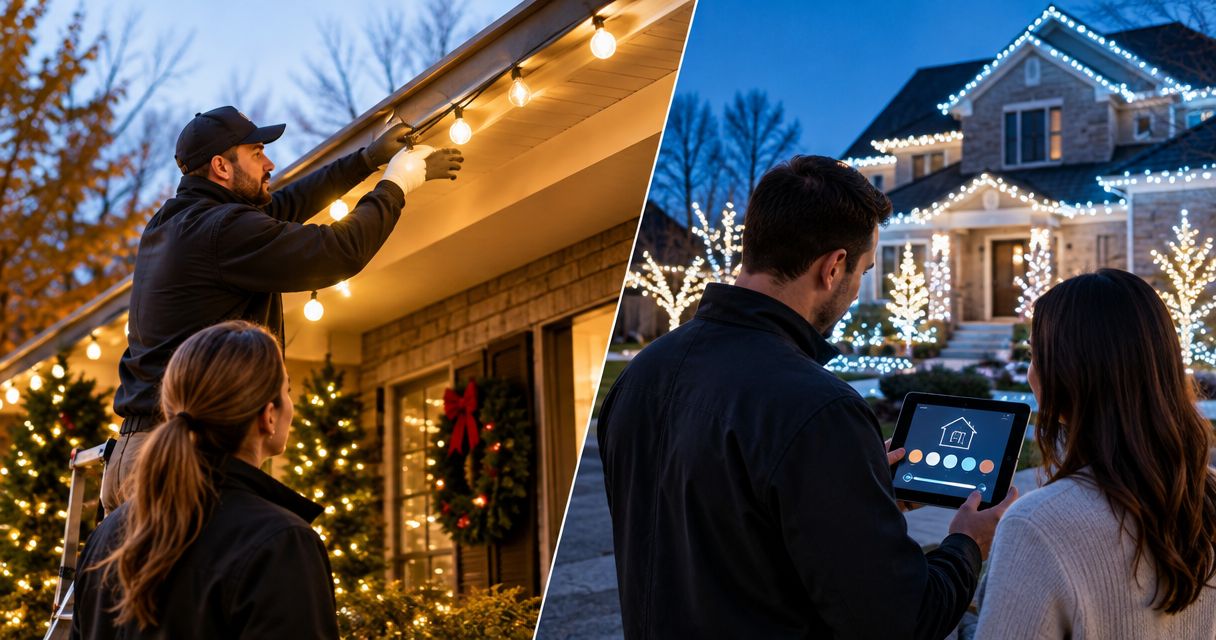
Choose Atlanta Christmas Lighting Co if you want Christmas light design, installation, maintenance, takedown, and storage from one provider; choose Christmas Elves if its written proposal gives your property a better fit on design, service responsibilities, and removal arrangements. For your 2026 decision, compare the full season of work—not just the display on installation day.
- Atlanta Christmas Lighting Co vs Christmas Elves comes down to the written scope, not the company name.
- Atlanta Christmas Lighting Co provides Christmas light installation, design, maintenance, takedown, and storage across greater Atlanta.
- Choose Christmas Elves when its property-specific proposal better meets your documented requirements.
- Compare maintenance responsibilities, equipment ownership, removal arrangements, and storage before signing either proposal.
Why this matters
A Christmas lighting agreement needs to explain what happens before installation, while the lights are up, and after the season ends. A design you like is only part of the decision. You also need to know who handles an outage, who removes the display, and where the materials go afterward.
Atlanta Christmas Lighting Co is a full-service Christmas lighting provider for greater Atlanta homeowners and commercial properties. Its Christmas lighting services cover the seasonal process from design through storage. Your proposal should identify which of those services apply to your property and the conditions attached to them.
For 2026, use the same property brief when requesting both proposals. That makes differences visible without confusing a smaller display with a more complete service.
At a glance
Use this table as your comparison worksheet. Entries asking for confirmation are questions to resolve in the agreement, not promises about either provider.
| Dimension | Atlanta Christmas Lighting Co | Christmas Elves |
|---|---|---|
| Best for | Greater Atlanta residential and commercial customers seeking full-season service | Buyers whose written proposal better matches their property requirements |
| Design | Professional Christmas light design is part of its service offering | Request a property-specific design and installation scope |
| Installation | Professional installation is part of its service offering | Confirm covered surfaces, access needs, and responsibilities |
| Maintenance | Maintenance is part of its service offering; confirm terms | Confirm covered issues and service arrangements |
| Takedown and storage | Both are part of its service offering; confirm arrangements | Confirm removal, storage, and collection responsibilities |
| Property fit | Serves residential and commercial properties across greater Atlanta | Confirm the exact address and property type |
| Pricing model | Establish whether services are bundled or itemized in your proposal | Establish whether services are bundled or itemized in your proposal |
| Standout feature | An explicitly stated design-to-storage service scope | Use the proposal to identify a specific advantage for your property |
Full-season service favors the explicitly stated scope
The clearest reason to shortlist the full-service provider is continuity. Design, installation, maintenance, takedown, and storage are all part of its stated offering, so you can discuss the entire season with the same business.
That is a service-scope advantage, not proof that every task is automatically included in every agreement. Ask for each stage to appear in writing. A broad service description should become a specific set of responsibilities for your property.
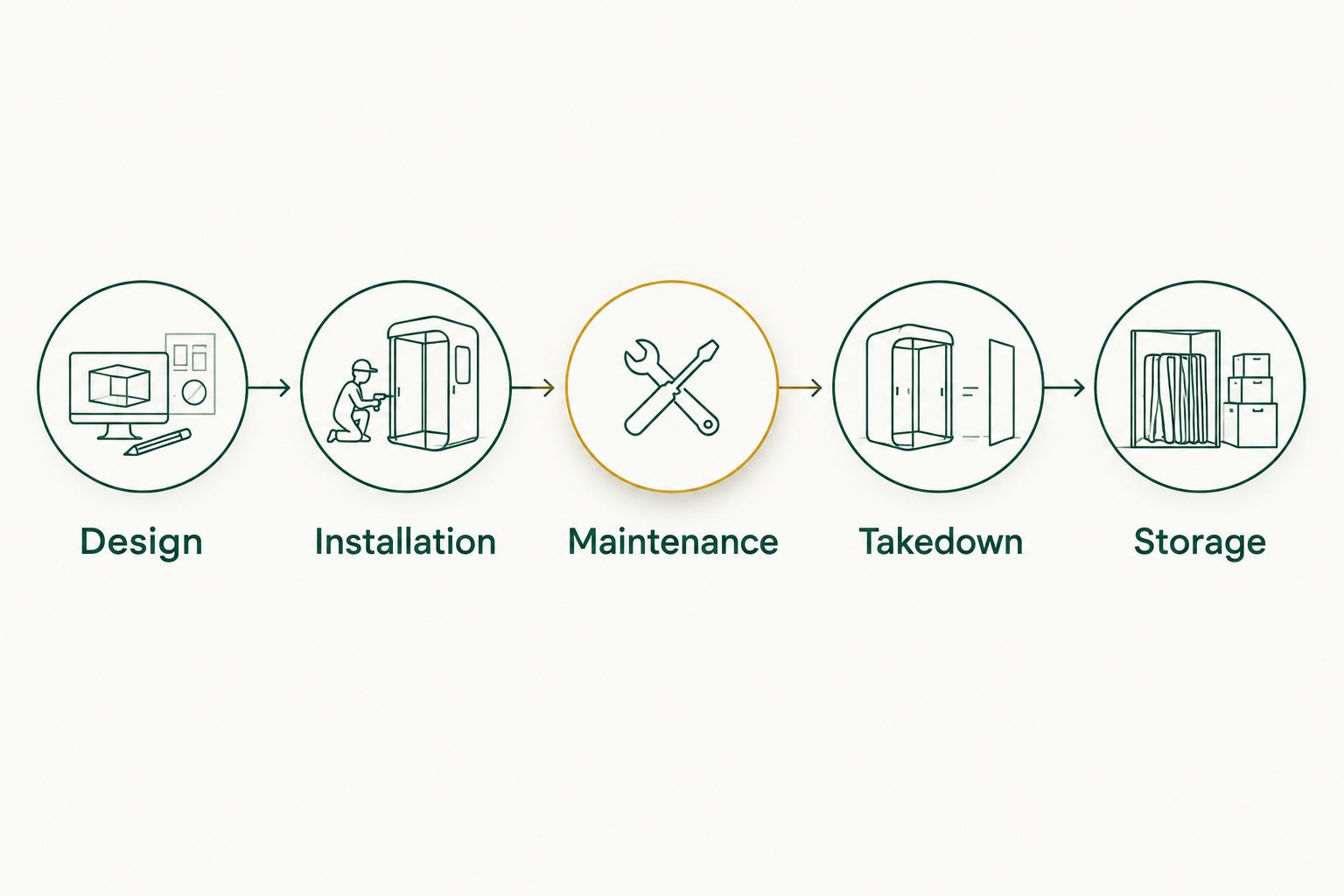
Compare these 5 service stages across both proposals:
- Design: Identify the areas to decorate and the appearance you approve.
- Installation: Identify the surfaces, access arrangements, and work included.
- Maintenance: Identify the issues covered and the process for requesting help.
- Takedown: Identify who removes the display and how scheduling works.
- Storage: Identify who holds the materials and what happens when service ends.
The tradeoff: a full-season arrangement is the wrong scope if you only want a narrowly defined task. If you already have materials and only need removal, request that exact work rather than assuming a complete seasonal package suits you.
Design is a tie until you approve the property plan
Neither a company name nor a general service description tells you which design you will prefer. Choose the design you can evaluate against your actual property. Ask both providers to identify what is included and what is excluded.
For a home, separate rooflines, entry features, trees, and landscaping in your request. For a commercial property, identify public-facing areas, entrances, tenant boundaries, and any approval requirements. These are briefing categories, not a claim that either provider includes every type of work.
Your 2026 design approval should resolve:
- Which parts of the property receive lights.
- Which light colors and visual style you approve.
- Which areas stay undecorated.
- How additions or revisions are authorized.
A more elaborate proposal is not automatically the better one. If you want a restrained roofline display, extra decorative areas add scope you did not request. Conversely, a roofline-only proposal is not equivalent to one covering the entrance and landscaping.
Christmas Elves wins this dimension if its proposed design better matches your written brief. Make that judgment from the property plan rather than assumed differences between the businesses.
Installation is a tie until the access plan is clear
Professional installation belongs in the comparison, but the useful question is what the installation agreement covers. Both proposals should address the surfaces involved, access to the property, and who approves changes discovered during the work.
For example, tell each provider about restricted gates, tenant access, delicate finishes, or areas that must remain clear. Do not assume an installer knows your property's operating rules before you provide them.
Ask 3 installation questions before authorizing work:
- What attachment approach is proposed for each surface?
- What access or preparation must you provide?
- What happens if the agreed design needs to change on installation day?
Neither provider earns an installation-quality win from a service description alone. Choose the agreement that clearly addresses your surfaces and access constraints. Request insurance documentation separately; a lighting design does not establish coverage, and an installation proposal does not replace proof of insurance.
The practical downside of an unclear installation scope is uncertainty about responsibility. Resolve it before work begins, especially when multiple people manage the property.
Maintenance favors a written responsibility, not a vague promise
Maintenance is part of the client's stated service offering. That makes it a relevant reason to consider the business, but the proposal still needs to explain what maintenance means for your display.
An outage, a displaced section, and a requested design change are different requests. Ask which issues the agreement covers, how you report them, and whether any exclusions apply. Do not treat the word maintenance as a response-time guarantee.
For Christmas Elves, apply the same standard. A proposal that clearly defines covered work is more useful than a reassuring description without specific responsibilities.
For your 2026 display, record:
- The contact method for reporting an issue.
- The information needed to identify the affected area.
- The covered service period.
- The process for work outside the agreed scope.
Give the maintenance win to the clearer written commitment. The full-service offering is a useful starting point, but it does not establish a faster response, broader coverage, or better workmanship than another provider.
Takedown and storage favor planning the end at the start
Takedown and storage are both part of the client's service offering. If you do not want to organize removal or find room for lighting materials, that scope directly addresses your needs.
Still, storage requires more than knowing that someone will hold the lights. Establish ownership, collection arrangements, identification of your materials, and what happens if you do not renew service. Those details determine whether the arrangement suits you.
Ask each provider to distinguish:
- Removal responsibility: Who takes down the display?
- Scheduling responsibility: Who initiates and confirms removal?
- Material responsibility: Who owns and holds the lighting afterward?
- Exit arrangements: How are materials handled when the relationship ends?
Christmas Elves wins this dimension if its written removal and storage terms better suit your plans. For example, a customer who wants materials returned needs an agreement that expressly addresses return, rather than assuming storage means eventual delivery.
The tradeoff is control versus convenience. Having a provider hold materials removes a household storage task, but you still need clear access and ownership terms.
Property fit favors the provider that meets your exact brief
Serving greater Atlanta residential and commercial properties is part of the client's stated business scope. That supports considering the company for either category; it does not establish suitability for every building or every address.
For a homeowner, the decision centers on the approved appearance and the work you want handled. For a property manager, it also includes access rules, approval authority, and communication with occupants or tenants.
Christmas Elves is the better choice when its proposal meets a property requirement the alternative proposal does not. That is a concrete reason to choose it. A preferred design, an acceptable removal arrangement, or a clearly addressed access restriction is more useful than a general claim that one company is better.
Send both providers the same brief, including photographs and any property rules. Ask each to confirm exceptions explicitly. Silence about a requirement is not confirmation that it is included.
Pricing: compare the model and scope, not an isolated total
For the 2026 comparison, establish whether each proposal bundles the seasonal services or lists them separately. Also establish whether materials are purchased, supplied for seasonal use, or handled under another ownership arrangement. Do not infer the model from the presence of storage.
A bundled agreement gives you a single defined scope when its inclusions are clear. An itemized agreement makes individual tasks easier to distinguish. Neither structure wins automatically: exclusions, change approvals, and end-of-season responsibilities determine how useful the proposal is.
Put 2 proposals beside each other and check:
- Whether both cover the same decorated areas.
- Whether maintenance is included or separately authorized.
- Whether removal and storage appear explicitly.
- Whether equipment ownership is stated.
- Whether additions require approval before work proceeds.
The better comparison is equal scope against equal scope. Do not interpret a difference between proposals until you know whether the deliverables differ. Request clarification rather than assigning a pricing-model advantage that the agreements do not establish.
Final verdict: choose the agreement that fits your season
Choose Atlanta Christmas Lighting Co for full-season coordination
Best for: the hands-off Atlanta homeowner or commercial property manager. Choose this provider when you want to discuss design, installation, maintenance, takedown, and storage with one business whose stated offering covers those stages.
The limitation is straightforward: the service list is not your contract. Confirm the property-specific scope, maintenance conditions, equipment arrangements, and removal responsibilities before committing.
Choose Christmas Elves for a better property-specific proposal
Best for: the buyer with a clearly defined requirement and a better-matched written offer. Choose Christmas Elves when its actual proposal provides the design, access arrangements, maintenance responsibilities, or end-of-season terms you prefer.
The limitation is equally practical: do not substitute assumptions for written terms. A familiar name or an attractive design does not answer questions about maintenance, ownership, or takedown.
| Dimension | Winner |
|---|---|
| Explicit full-season service scope | Atlanta Christmas Lighting Co |
| Design | Tie until property plans are compared |
| Installation | Tie until access and attachment plans are compared |
| Maintenance | Provider with the clearer written responsibility |
| Takedown and storage | Provider with the better ownership and removal terms |
| Property fit | Christmas Elves when its proposal better meets your brief |
| Pricing model | No automatic winner; compare equal scope |
| Standout feature | Full-season scope versus a proposal-specific advantage |
Ready to turn the comparison into a property-specific decision? Contact the team with the same brief you use for the other proposal.
FAQ
Is Atlanta Christmas Lighting Co better than Christmas Elves?
Atlanta Christmas Lighting Co is a fit for buyers seeking design, installation, maintenance, takedown, and storage across greater Atlanta. Choose Christmas Elves instead when its written proposal better meets your property's specific requirements.
What should I compare before hiring a Christmas light installer?
Compare the approved design, installation scope, maintenance responsibilities, takedown arrangements, and storage terms. Use the same property brief so differences between proposals are clear.
Does a full-service Christmas lighting agreement include everything?
A full-service description does not establish every inclusion in your agreement. Ask the provider to state the covered tasks, exclusions, and approval process for additional work.
Which company has the better Christmas light design?
Choose the company whose property-specific design best matches your brief. Compare decorated areas, colors, and exclusions rather than judging from the business name.
How should I compare Christmas lighting pricing models?
Compare whether services are bundled or itemized and whether both proposals cover the same work. Establish material ownership, maintenance responsibilities, removal, and storage before making the decision.
Should I ask about takedown before installation?
Yes, agree on takedown responsibilities before authorizing installation. Confirm who schedules removal and what happens to the materials afterward.
What should a commercial property manager ask each installer?
Ask each installer to address access restrictions, approval authority, maintenance reporting, and removal arrangements. Provide the same property rules to both businesses and request written confirmation of exceptions.
One last thing
Read the removal terms before approving the installation plan. That reverses the usual visual-first decision and forces the agreement to address the whole job. For 2026, choose the provider whose responsibilities remain clear after the lights are switched off—not just the one whose proposed display looks right.