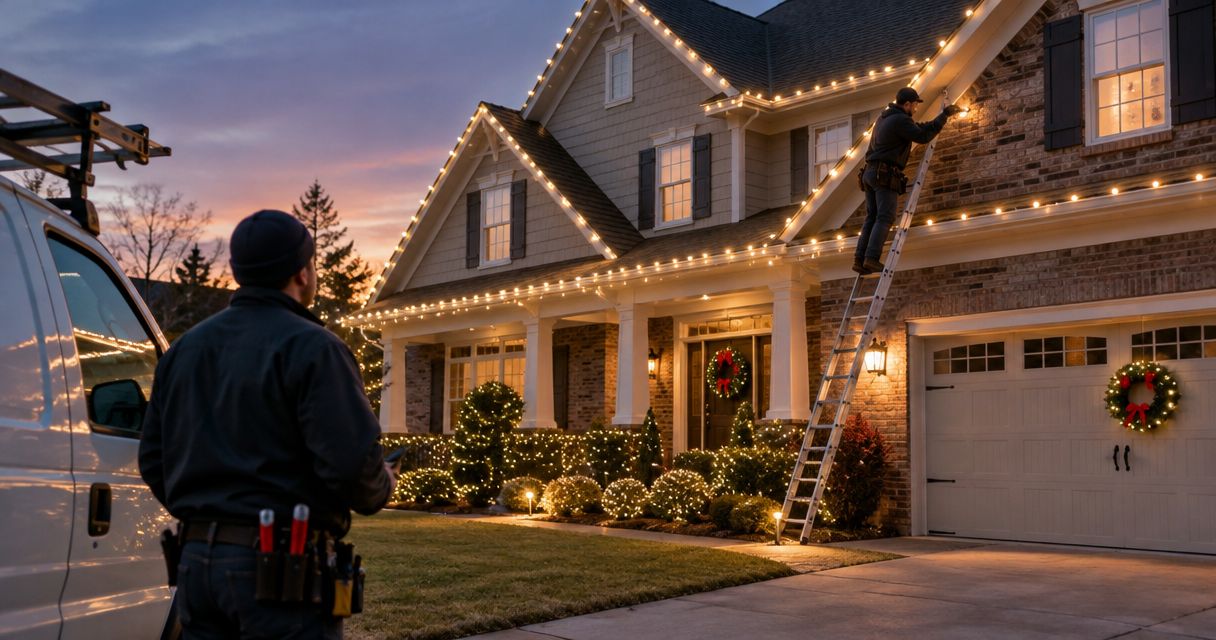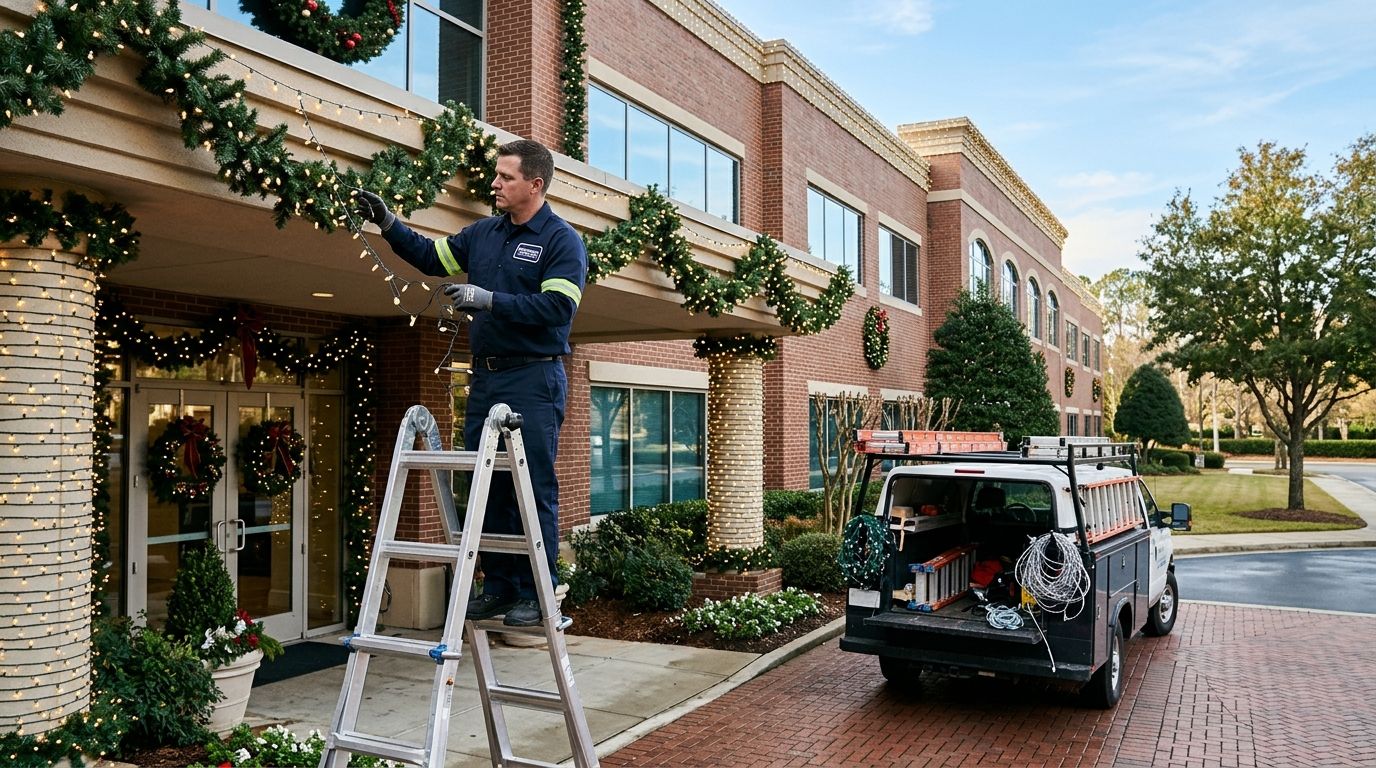
Yes—a maintenance plan is worth it for commercial Christmas lighting when your display needs to work throughout business hours and your staff cannot safely handle repairs. Its value depends on written coverage, repair arrangements, and exclusions—not the word maintenance on a proposal. For your 2026 display, choose a plan that assigns responsibility for faults rather than leaving your team to arrange help after something stops working.
- Is a maintenance plan worth it for commercial Christmas lighting? Yes, when written coverage matches your property's needs.
- Atlanta Christmas Lighting Co offers commercial Christmas lighting maintenance; confirm the scope before booking.
- Choose coverage by repair responsibilities, access arrangements, exclusions, and service dates—not the plan name.
- Keep repair response and repair completion separate when comparing maintenance proposals.
Is a maintenance plan worth it for commercial Christmas lighting?
A maintenance plan is worth choosing when it gives your property a clear repair process that your team cannot provide itself. That includes knowing whom to contact, what work is covered, and how a technician gains access without disrupting your business.
Start with the operating needs of your property. The guide to commercial Christmas lighting for storefronts and shopping centers addresses that setting; the maintenance decision should then follow the actual display and site requirements.
Compare these approaches before accepting a proposal. These are service arrangements to evaluate, not packages that every installer offers.
| Approach | Best for | Main advantage | Main limitation |
|---|---|---|---|
| Written maintenance plan | Properties that need assigned responsibility throughout the display period | Establishes coverage and a reporting process before a fault | Exclusions and service restrictions still need review |
| Repairs arranged as needed | Properties with an established contractor and a clear authorization process | Lets you request work for a specific problem | Repair arrangements must be confirmed when you request service |
| Staff-managed checks | Properties with facilities staff able to perform appropriate ground-level observations | Keeps reporting close to daily operations | Observation does not replace qualified repair work |
A plan is not automatically the strongest choice. If an installation agreement already includes the maintenance you need, a separate agreement must add something useful. Ask the provider to identify that difference in writing.
Why this matters
A commercial display sits inside a working property. Staff, customers, delivery drivers, landscapers, and other contractors still need to use the site while the lights are installed.
Maintenance therefore involves more than replacing a failed light. Someone must identify the affected area, report the problem, authorize any excluded work, and arrange safe access. Without those responsibilities, even a straightforward fault becomes an administrative task for your team.
For 2026 planning, treat maintenance as part of the installation specification. Decide how the display will be supported before approving its layout, especially where repairs would require access above an entrance or beside a busy walkway.
What should a commercial lighting maintenance plan cover?
Use 5 coverage checks to turn a broad promise into a usable agreement. These checks describe what to request; they do not establish what any particular installer includes.
Fault coverage
Ask which components and problems the agreement covers. Separate failed lights, loose attachments, connection issues, timer settings, and damage caused by outside activity rather than accepting a single reference to repairs.
The useful question is specific: if part of the installed display stops working, who diagnoses the fault and who handles the repair? Ask how the provider treats a problem that originates in the property's electrical system rather than the lighting installation.
Service dates
Get the maintenance start and end dates in writing. Installation, illumination, maintenance, and removal do not necessarily describe the same period.
For your 2026 agreement, make sure coverage matches the dates you intend to operate the display. Also establish what happens if your property requests a later removal date or changes its operating schedule.
Response terms
Separate acknowledgment, inspection, and completed repair. A promise to respond does not, by itself, explain when a technician will attend or when the display will work again.
Ask how service requests are prioritized and what restrictions affect attendance. Treat weekend, holiday, and after-hours support as questions to resolve—not benefits to assume.
Site access
Specify who provides gate access, coordinates with security, and authorizes work near occupied entrances. Identify any areas where equipment placement or temporary pedestrian restrictions need approval.
Give the installer a property contact who can make decisions. A maintenance agreement cannot resolve an access problem if nobody on site knows the technician is coming.
Exclusions
Ask the provider to distinguish an installation fault from damage caused by weather, vehicles, landscaping work, vandalism, or someone moving the lights. These are questions for the agreement, not assumed exclusions.
Also confirm whether changing the design counts as maintenance. Moving a display to a different entrance is a different request from restoring the approved installation.
These checks belong together. A clearly defined fault still needs a reporting route, an agreed service period, and access for the person assigned to fix it.
Why maintenance value varies by property
The right decision follows your operating requirements, not the size of the maintenance heading on a proposal. Review these factors against the actual installation:
- Public visibility. Identify which illuminated areas form part of the entrance or frontage your visitors see. Tell the provider which faults need immediate reporting.
- Access requirements. Distinguish ground-level observations from repairs requiring ladders, lifts, restricted areas, or work near pedestrian routes.
- Staff responsibilities. Establish whether your facilities team will only report faults or has an approved role in maintaining the display.
- Operating schedule. Record when lighting should run and when technicians can enter the property. Include events that require separate coordination.
- Display layout. Identify rooflines, trees, entrances, and other distinct areas so a fault report points to a recognizable location.
- Existing coverage. Compare the installation agreement with the proposed maintenance terms. Do not approve duplicate responsibilities without understanding the difference.
A tall installation does not prove that every maintenance proposal is worthwhile. It does make the repair-access question harder to ignore. The agreement should explain who arranges that access and what the property must provide.
When should you choose a maintenance plan?
Choose a written maintenance plan when your business needs an assigned provider to handle covered faults throughout the display period. This is particularly relevant when your staff's role should stop at observing and reporting a problem.
Before approving your 2026 scope, describe a realistic fault: an entrance section fails while the rest remains lit. Ask the provider to walk through reporting, diagnosis, access, authorization, and completion. That conversation tests the agreement more effectively than asking whether service is included.
A satisfactory answer identifies responsibilities without promising that every problem has the same solution. If the provider cannot explain the process, request clearer terms before signing.
Atlanta Christmas Lighting Co is best suited to Atlanta property managers seeking commercial Christmas lighting support from design through maintenance and takedown. The company provides those services, including storage, across greater Atlanta. Its service range does not replace a property-specific agreement: confirm maintenance coverage and service arrangements directly with Atlanta Christmas Lighting Co.
The advantage of that full-service approach is keeping the requested work within a connected installation-to-removal scope. The limitation is that a service description alone does not establish repair deadlines, exclusions, or the terms for your particular site.
Discuss your commercial lighting scope
Ask about design, installation, maintenance, takedown, and storage for your Atlanta property.
When is a separate maintenance plan unnecessary?
A separate maintenance plan is unnecessary when your signed installation agreement already supplies the same coverage and responsibilities. Compare the documents rather than treating a second agreement as extra protection by default.
An as-needed repair arrangement is another option when your property has a defined reporting process and accepts that each service request needs confirmation. Its strength is handling a specific fault without assuming broader coverage; its limitation is the coordination your team retains.
For 2026, reject a plan that adds only vague reassurance. Ask what changes when you accept it: covered work, service dates, reporting arrangements, or assigned responsibility. If nothing changes, request an explanation of its purpose.
Do not confuse staff oversight with a complete substitute for maintenance. Staff can document what they see from a safe location, but that does not establish their competence or authorization to repair electrical equipment or work at height.
Does maintenance include storm damage and timer problems?
Maintenance includes storm damage or timer problems only when the agreement says it does. Ask about each separately, because restoring a timer setting and repairing physical damage are different tasks.
For a timer problem, record the intended operating schedule and tell the provider what actually happens. For damage, report the affected location and visible condition without asking staff to handle suspect wiring or climb to inspect it.
Keep a failed lighting component separate from a property power problem. A maintenance provider needs to explain where its responsibility ends and when the property must involve an appropriately qualified electrical contractor.
How should your team report a lighting fault?
Use 3 reporting steps so the provider receives a useful request without turning your staff into repair technicians.
- Identify the location. Use the agreed site names, such as main entrance, courtyard tree, or street-facing roofline. Explain whether one area or the entire display appears affected.
- Record the condition. Note when staff observed the problem and provide a photograph from a safe, accessible position. Mention visible damage without touching or moving equipment.
- Send the request. Use the agreed contact method and include the person who can arrange access. Ask for the next action and keep the request open until its status is clear.
Choose one person to coordinate updates. That avoids separate employees giving conflicting access instructions or assuming another team has already reported the fault.
Keep a marked-up layout with the agreement. A shared location name is more useful than a message saying the lights near the building are out.
FAQ
Is a maintenance plan worth it for commercial Christmas lighting?
Yes, when a written maintenance plan assigns covered repairs that your staff cannot safely or practically handle. Compare fault coverage, service dates, response terms, access requirements, and exclusions before approving it.
Does commercial Christmas light installation automatically include maintenance?
Do not assume commercial Christmas light installation includes maintenance. Ask the provider to state the covered work and service period in the installation agreement.
Does a lighting maintenance plan guarantee same-day repairs?
A maintenance plan does not establish same-day repair terms unless the agreement explicitly provides them. Separate acknowledgment of your request from technician attendance and completed repair.
Should our staff try to fix commercial Christmas lights?
Your staff should report faults and perform only tasks they are trained and authorized to carry out safely. Do not treat a maintenance agreement as permission for unqualified electrical work or work at height.
Does maintenance cover lights damaged during a storm?
Storm-damage coverage depends on the written agreement. Ask the provider to explain damage coverage, exclusions, and the authorization process before the display is installed.
Does Atlanta Christmas Lighting Co provide commercial lighting maintenance?
Atlanta Christmas Lighting Co provides commercial Christmas lighting maintenance as part of its service offering across greater Atlanta. Confirm the coverage, reporting process, and service arrangements for your property directly.
Are takedown and storage the same as maintenance?
Takedown and storage are separate tasks from maintaining an operating display. Confirm each responsibility in your agreement rather than assuming maintenance includes removal and storage.
One last thing
Test the handoff, not just the coverage list. Before your 2026 display is installed, ask your property contact to explain how they would report a failed entrance section and admit the technician.
If that person cannot find the contact method, coverage dates, or access instructions, the agreement is not yet ready for daily use. Put those details beside the display layout so the repair process remains clear when the person who approved the project is away.