Yes, Christmas lights can be removed without damaging paint or siding when the attachments suit the surface, the finish is sound, and each fastener is released rather than pulled loose by the wire. Adhesive hooks, existing paint failure, and fasteners that penetrate the exterior require extra care; careful removal cannot undo damage caused during installation.
- Can Christmas lights be removed without damaging paint or siding? Yes, but attachment choice and surface condition determine the risk.
- Release Christmas light clips individually; never pull a connected strand to strip attachments from the house.
- Follow adhesive removal instructions, and stop immediately if paint lifts or siding moves.
- Atlanta Christmas Lighting Co provides Christmas light takedown and storage for Atlanta homeowners and commercial properties.
Can Christmas lights be removed without damaging paint or siding?
Damage-free removal depends on releasing the attachment without transferring force to the finish or siding. Start by identifying what holds the lights in place. A clip that opens mechanically needs a different approach from an adhesive hook or a screw-mounted bracket.
For your 2026 display, plan removal before choosing the attachment. A fastening method that is easy to install is not automatically easy to remove.
| Attachment | Best for | Benefit during removal | Limitation or risk |
|---|---|---|---|
| Compatible removable clips | Edges and profiles the clip is designed to fit | Release mechanically without an adhesive bond | The wrong fit or forced removal can stress the edge |
| Exterior-rated adhesive hooks | Surfaces expressly permitted by the hook manufacturer | Some designs provide a dedicated release method | Paint adhesion and removal technique affect the outcome |
| Screws, nails, or staples | Only locations specifically approved for that fastening method | The attachment point is identifiable | Removal leaves a penetration; patching is a separate task |
| Unknown attachments | Inspection before any removal attempt | Identifying the attachment prevents blind pulling | You cannot choose a safe release method until you identify it |
Roofline attachment points deserve the same attention as siding. Read the guide to whether Christmas lights can damage roofs or gutters before treating every exterior edge as interchangeable.
Why this matters
A light strand can come down intact while the house still suffers damage. Paint can separate beneath an adhesive pad, a siding edge can move with a tight clip, and a screw hole remains after the bracket is gone.
Your goal is not simply to get the lights down. It is to remove them without creating a repair, leaving an unsafe attachment behind, or damaging equipment you intend to reuse.
For Atlanta homes and businesses, access also belongs in the plan. An attachment that requires awkward reaching is not a suitable do-it-yourself removal task, even if its release mechanism looks simple from the ground.
How do you remove Christmas lights without pulling off paint?
Use a controlled sequence rather than pulling on the strand and hoping the clips follow. If the paint or siding starts moving with an attachment, stop. More force is not the next step.
Disconnect power
Unplug the display before handling strands or attachments. Turning off a timer or using a scheduling app is not the same as physically disconnecting the lights from power.
Keep disconnected cords clear of walking routes while you work. Do not leave a loose strand hanging where it can snag someone or pull against the remaining attachments.
Inspect attachments
Identify the clip, hook, tie, or fastener before trying to release it. Look for peeling paint, cracked material, loose siding, and attachments that appear bonded to the finish.
Photograph questionable areas before touching them. For your 2026 takedown, those photos provide a useful record of the condition you found, rather than relying on memory afterward.
Support strands
Support the section you are removing so its weight does not hang from the next attachment. Keep the wire relaxed rather than using it as a handle to pull a hook or clip free.
Work within safe reach. If you need to lean sideways, climb onto an unsuitable surface, or pull from below to reach an attachment, arrange appropriate professional access instead.
Release attachments
Open or disengage mechanical clips according to their design. For adhesive products, follow the specific manufacturer's removal instructions, including the direction in which a release tab must move.
Do not substitute a knife, solvent, or heat source simply because an attachment resists. Those methods introduce separate risks to the coating, siding, wiring, and person doing the work.
Check surfaces
Inspect each area as the lights come down. Look for lifted paint edges, movement at siding joints, exposed penetrations, and pieces of broken hardware.
Keep questionable lighting components separate from equipment ready for storage. A damaged cord or broken attachment needs attention before the next installation, not after it reaches the roofline again.
Removable clips: release the mechanism, not the strand
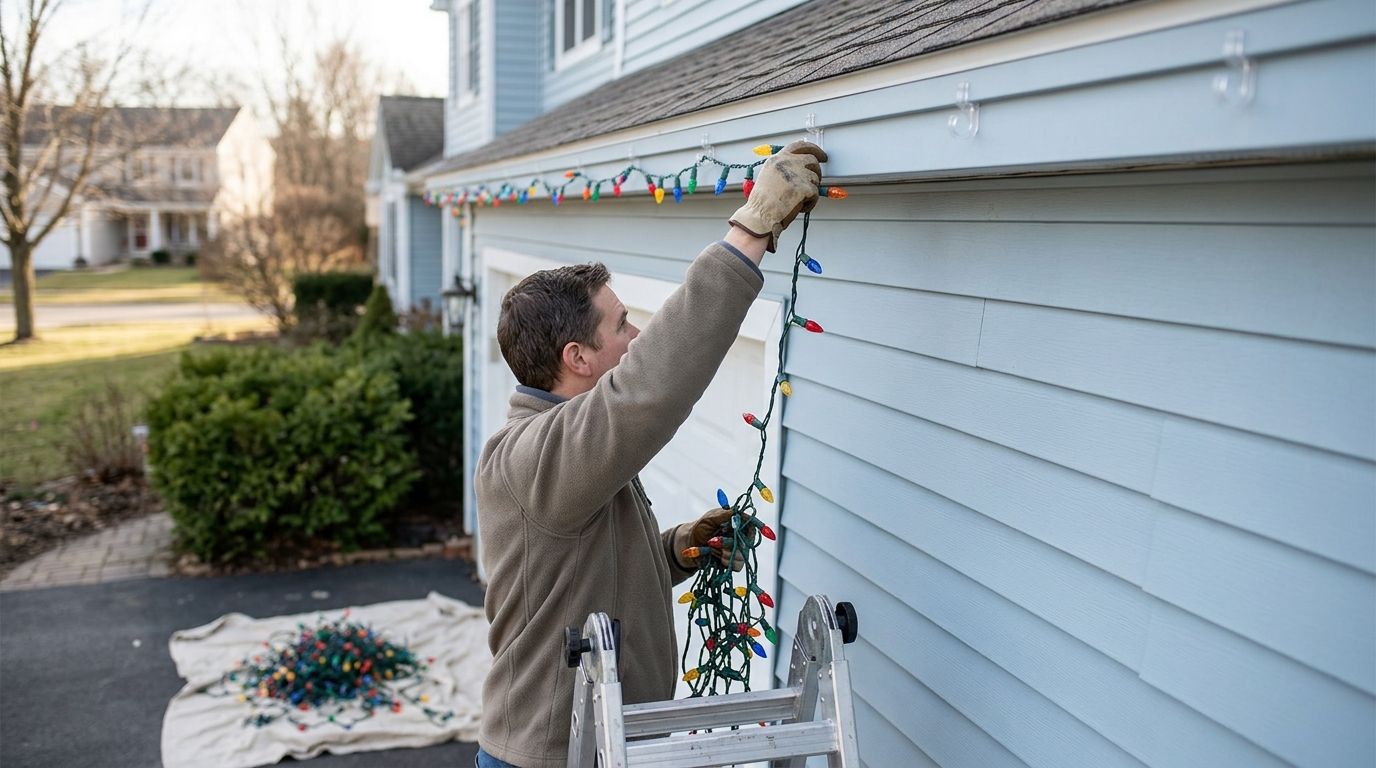
A compatible mechanical clip avoids an adhesive bond, but it still needs deliberate removal. Inspect how the clip grips the edge before opening, sliding, or disengaging it.
Do not assume all clips release in the same direction. A clip fitted around a gutter edge is not necessarily interchangeable with a clip fitted to another building component.
The advantage is straightforward: a suitable clip provides a way to detach the lights without peeling something from a painted face. The limitation is fit. A clip that is jammed into an unsuitable gap or gripping a fragile edge can still cause trouble.
If a clip has become brittle or broken, do not drag the remaining piece across the finish. Stop and assess how to remove the fragment without scraping or forcing the underlying material.
Adhesive hooks: follow the exact removal instructions
An outdoor-use label does not establish that an adhesive hook is suitable for every painted surface. Check both the permitted surfaces and the removal instructions for the actual product used.
Some adhesive systems release by stretching a tab in a specified direction. Other products use different methods. Pulling a hook straight outward because it looks removable can put force directly on the paint layer.
The benefit of a suitable adhesive attachment is that installation does not require a screw hole. The drawback is that removal depends on the adhesive system and the condition of the coating beneath it.
If the tab breaks, the product is unidentified, or the paint starts lifting, stop improvising. Get product-specific guidance before applying chemicals or heat. Protecting the finish matters more than preserving a disposable hook.
Nails, screws, and staples: removal does not erase holes
A penetrating fastener leaves a penetration even when you remove it cleanly. That makes it different from a removable clip, not simply a stronger version of the same attachment.
Do not pull a light strand against a staple or use the electrical cord to extract hardware. The wire is not a removal tool, and damage to its insulation creates another problem.
Before removing screws or nails, determine what they enter and whether removal requires an exterior repair. The appropriate repair depends on the building material and its manufacturer's guidance; a generic dab of filler is not a universal answer.
For a 2026 installation, agree in advance whether any permanent mounting hardware will remain. Do not remove an established attachment merely because it is visible after the lights come down.
Why removal risk varies
The same attachment can behave differently on different parts of a property. These factors determine where you need extra caution:
- Paint condition: Peeling, blistering, or poorly bonded paint is already vulnerable. An attachment can reveal that failure during removal.
- Surface compatibility: A method intended for a smooth approved surface is not automatically suitable for textured siding, masonry, or painted trim.
- Attachment design: Mechanical releases, adhesive release tabs, and penetrating fasteners require different handling.
- Weather and surface conditions: Wet or icy access surfaces create a safety problem. Follow any temperature restrictions in the attachment manufacturer's instructions.
- Access and strand tension: Awkward reaching and unsupported strands make controlled release harder. Change the access plan rather than pulling harder.
- Existing installation damage: Holes, compressed edges, and lifted paint do not disappear when the lights are removed. Identify them before assuming takedown caused everything you find.
What should you check before hiring a takedown service?
Ask how the crew will identify attachments, protect vulnerable finishes, and respond if something resists removal. A useful answer describes the process rather than promising that damage is impossible.
Atlanta Christmas Lighting Co is best suited to Atlanta homeowners and businesses seeking full-service Christmas light installation, maintenance, takedown, and storage. That service scope keeps removal in the same planning conversation as the original design.
The trade-off is that booking a service does not establish the condition of your paint or repair an unsuitable attachment already on the property. Tell the provider about known peeling, recent painting, unfamiliar hardware, and difficult access before work begins.
For your 2026 booking, confirm:
- Which lights and attachments the takedown scope covers.
- Whether the provider will assess an existing installation it did not install.
- What happens if an attachment cannot be removed without risking damage.
- Whether hardware remains in place after the season.
- How existing damage and any concerns discovered during removal are documented.
- Whether storage is included in your particular agreement.
Atlanta Christmas Lighting Co provides Christmas light takedown and storage across the greater Atlanta area. Confirm the agreed scope for your property rather than assuming every installation has identical removal requirements.
Plan your Christmas light takedown
Discuss installation, maintenance, takedown, and storage for your Atlanta property.
Can I pull Christmas lights down from the ground?
Do not pull a light strand from the ground to strip clips from the house. That approach transfers force through the wire and attachments without letting you control what releases first. Arrange access that lets you handle each attachment directly, or hire a professional.
Will removing adhesive hooks always peel the paint?
Adhesive hook removal does not always peel paint, but a removable label is not a guarantee. The exact adhesive system, approved surface, paint condition, and release technique determine the risk. Stop if the coating begins to lift rather than continuing across the remaining hooks.
Should I leave difficult attachments until next season?
Do not leave an attachment solely because you cannot remove it safely yourself. Identify the product and seek appropriate help. Whether hardware is suitable to remain outdoors depends on its intended use, condition, and the building surface—not the convenience of leaving it for the 2026 display.
FAQ
Can Christmas lights be removed without damaging paint or siding?
Yes, Christmas lights can be removed without damaging paint or siding when compatible attachments are released carefully from sound surfaces. Adhesives, penetrating fasteners, and existing finish damage require separate assessment.
What's the safest way to remove Christmas light clips?
Disconnect power, support the strand, and release each clip according to its design. Do not pull the electrical wire to extract the clip or force a clip that moves the underlying surface.
Can I use a heat gun to remove Christmas light adhesive?
Do not use a heat gun as a default adhesive-removal method. Follow the attachment manufacturer's instructions and the surface manufacturer's restrictions before applying heat.
Will a solvent remove adhesive without harming exterior paint?
No solvent is universally safe for every exterior coating and siding material. Use only a removal method permitted for both the adhesive and the underlying surface.
What should I do if paint starts coming off with a hook?
Stop removing the hook when paint begins to lift. Identify the adhesive system and get guidance before applying more force, heat, or chemicals.
Should I remove Christmas lights when the siding is wet or icy?
Postpone removal when wet or icy conditions prevent safe access or controlled handling. Also follow any environmental restrictions in the attachment manufacturer's instructions.
Does professional takedown guarantee there will be no paint damage?
Professional takedown is not a blanket guarantee against paint damage. Existing coating failure, unsuitable adhesives, and installation penetrations remain relevant even with careful handling.
One last thing
Photograph the attachment, not just the finished display. A close-up of how a clip fits or where an adhesive tab sits gives you something useful to review before the next installation.
Keep a short note identifying surfaces that should not receive attachments again. When you discuss your next display with Atlanta Christmas Lighting Co, that record helps put removal requirements into the design conversation before anything goes up.