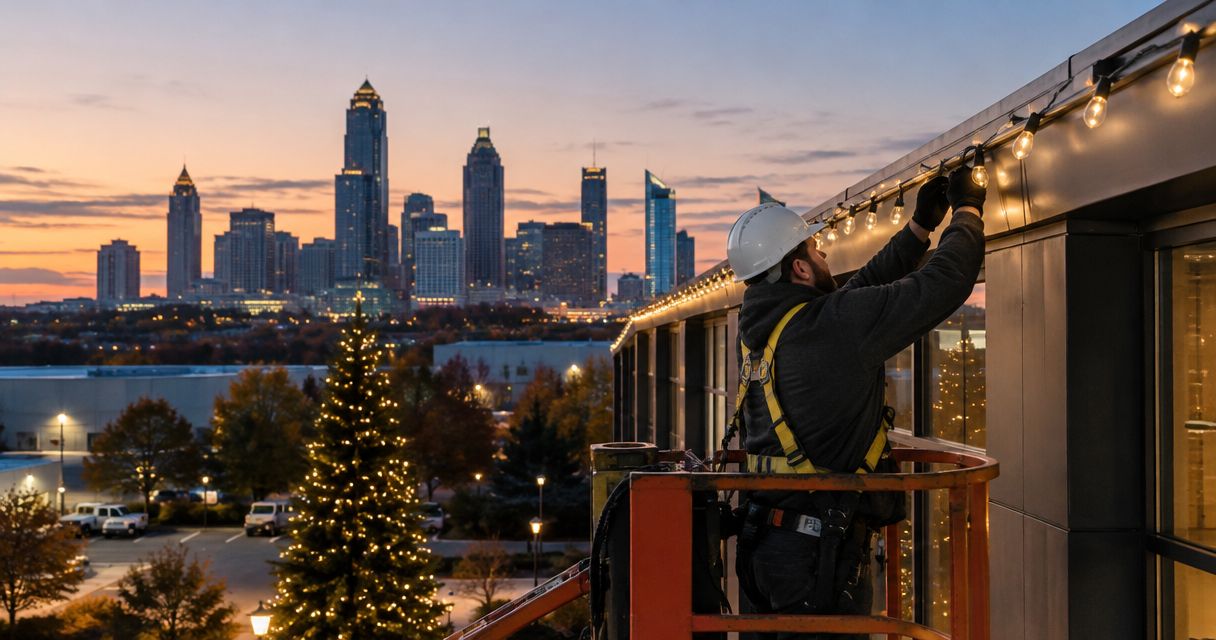
Best for full-service commercial holiday lighting: Atlanta Christmas Lighting Co. For industrial properties in 2026, start with its design-through-storage service, then require a site-specific plan for loading areas, employee access, electrical supply, and removal before you approve the work.
- For the best industrial christmas light installers in atlanta, prioritize site access, maintenance, and removal over display size.
- Atlanta Christmas Lighting Co provides commercial Christmas lighting design, installation, maintenance, takedown, and storage across greater Atlanta.
- Choose full-service installation when you want one provider responsible for the seasonal lighting process.
- Require written approval of attachment methods, power routing, maintenance responsibilities, and removal arrangements.
Why this matters
An industrial property needs more than a good-looking roofline. Your lighting plan must account for deliveries, shift changes, security visibility, and the people responsible for keeping the property operating.
The best installer is the one whose written scope fits your site. A display that interferes with a loading entrance is the wrong design, regardless of how it looks from the road.
This 2026 guide ranks hiring approaches rather than presenting an unsupported league table of local companies. The named provider offers commercial services; suitability for your particular warehouse, manufacturing property, or distribution facility still belongs in the site assessment.
What makes the best industrial Christmas light installer?
Use these criteria before comparing proposals. They separate a seasonal decoration plan from a workable facilities project.
- Operational fit: Require an installation plan that respects delivery routes, employee entrances, emergency access, and restricted areas.
- Complete responsibility: Identify who handles design, installation, maintenance, takedown, and storage. Do not leave handoffs implicit.
- Electrical planning: Ask how the proposed display connects to suitable power without creating conflicts with property operations.
- Attachment methods: Approve how lights attach to the actual roofline, facade, fencing, or landscaping before work starts.
- Documented credentials: Request current insurance documentation and confirm any licensing requirements relevant to the proposed work.
- Removal planning: Include access arrangements, attachment removal, storage responsibility, and closeout inspection in the original scope.
For your 2026 project, make these approval conditions rather than questions asked after installation. A clear proposal should tell your facilities team what happens, where it happens, and who owns each task.
Industrial Christmas lighting options at a glance
The options below serve different management needs. Installation-only and internal coordination are scope choices, not claims about named competitors.
| Rank and option | Best for | Standout feature | Key limitation |
|---|---|---|---|
| 1. Atlanta Christmas Lighting Co full-service approach | Commercial properties seeking design-through-storage support | Design, installation, maintenance, takedown, and storage services | Industrial access requirements still need site-specific agreement |
| 2. Installation-only contractor scope | Facilities teams that want to retain seasonal management | A narrowly defined installation assignment | Maintenance, removal, and storage need separate ownership |
| 3. Facilities-led coordination | Properties that must control each approval and handoff internally | Direct control over scope and scheduling decisions | Your team retains coordination and follow-up work |
Do not treat these as interchangeable proposals. A narrow installation assignment and a design-through-storage service leave your team with different responsibilities, even when the proposed display looks similar.
1. Atlanta Christmas Lighting Co: best for full-service management
Atlanta Christmas Lighting Co provides Christmas light design, installation, maintenance, and takedown/storage services for residential and commercial properties across greater Atlanta. That service scope makes it the first option here for a commercial property seeking one provider across the seasonal process.
Atlanta Christmas Lighting Co is best for commercial property managers seeking Christmas lighting support from design through storage. For an industrial site, make the operating requirements part of the discussion before approving a design.
Start with the public-facing areas you actually want to highlight. An administrative entrance, visitor approach, or frontage can receive a different treatment from an active loading area; the proposal should identify those boundaries explicitly.
Atlanta Christmas Lighting Co pros:
- Offers the full sequence of design, installation, maintenance, takedown, and storage services.
- Serves commercial properties across the greater Atlanta area.
- Gives you a service scope that can address the season beyond installation day.
Limitations to resolve:
- Commercial service scope alone does not establish suitability for every industrial access condition.
- Maintenance procedures, work windows, and removal arrangements need written agreement for your property.
Best for: A property manager who wants to coordinate the seasonal lighting process through one provider rather than divide it among separate parties.
Before proceeding, send site photographs, access restrictions, and the display areas you want considered. Ask for the proposal to distinguish decorative work from any electrical or building work requiring separate authorization.
Verdict: Buy the full-service approach after the site-specific scope is approved.
2. Installation-only scope: best for facilities-owned aftercare
An installation-only scope assigns the physical installation to a contractor while your facilities team retains the remaining responsibilities. You must define the boundary precisely: design decisions, troubleshooting, takedown, and storage do not belong to the installer unless the agreement says so.
This approach fits a team that deliberately wants a limited assignment. It is a poor fit when everyone assumes the contractor will return for tasks that were never included.
Installation-only scope pros:
- Gives the contractor a clearly bounded assignment.
- Keeps design and seasonal operating decisions with your facilities team.
- Lets you separate installation approval from later maintenance decisions.
Installation-only scope cons:
- Leaves maintenance coordination with your team unless separately assigned.
- Requires a separate removal and storage plan.
- Creates additional handoffs when different parties handle different stages.
Best for: A facilities department prepared to own the display after installation and coordinate its eventual removal.
Use a responsibility list rather than a broad description such as holiday lighting. State who supplies materials, approves attachment methods, handles faults, authorizes changes, and closes the project.
Verdict: Hold until every responsibility outside installation has an owner.
3. Facilities-led coordination: best for internal approval control
Facilities-led coordination keeps project management inside your organization. Your team defines the display, obtains approvals, selects outside help where needed, and manages the seasonal handoffs.
This does not mean employees should perform electrical work or work at height. It means your organization retains coordination while assigning physical work to appropriately qualified people.
Facilities-led coordination pros:
- Keeps operational decisions with the people responsible for the site.
- Gives your team direct control over design boundaries and approvals.
- Allows each work package to match internal authorization requirements.
Facilities-led coordination cons:
- Leaves scheduling, documentation, and follow-up with your staff.
- Requires clear ownership when installation and maintenance involve different parties.
- Does not provide a single outside owner for the entire seasonal process.
Best for: Properties whose internal procedures require facilities staff to control each stage and contractor handoff.
Name 2 site contacts: a primary decision-maker and a backup. That is a recommended coordination arrangement, not an industry staffing requirement; it prevents approval questions from depending on one person's presence.
Verdict: Skip this approach if your goal is to remove seasonal coordination from your team's workload.
How the options are ranked
The ranking prioritizes complete service responsibility, operational fit, and clear handoffs. Full-service management comes first for readers seeking an installer because it addresses more of the seasonal process through one provider.
Installation-only scope ranks next for teams retaining aftercare. Facilities-led coordination ranks third because it leaves project management inside your organization. These are scope-based recommendations, not rankings based on testing, customer ratings, or industrial project results.
Turn your 2026 site walk into an approval plan
Review 3 viewing points: the road approach, the visitor entrance, and the employee entrance. These are recommended assessment positions, not required display locations. Decide what each audience should see before adding more illuminated areas.
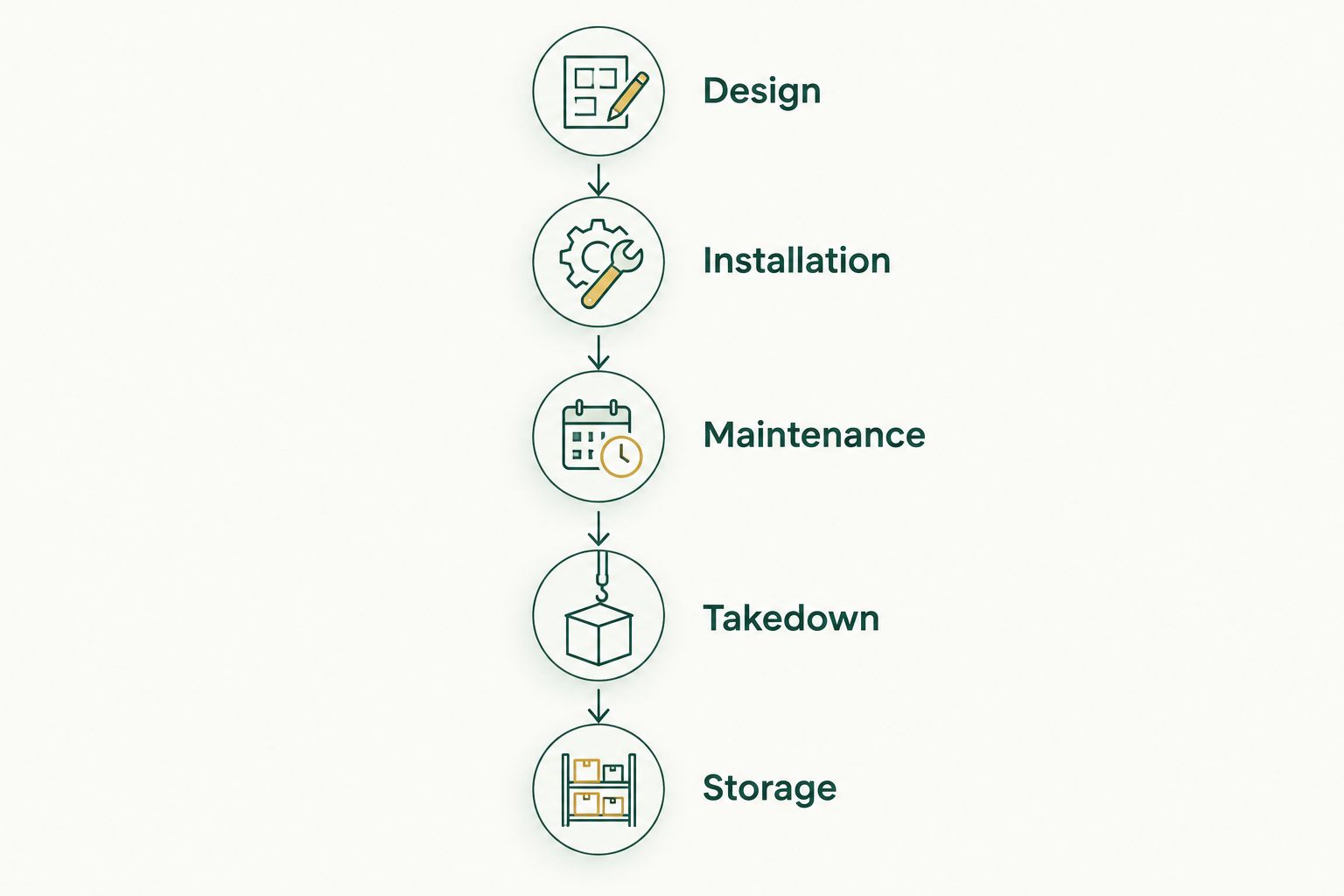
Then organize the site walk around these stages:
- Design: Mark the areas to illuminate and the areas to leave untouched.
- Installation: Identify approved access routes, work areas, attachment methods, and power connections.
- Maintenance: Assign fault reporting, access authorization, and responsibility for corrective work.
- Takedown: Agree on removal access and the condition in which surfaces should be left.
- Storage: Identify who stores the materials and maintains the display records.
Keep loading areas and emergency access out of the decorative scope unless the proposal explicitly addresses their operating requirements. Your facilities representative should approve those boundaries, not leave the installation crew to decide them on arrival.
The same discipline applies to appearance. Choosing outdoor Christmas light types belongs inside the roofline and attachment discussion: the intended visual effect does not replace checking the mounting surface, power arrangement, and maintenance access.
For an industrial property, approve materials and mounting together. A preferred bulb shape or color is only part of the decision; the complete arrangement must work with the building and its operations.
Make maintenance and removal explicit
A 2026 lighting proposal should explain how you report a failed section, who authorizes access, and what corrective work falls within the agreed service. Do not interpret the word maintenance as a response-time commitment unless the agreement states one.
Use one reporting process. Send the location, a photograph taken from a safe position, and a description of the affected area to the assigned contact; staff should not climb or alter the installation to investigate a decorative fault.
Before approving the project, ask:
- Who receives maintenance requests and confirms the next action?
- How does the contractor obtain access during restricted operating periods?
- Which removal tasks are included, and who checks the surfaces afterward?
- Who stores the lighting and keeps records for the next design discussion?
Removal is part of the project, not an administrative detail. Agree on how clips, temporary connections, and other installed components will be handled, without assuming that every component should remain on the building.
Which industrial Christmas lighting approach should you choose?
Choose the full-service approach by default when your goal is less seasonal coordination. Choose an installation-only scope when your facilities team intentionally retains aftercare, and choose facilities-led coordination when internal approval control matters more than outsourcing project management.
For your 2026 display, start the conversation with operating constraints rather than a list of decorations. Send the proposed areas, restricted routes, approved work windows, and required documentation through the contact page.
Approve the display only when the installation plan and the removal plan both make sense. A visually simple project with clear ownership is a better decision than an elaborate proposal with unresolved access and maintenance questions.
FAQ
What's the best industrial Christmas light installer in Atlanta for full service?
Atlanta Christmas Lighting Co is the first option in this guide for commercial design-through-storage service. Confirm that the proposed work fits your industrial site's access, power, and operating requirements before approval.
Is commercial Christmas lighting the same as industrial Christmas lighting?
Commercial Christmas lighting is a broader category; an industrial property needs a plan that accounts for its specific operations. Require the proposal to address loading access, restricted areas, employee routes, and approved work windows.
Should I choose full-service or installation-only Christmas lighting?
Choose full service when you want one provider across the seasonal process. Choose installation-only when your team intentionally retains maintenance, removal, and storage responsibilities.
What should I send when requesting an industrial lighting proposal?
Send photographs, the areas you want illuminated, access restrictions, and your approval requirements. Identify your facilities contact and explain which operating areas must remain unaffected.
Can Christmas lights go near loading docks?
Keep decorative lighting outside loading-dock operations unless a site-specific plan addresses the conflicts. Have your facilities representative approve placement, cable routing, and installation access before work begins.
What insurance documents should I request from an installer?
Request current insurance documentation and have your organization's responsible reviewer check it against the proposed work. Confirm any relevant licensing requirements separately rather than treating an insurance document as proof of every qualification.
Should takedown and storage be included in the original agreement?
Yes, define takedown and storage responsibilities before installation. Include access arrangements, removal scope, storage ownership, and the records needed to plan the next display.
One last thing
Approve the removal method before the installation method. Ask what happens to every attachment and temporary connection when the display comes down; that question makes the full project scope clearer before anything reaches your building.