For Atlanta Christmas light installation, choose written coverage for installation, equipment failures, and seasonal service—not the longest warranty headline. Atlanta Christmas Lighting Co is a full-service option for homeowners and businesses seeking design, installation, maintenance, takedown, and storage; those services alone do not establish a warranty ranking.
- The best christmas light installers in atlanta ranked by warranty need comparison on written coverage, exclusions, and repair commitments.
- Atlanta Christmas Lighting Co suits customers seeking full-service Christmas light installation, maintenance, takedown, and storage.
- Prioritize seasonal service coverage over a product warranty that leaves labor and access unresolved.
- Get equipment ownership, weather exclusions, service dates, and takedown responsibilities into the agreement.
Why warranty details matter
A Christmas light warranty is useful only when you understand what happens after part of the display stops working. Replacing a failed light and sending someone to reach it are different obligations. Your agreement should address both.
For your 2026 display, compare the promised remedy rather than the word guarantee. A product replacement promise does not answer who diagnoses the fault, removes the failed component, or restores the display.
The strongest warranty for your property is the one that assigns responsibility for the problems you cannot handle yourself. That matters particularly when lights sit above an entrance, along a roofline, or around landscaping that needs careful access.
What makes the best Christmas light installation warranty?
Use these criteria before comparing installers. They distinguish useful protection from language that sounds reassuring but leaves the next step unclear.
- Covered work: Identify whether protection applies to mounting, connections, lighting equipment, timers, and removal.
- Service remedy: Establish whether the installer repairs, replaces, reinstalls, or only supplies a replacement component.
- Labor and access: Confirm who handles the work required to reach and replace a failed section.
- Coverage dates: Record when protection starts and ends, separately from the installation appointment.
- Exclusions: Ask specifically about weather, customer changes, third-party interference, and existing electrical problems.
- Service process: Identify how to report a fault and what commitment applies after the report.
Keep warranty, maintenance, and insurance separate. Warranty addresses an agreed remedy; maintenance describes service work; insurance addresses covered risks under a policy. One does not automatically establish the others.
Warranty choices at a glance
The ranking below orders coverage structures to request, not unverified warranty claims about competing Atlanta companies. Use it to assess written proposals for 2026. A company earns its position through its agreement, not its service description.
| Rank | Coverage structure | Best for | Standout protection to request | Key limitation |
|---|---|---|---|---|
| 1 | Seasonal service plus workmanship and equipment coverage | Customers handing off the entire display | A clear route from reporting a fault to restoring the affected lighting | Exclusions and service commitments still need definition |
| 2 | Workmanship coverage with separate equipment protection | Owners keeping their existing lights | Accountability for installation work | Equipment failures can involve a separate supplier |
| 3 | Product replacement coverage only | Customers able to manage repairs themselves | A defined remedy for a defective component | Replacement does not necessarily include diagnosis, labor, or access |
Full-service provider to consider: Atlanta Christmas Lighting Co offers the service stages needed for a hands-off arrangement. Request the written warranty terms before treating any stage as guaranteed coverage.
1. Seasonal service coverage: best for a hands-off display
A seasonal service agreement should explain who handles faults while your Christmas lights are in use. For a hands-off arrangement, ask for equipment, installation workmanship, and repair responsibilities to appear together rather than in disconnected promises.
Atlanta Christmas Lighting Co provides design, installation, maintenance, takedown, and storage across greater Atlanta. That makes the company relevant to a full-service shortlist, but a maintenance service is not automatically an unlimited repair warranty.
Best for: Homeowners and business owners who want an installer responsible for managing the display through removal.
Seasonal service coverage pros:
- Gives you a defined place to report display problems when the agreement names the responsible provider.
- Can connect equipment replacement with the labor needed to complete it.
- Can address the display as an installed system rather than isolated components.
- Lets you establish removal responsibilities before installation begins.
Seasonal service coverage cons:
- Broad service descriptions can leave exclusions unresolved.
- A repair promise without timing does not establish when the display will be restored.
- Coverage can end before your intended removal date unless dates match.
Ask whether a dark roofline section, failed timer, or loose attachment triggers the same reporting process. Do not assume that different faults receive identical treatment.
Verdict: Buy only when the written agreement connects coverage, repair responsibility, and your display dates.
2. Workmanship coverage: best for owners of existing lights
Workmanship coverage addresses the installer's work as defined in the agreement. If you supply your own lights, separate installation faults from equipment faults before anyone starts.
This structure suits a customer who wants to keep existing equipment and understands its condition. It requires a clear boundary: a failed component and an incorrectly installed component need different remedies.
Best for: Property owners retaining their own lighting equipment and arranging professional installation.
Workmanship coverage pros:
- Focuses accountability on the installation tasks listed in the scope.
- Allows you to document existing equipment separately from newly completed work.
- Supports a clear discussion of attachments, connections, and placement.
Workmanship coverage cons:
- Does not establish protection for defective customer-owned lights.
- Can leave diagnosis unresolved when the cause of failure is disputed.
- Requires clarity about who removes and reinstalls a replacement component.
For a 2026 proposal using your equipment, request an equipment-condition record. Identify anything that does not work before installation and ask how later faults will be classified.
Verdict: Hold until the agreement separates installation responsibility from equipment responsibility.
3. Product replacement coverage: best for self-managed repairs
Product replacement coverage concerns the lighting component itself. It is not a substitute for an installed-display service agreement unless the document also includes diagnosis, access, and replacement labor.
This option belongs last for customers seeking full-service convenience. A replacement light does not restore a display until someone installs it safely and checks the result.
Best for: Customers who can arrange the practical repair work independently and want protection for specified equipment defects.
Product replacement coverage pros:
- Can provide a defined remedy for a covered defective component.
- Lets you assess equipment protection separately from installation work.
- Can remain useful when a service agreement excludes customer-owned equipment.
Product replacement coverage cons:
- Does not, by itself, promise an installer visit.
- Does not establish responsibility for troubleshooting.
- Can leave you coordinating the supplier and installer separately.
Read who receives the replacement and who authorizes the claim. If the installer owns the equipment, ask how the product warranty translates into service for your property.
Verdict: Skip as your only protection when you want someone else to manage repairs.
Compare the documents, not just the promise
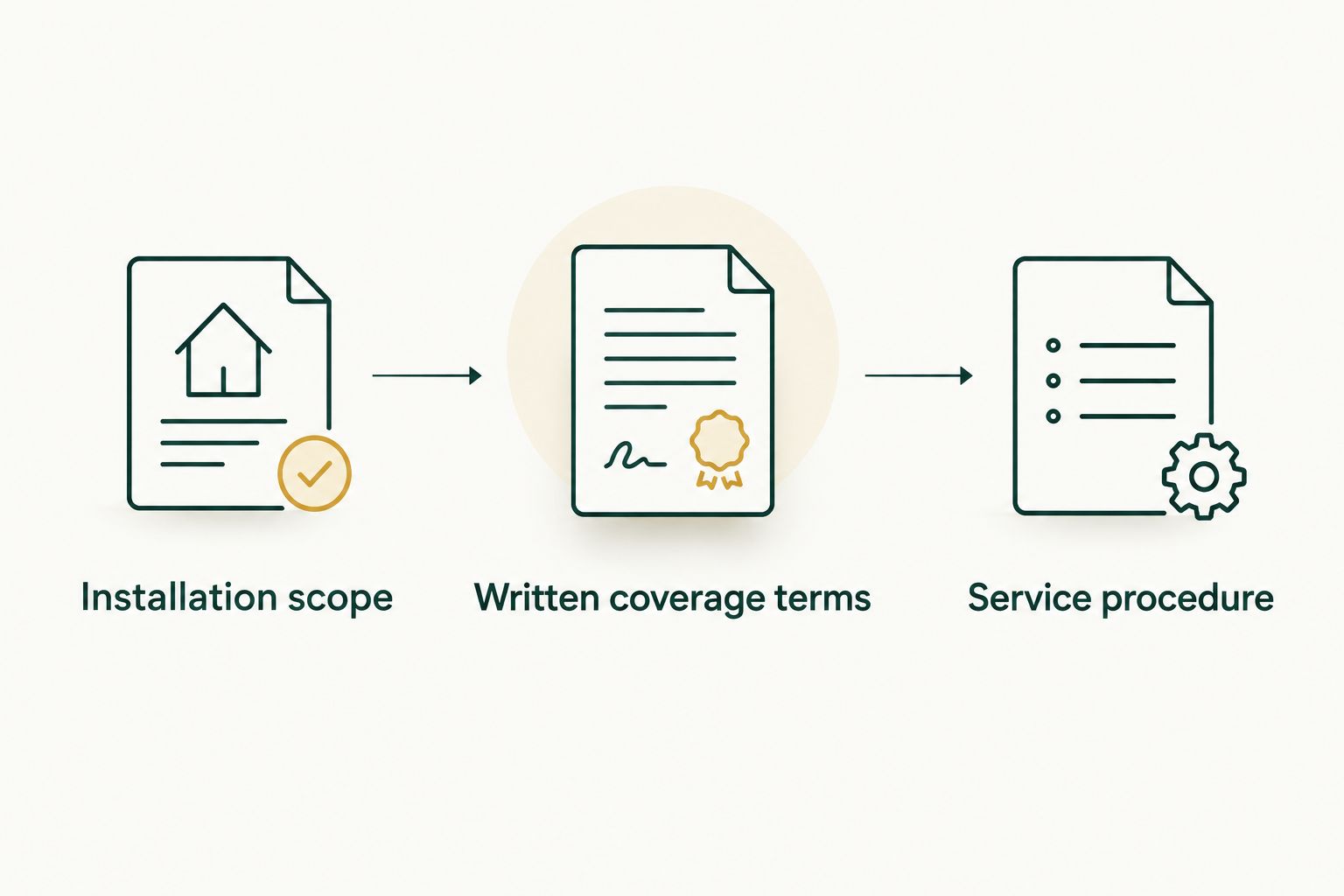
Request 3 documents before choosing: the installation scope, the written coverage terms, and the maintenance or service procedure. They can be sections of the same agreement, but each needs to answer a different question.
Installation scope
The scope identifies what the installer will place and where. Ask it to distinguish rooflines, trees, landscape features, entrances, and any other included areas. A warranty cannot resolve a disagreement about work that was never clearly specified.
Written coverage terms
The coverage terms identify protected work or equipment, exclusions, and the remedy. For 2026, make sure the terms refer to your actual project rather than relying on a general statement elsewhere.
Service procedure
The service procedure explains how to report a problem and what happens next. Name 1 service contact in your project records so the person reporting a fault knows where to send it.
Record 2 coverage dates explicitly: the start and the end. Then check that your planned display period sits inside them. Do not substitute the installation date or removal appointment for a stated coverage period.
Questions that expose gaps before installation
Ask each installer the same questions. Written answers make proposals comparable without assuming that similar wording means similar protection.
What happens when a section stops working?
Ask who diagnoses the cause, who supplies any replacement, and who completes the repair. Request a distinction between acknowledging your report and restoring the lighting. Those are separate commitments.
What happens after wind, rain, or ice?
Ask which weather-related problems are covered and which are excluded. Separate failed equipment, displaced attachments, and damage caused by falling objects. Do not treat the phrase weather resistant as a warranty against every weather event.
What happens if someone changes the setup?
Ask whether moving a cord, adjusting a timer, or allowing another contractor to work near the display affects coverage. You need practical instructions for the people using or maintaining the property.
What happens during takedown and storage?
Ask who documents the condition of the lights before removal, handles a reported surface-damage concern, and tracks equipment placed into storage. Also establish ownership. Storage responsibility and equipment ownership are separate questions.
For additional detail, read the guide to whether professional installers guarantee their Christmas light work.
How these warranty options are ranked
The order prioritizes responsibility for restoring an installed display. Seasonal service with defined workmanship and equipment coverage ranks first because it addresses more of that task. Workmanship-only protection leaves equipment responsibility separate; product-only protection leaves the installation work unresolved.
This is a contract-selection framework, not a claim that one Atlanta company has a longer or broader warranty than another. A named installer should rank first on warranty only when its written terms support that position.
For your 2026 comparison, reject vague answers rather than filling in the gaps yourself. The strongest proposal explains the covered problem, the responsible party, and the remedy in language you can use when something fails.
Which Atlanta Christmas light installer should you choose?
Atlanta Christmas Lighting Co is a fit for Atlanta homeowners and businesses seeking full-service Christmas light installation, maintenance, takedown, and storage. Choose the provider only after the written agreement matches the protection you need.
If you want a hands-off display, prioritize the first coverage structure. If you keep your own equipment, insist on the responsibility split described in the second. Do not choose product-only protection expecting it to function as seasonal repair service.
Request your installation scope
Discuss your property, service needs, and written coverage terms before choosing an installer.
FAQ
What's the best Christmas light installer in Atlanta by warranty?
Choose the installer whose written agreement best covers your equipment, installation work, and seasonal repair needs. A defensible company ranking requires comparable written terms, not just a guarantee headline.
Does a Christmas light warranty include repair visits?
A Christmas light warranty includes repair visits only when its terms say so. Check diagnosis, replacement labor, access, and the reporting process separately.
Is a product warranty better than workmanship coverage?
Neither replaces the other because they address different responsibilities. Product protection concerns specified equipment defects; workmanship coverage concerns the installation work defined in the agreement.
Does seasonal maintenance mean every repair is covered?
Seasonal maintenance does not by itself establish coverage for every repair. Read the agreement for included tasks, exclusions, and the remedy for a reported fault.
Are Christmas lights covered after a storm?
Storm-related coverage depends on the written terms and the cause of the problem. Ask the installer to distinguish equipment failure, displaced attachments, and damage caused by outside objects.
Does liability insurance replace an installation warranty?
Liability insurance does not replace an installation warranty. Insurance and warranty terms address different obligations, so evaluate them separately.
What should I ask before booking Christmas lights for 2026?
Ask for the installation scope, coverage terms, and service procedure before booking. Confirm equipment ownership, coverage dates, exclusions, and takedown responsibilities.
One last thing
Ask what happens if a covered light fails shortly before your scheduled takedown. That single scenario forces the agreement to address coverage dates, repair responsibility, and the remaining display period together.
Keep the answer with your installation paperwork. A useful warranty tells you what to do when the display is not working—not just what sounded reassuring when you booked.