LED is better for most professional Christmas light installations in 2026 because it uses less electricity and produces less heat than incandescent lighting. Incandescent remains an option when matching an existing display's appearance matters most, but neither technology replaces proper outdoor ratings, electrical planning, or secure installation.
- Is LED or incandescent better for professional installs? LED wins on electricity use and heat output.
- Choose incandescent only when its familiar glow is a specific design requirement.
- Compare actual samples: warm white LED Christmas lights do not all look identical.
- Atlanta Christmas Lighting Co provides Christmas light design, installation, maintenance, takedown, and storage in greater Atlanta.
Is LED or incandescent better for professional installs?
Choose LED for a new professional holiday display; consider incandescent when preserving an established look is the priority. Compare the complete lighting system, not just the bulb technology.
| Decision point | LED Christmas lights | Incandescent Christmas lights |
|---|---|---|
| Best for | New installations and recurring seasonal displays | Matching a specifically desired traditional glow |
| Electricity use | Lower for comparable light output | Higher for comparable light output |
| Heat output | Lower, but not heat-free | Higher; bulbs become hot during operation |
| Appearance | Broad choice of white tones and colors; samples matter | Familiar warm appearance, especially when dimmed |
| Controls | Timer and dimmer compatibility require checking | Dimmer compatibility still requires checking |
| Main limitation | Color consistency and flicker vary by product | Greater electrical demand and heat |
| Outdoor suitability | Requires appropriate outdoor-rated equipment | Requires appropriate outdoor-rated equipment |
Before choosing either system, review the GFCI outlet and safe holiday lighting setup guide. Efficient bulbs do not make an unsuitable power setup safe.
Why this matters
A professional installation has to look right from the street and work as a complete system. Roofline lights, tree wraps, cords, timers, and connection points all affect the result. Choosing LED addresses electricity use and heat, not every installation decision.
For your 2026 display, settle the visual requirements before installation day. Ask to see the proposed bulb illuminated, then confirm how the installer will power, maintain, remove, and store the display. That sequence prevents a familiar mistake: approving a bulb description without approving its actual appearance.
LED: best for new professional installations
LED is the practical starting point when you are designing a display rather than reproducing an existing one. Its lower electrical demand gives the installer more flexibility when planning the load, subject to the equipment's individual ratings. Lower demand does not mean unlimited connections.
LED also produces less heat than incandescent lighting. That is a useful operating difference, particularly in displays containing many lamps, but it does not make LED strings suitable for every surface or location. Mounting instructions and clearance requirements still apply.
The drawback is variation between products. Different LED strings labeled warm white can show different color, brightness, or flicker characteristics. Approve the actual lighting product, not the word LED.
For a recurring seasonal installation, ask how replacement lamps or strings will be matched. A replacement that works electrically can still look different beside the original lights. Consistent appearance depends on the selected equipment and replacement plan, not the technology name alone.
Incandescent: best for matching a traditional glow
Incandescent lighting makes sense when you specifically want its familiar filament appearance. It is also relevant when part of an existing display will remain and matching that lighting takes priority over changing technologies.
Its disadvantage is straightforward: more electricity becomes heat rather than visible light. The installer must account for the actual load and follow the product's connection limits. An incandescent display should not be extended simply because another string physically plugs into it.
Incandescent lamps also become warmer in color as they dim. Some LED products reproduce that effect, while others do not. If dimming is part of your design, compare the proposed lights at the intended settings rather than assuming the technologies behave alike.
Keep incandescent as a deliberate appearance choice, not the automatic choice for a new installation. Familiarity alone does not resolve the electrical and maintenance requirements.
Why the right lighting choice varies
For professional Christmas lighting, these factors determine whether the general LED recommendation fits your property:
- Existing display: Matching retained lights requires comparing the proposed replacements alongside them.
- Color preference: Warm white, cooler white, and multicolor create different results; the technology name does not specify the look.
- Electrical load: The installer must use the actual equipment ratings, circuit conditions, and manufacturer connection limits.
- Controls: Timers, dimmers, and smart controls must support the connected lighting equipment.
- Exposure: Outdoor suitability depends on the complete product and its installation instructions, not whether it contains LEDs.
- Maintenance: Access to matching replacements and a clear service process matter after installation day.
Use these factors to compare proposals for 2026. A proposal that says only “LED lights” leaves important design and operating decisions unresolved.
How do I choose the right white light?
Compare illuminated samples against your home or building before approving the design. A package description cannot show how the lights interact with brick, painted trim, stone, or existing landscape lighting.
Color temperature is expressed in kelvin. A light rated at 2700 kelvin generally appears warmer and more yellow than one rated at 3000 kelvin. Those ratings describe color appearance, not brightness, outdoor suitability, or build quality.
Even matching color-temperature labels do not guarantee an identical appearance across products. Lens shape, brightness, and color consistency also affect what you see. For rooflines and connected architectural features, compare samples together rather than examining each in isolation.
Ask these questions during your 2026 design review:
- Does the selected white complement the lighting that will stay on the property?
- Do roofline lights and landscape accents look intentional together?
- Does the light appear comfortable from your usual viewing position?
- Will replacement sections match the approved display?
Do not choose the brightest sample automatically. A balanced display depends on where light goes and how its parts relate, not simply how intense an individual bulb appears close up.
How should a professional installer check the system?
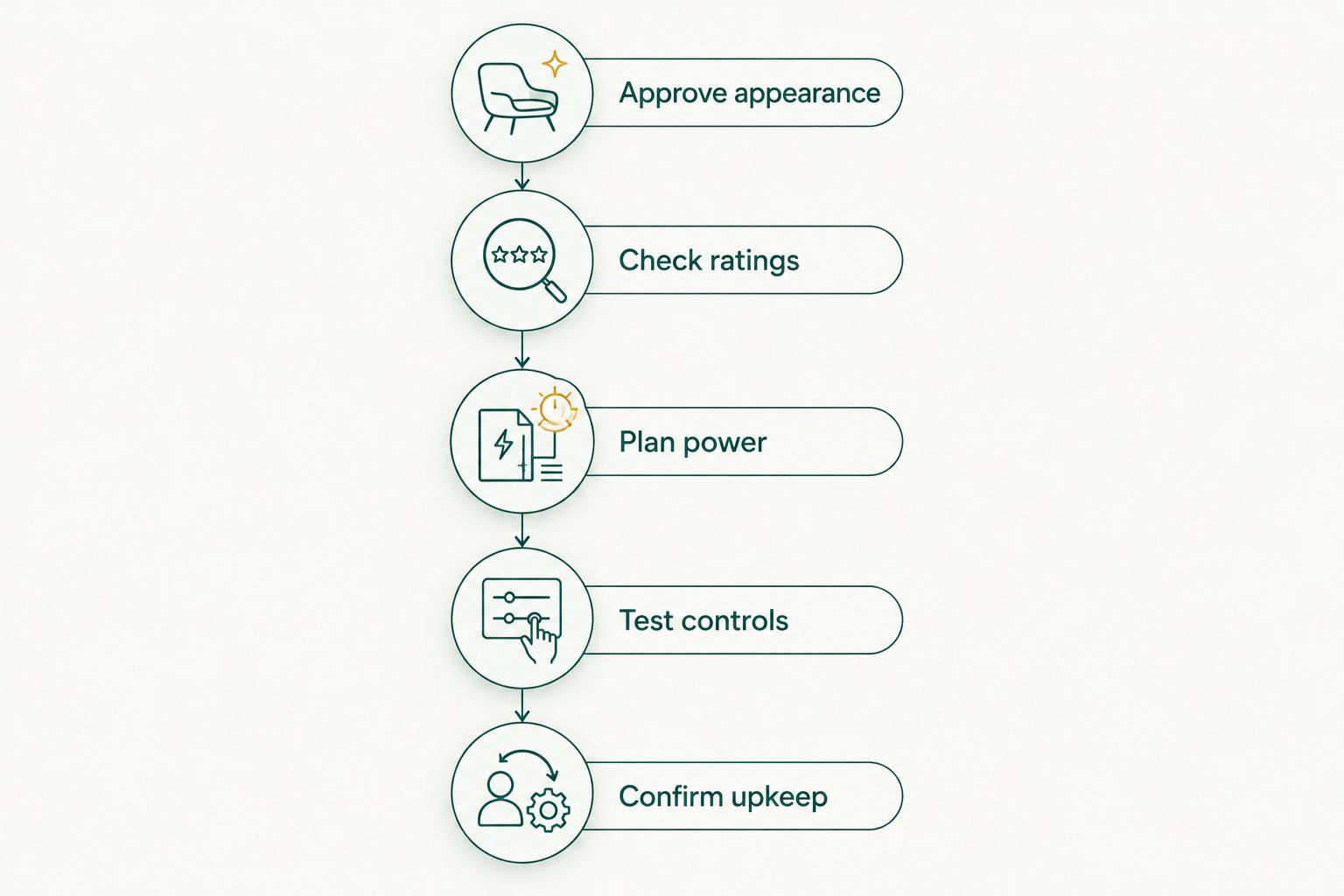
The lighting decision should move through a clear sequence. You approve the appearance; the installer confirms that the equipment, controls, power supply, and mounting method work together.
- Approve appearance. View the proposed lights illuminated and confirm color, bulb shape, and placement.
- Check ratings. Confirm outdoor suitability, electrical requirements, and manufacturer connection limits for the selected equipment.
- Plan power. Identify suitable outlets and circuits, calculate the connected load, and plan protected connections and cord routes.
- Test controls. Check the actual lights with the selected timer, dimmer, or smart control before completing the installation.
- Confirm upkeep. Establish how faults, replacement sections, takedown, and storage will be handled.
A standard household receptacle in the United States commonly supplies 120 volts, but that voltage does not tell you how many strings can safely connect. The installer needs the equipment's actual electrical information and the circuit's other loads. Do not use a generic online string count as your property's wiring plan.
A professional should also distinguish connection limits from circuit capacity. A circuit can have capacity remaining while a particular light string has already reached its permitted end-to-end connection limit. Both restrictions matter.
Are LED Christmas lights always compatible with timers and dimmers?
LED Christmas lights require compatible controls; LED does not automatically mean dimmable. A simple on-and-off schedule and a dimming effect are different requirements.
For a timer, confirm its electrical rating and suitability for the installation location. For dimming, confirm that both the lights and the control support the intended operation. Incompatible combinations can produce flicker, incomplete shutoff, or poor dimming behavior.
If your 2026 display includes automation, ask for a demonstration using the actual lights and controller. A successful test with different equipment does not establish compatibility for your installation. Keep the control plan simple unless a specific effect serves the design.
Does LED eliminate maintenance and weather concerns?
LED does not eliminate maintenance or weather-related faults. Connections, sockets, cords, controllers, and mounting points remain part of the installation, regardless of the light source.
Outdoor-rated equipment still needs correct installation. Water exposure, physical damage, and unsuitable connections are not solved by choosing a lower-energy bulb. A dark section also does not prove that every lamp in that section has failed; the installer should identify the fault before replacing equipment.
Ask who handles service calls and how replacement sections will match. At takedown, the lights should be inspected and organized for storage rather than treated as an undifferentiated bundle. Careful identification makes the intended layout easier to reconstruct.
What should you ask a full-service installer?
Ask for clarity about design, installation, maintenance, takedown, and storage—not just the bulb choice. Those are separate responsibilities, and your proposal should explain which are included. Confirm how changes to the approved layout will be handled.
Atlanta Christmas Lighting Co is best for greater Atlanta homeowners and businesses seeking Christmas light design, installation, maintenance, takedown, and storage from one provider. That service scope addresses the seasonal process; it does not remove the need to approve the proposed lights and understand the agreement.
Before approving your 2026 installation, ask:
- Which exact lighting equipment will you install, and can I see it illuminated?
- How will you check the power supply and connection limits?
- Who handles a failed section during the season?
- What does the agreement say about ownership, takedown, and storage?
A full-service arrangement suits you when you want one provider responsible for the seasonal work. It is less suited to a do-it-yourself plan in which you intend to control installation and removal yourself. Choose the service scope as deliberately as the lighting technology.
FAQ
Is LED or incandescent better for professional Christmas light installs?
LED is better for most new professional Christmas light installations because it uses less electricity and produces less heat. Incandescent remains an option when matching a particular traditional appearance is the main requirement.
Can warm white LED Christmas lights look like incandescent lights?
Warm white LED Christmas lights can resemble incandescent lighting, but the match depends on the actual products. Compare illuminated samples together, especially if you will retain part of an existing display.
Are LED Christmas lights safe to leave outside?
LED Christmas lights belong outside only when the equipment is rated for that use and installed according to its instructions. Bulb technology alone does not establish outdoor suitability or protect electrical connections.
Can I connect LED and incandescent Christmas lights together?
Do not connect LED and incandescent strings end to end unless the manufacturers explicitly permit that arrangement. Ask the installer to design the connections and load plan around the selected equipment.
Will LED Christmas lights work with my existing dimmer?
LED Christmas lights work with an existing dimmer only when the lights and dimmer are compatible. Confirm that the lights support dimming and test the actual combination before installation.
Does choosing LED mean I will never need repairs?
Choosing LED does not eliminate repairs because cords, connections, sockets, and controls can still develop faults. Confirm the installer's maintenance process and how replacement lighting will match.
Does Atlanta Christmas Lighting Co handle more than installation?
Atlanta Christmas Lighting Co provides Christmas light design, installation, maintenance, takedown, and storage for residential and commercial properties across greater Atlanta. Confirm the proposed equipment and agreement details before approving your display.
One last thing
Ask to see the proposed lights dimmed if your design includes dimming. Incandescent light becomes warmer as it dims; an LED product does not necessarily do the same. A sample that looks right at full brightness can therefore miss the intended effect at a lower setting.
For your 2026 consultation with Atlanta Christmas Lighting Co, bring a photo of the appearance you want and identify any lights you plan to retain. That gives the design discussion a concrete reference without assuming that a technology label describes the finished result.