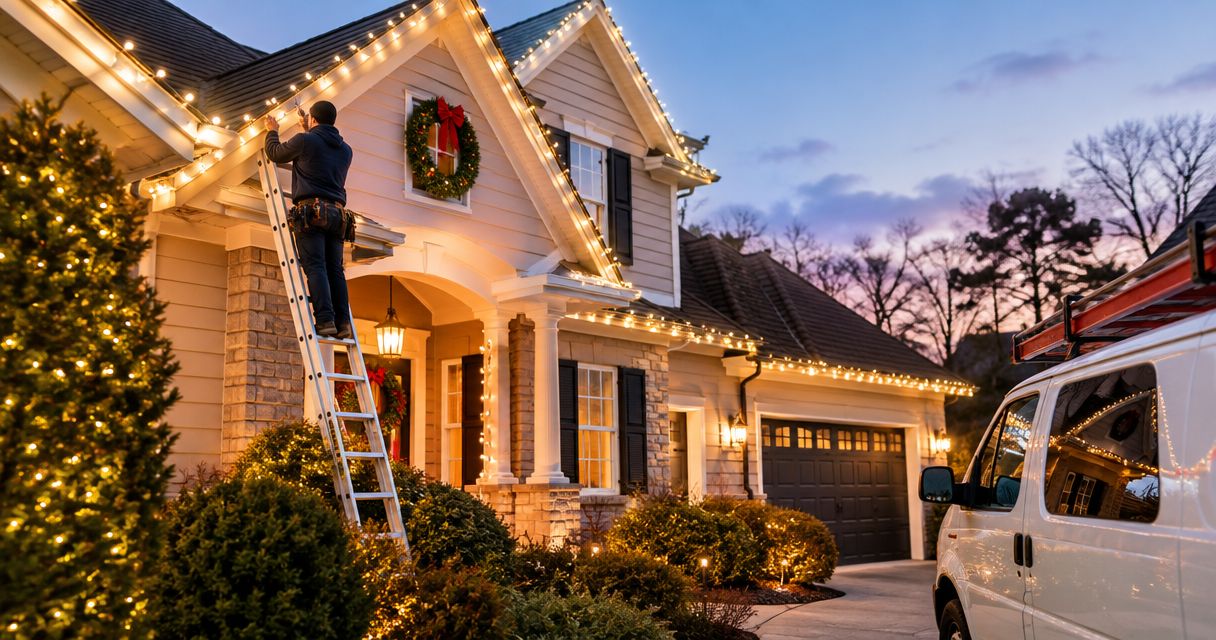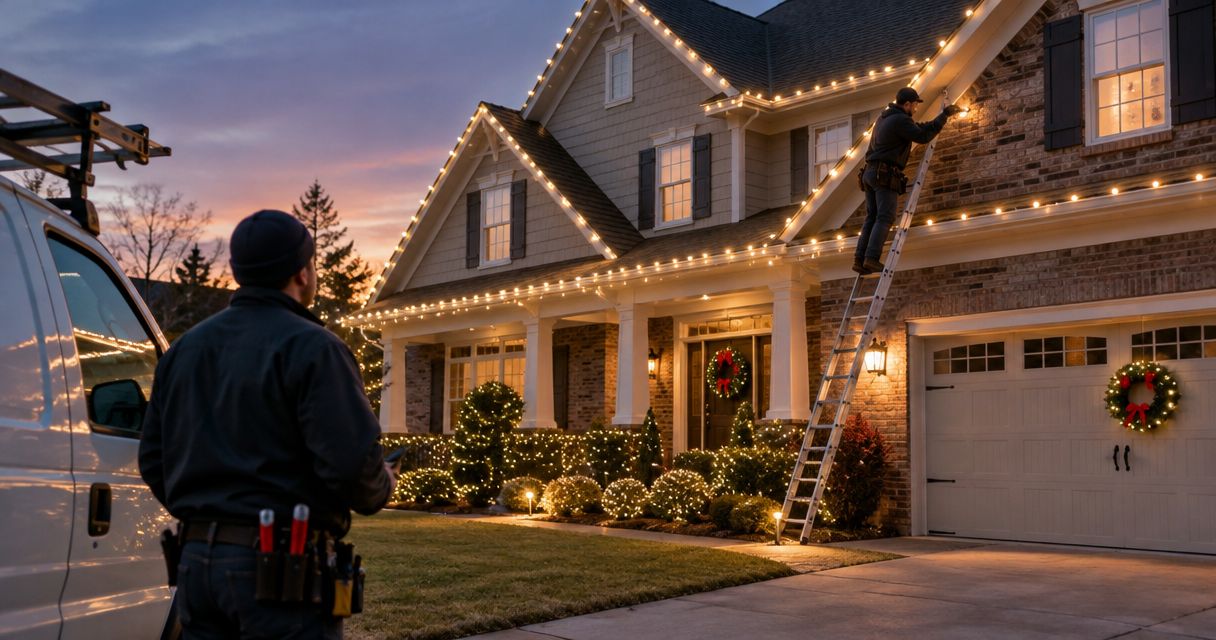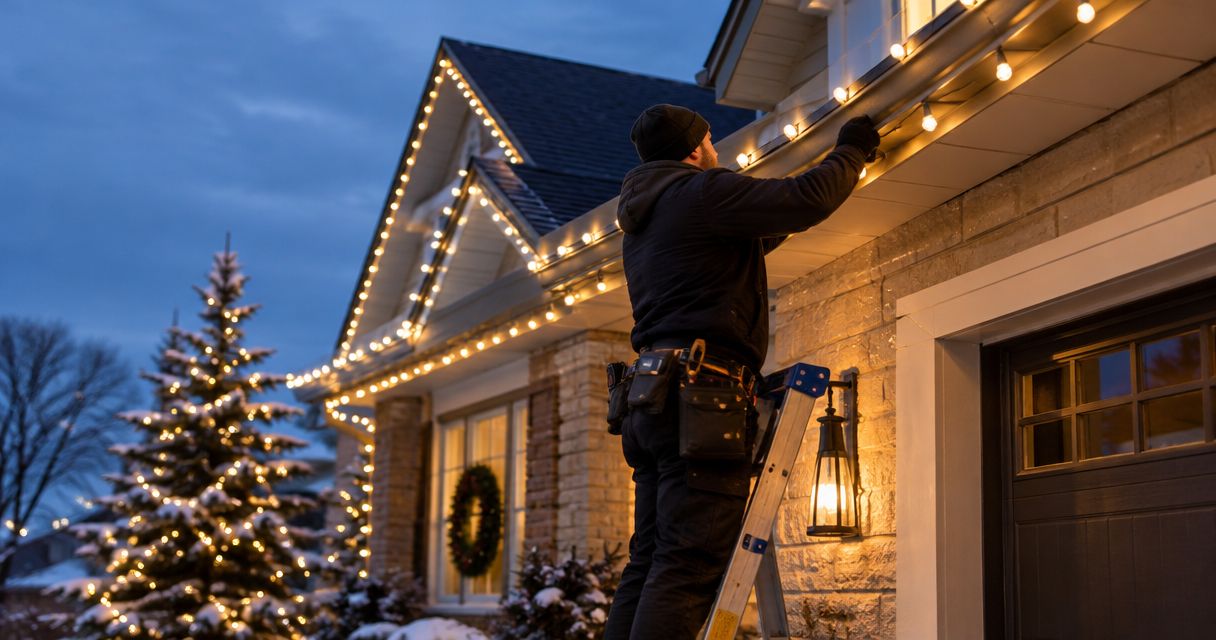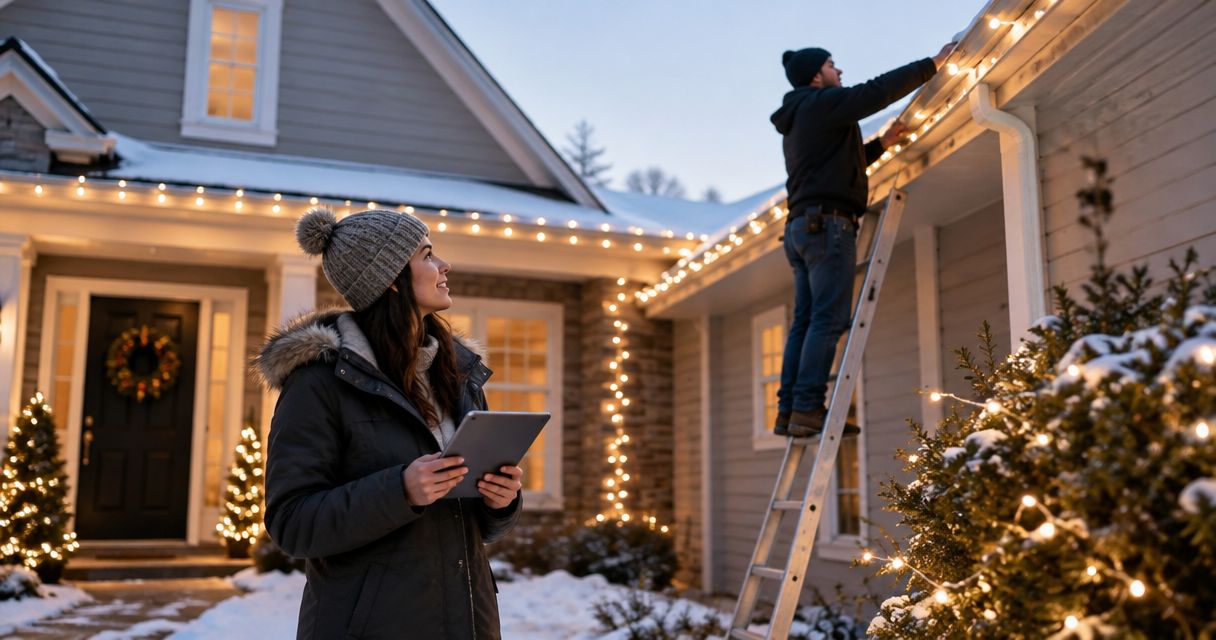
DIY Christmas lights eliminate paid installation labor, but they are not automatically cheaper than hiring a pro. For your 2026 display, compare the supplies and equipment you still need with a professional quote covering the same areas. Include maintenance, takedown, and storage before deciding: buying lights is only part of the job.
- Is it cheaper to install Christmas lights yourself or hire a pro? Compare matching scopes, not supplies against full-service quotes.
- DIY Christmas light installation suits manageable displays when you already own suitable equipment and can work safely.
- Atlanta Christmas Lighting Co provides professional Christmas light installation, maintenance, takedown, and storage across greater Atlanta.
- Confirm light ownership, maintenance responsibilities, and removal arrangements before choosing either approach.
Why this matters
A box of lights and a full-service installation quote do not purchase the same thing. DIY puts the planning, installation, troubleshooting, removal, and storage on you; professional service transfers the tasks specified in your agreement.
Atlanta Christmas Lighting Co provides Christmas light design, installation, maintenance, and takedown/storage for residential and commercial properties across greater Atlanta. Compare those services with the work you actually want to handle yourself, rather than treating installation day as the entire project.
Is it cheaper to install Christmas lights yourself or hire a pro?
DIY saves the installer’s labor charge; it does not remove the work or the equipment requirements. Whether that produces a lower total depends on what you already own, what you want illuminated, and which services the professional quote includes.
For a fair 2026 comparison, give both approaches the same design brief. A porch-only DIY display is not an equivalent alternative to a professionally installed roofline, trees, and entrance.
| Decision point | DIY installation | Professional installation |
|---|---|---|
| Best for | A manageable display you can install and remove safely | A display you want another party to design and service |
| Main advantage | You do not pay an installer for your own labor | You delegate the work listed in the agreement |
| Main drawback | You handle equipment, troubleshooting, and removal | You pay for services and must check the scope carefully |
| Materials | You choose, buy, inspect, and store them | Confirm who supplies and owns them |
| Maintenance | You diagnose and address problems | Confirm which repairs and visits are included |
| Takedown | You arrange the work yourself | Confirm removal is part of the agreement |
| Storage | You provide space and organization | Confirm whether storage is included and how it works |
The useful question is not simply which approach has the smaller initial payment. It is which approach covers your desired display without leaving work, equipment, or responsibilities out of the comparison.
DIY installation: best for a manageable display
DIY fits a homeowner who wants direct control over a modest design and is prepared to handle the entire season. Start with the lights, outdoor-rated accessories, attachment methods, and storage equipment you already have. Inspect their condition before counting them as usable.
Owning supplies helps only when those supplies fit the planned display. A collection of mismatched or damaged strands is not the same as having a ready-to-install system.
What belongs in your DIY calculation?
Make a shopping list for the finished design, not just the visible lights. Include any compatible clips, outdoor-rated cords, controls, replacement components, and storage containers you need.
Keep equipment separate from decorations. If the project requires access equipment you do not own or know how to use safely, reconsider the design or hire an appropriately equipped installer rather than assuming the purchase solves the access problem.
The advantage and the trade-off
DIY gives you control over placement and lets you reuse suitable supplies already in your possession. You also control when to start, change, and remove the display.
The trade-off is responsibility. A dark section, loose attachment, or tangled takedown becomes your job, including when it interrupts other plans. Choose DIY because the work is manageable, not because you counted only the light strands.
Professional installation: best for delegating the season
Professional installation fits a homeowner or property manager who wants defined responsibility for the display. The service agreement, rather than the word “professional,” determines which tasks transfer to the installer.
Atlanta Christmas Lighting Co is best for greater Atlanta homeowners and businesses seeking Christmas light design, installation, maintenance, and takedown/storage services. Ask for the proposed work to be itemized so you can compare it with your DIY plan.
What belongs in the professional scope?
Identify the exact rooflines, entrances, trees, or other features included. Confirm the light color, attachment approach, power arrangement, and any property restrictions before approving the design.
Then establish who handles problems after installation. Maintenance, removal, storage, and ownership of the lights deserve separate answers; do not treat them as automatic inclusions in every installer’s offer.
The advantage and the trade-off
The advantage is delegation across the services you agree to purchase. You are not organizing every installation task or storing every component yourself when those responsibilities belong to the provider.
The trade-off is less direct control over scheduling and a service payment beyond your own supplies. A detailed agreement matters because a limited installation service and a full-season arrangement are different purchases.
Why the DIY-versus-pro comparison varies
Your property and desired scope matter more than a generic claim that one approach always wins. For your 2026 decision, check these factors before comparing totals:
- Existing supplies: Usable lights and compatible accessories reduce what you need to acquire for DIY. Inspect them rather than assuming everything stored last season still works.
- Display coverage: An entrance, a complete roofline, and multiple landscaped features are different projects. Match the illuminated areas on both sides of the comparison.
- Access requirements: Height, roof pitch, and obstacles affect the work involved. Do not treat difficult access as ordinary decorating.
- Maintenance responsibility: Determine who diagnoses outages, replaces failed components, and restores loose sections. The responsibility continues after installation.
- Removal and storage: Include taking everything down, checking it, organizing it, and finding storage space. Those tasks belong in the original decision.
- Light ownership: Clarify whether you own the supplied lights and what happens when service ends. Ownership affects what remains available for another season.
Avoid assigning a generic hourly value to your time just to make one option win. Instead, ask a practical question: are you willing and able to do all the work that your preferred professional scope would transfer?
How to compare DIY and professional installation fairly
Use the same written brief for both choices. For a 2026 decision, a short worksheet makes exclusions easier to spot than a collection of receipts and a verbal estimate.
- Define the display. List the areas you want illuminated and the appearance you want. Keep optional additions separate so they do not distort the base comparison.
- Check supplies. Test existing lights according to their instructions and inspect accessories. Record what is usable, what is unsuitable, and what needs replacing.
- Assess access. Identify every location that requires work above ground level or near an obstacle. Choose a safer design or qualified help when the work exceeds your ability.
- Match the scope. Compare the DIY list with a written professional proposal for the same display. Check materials, maintenance, removal, storage, and ownership separately.
- Assign responsibilities. Write down who handles each task after the lights are installed. Decide only after the full season has an owner.
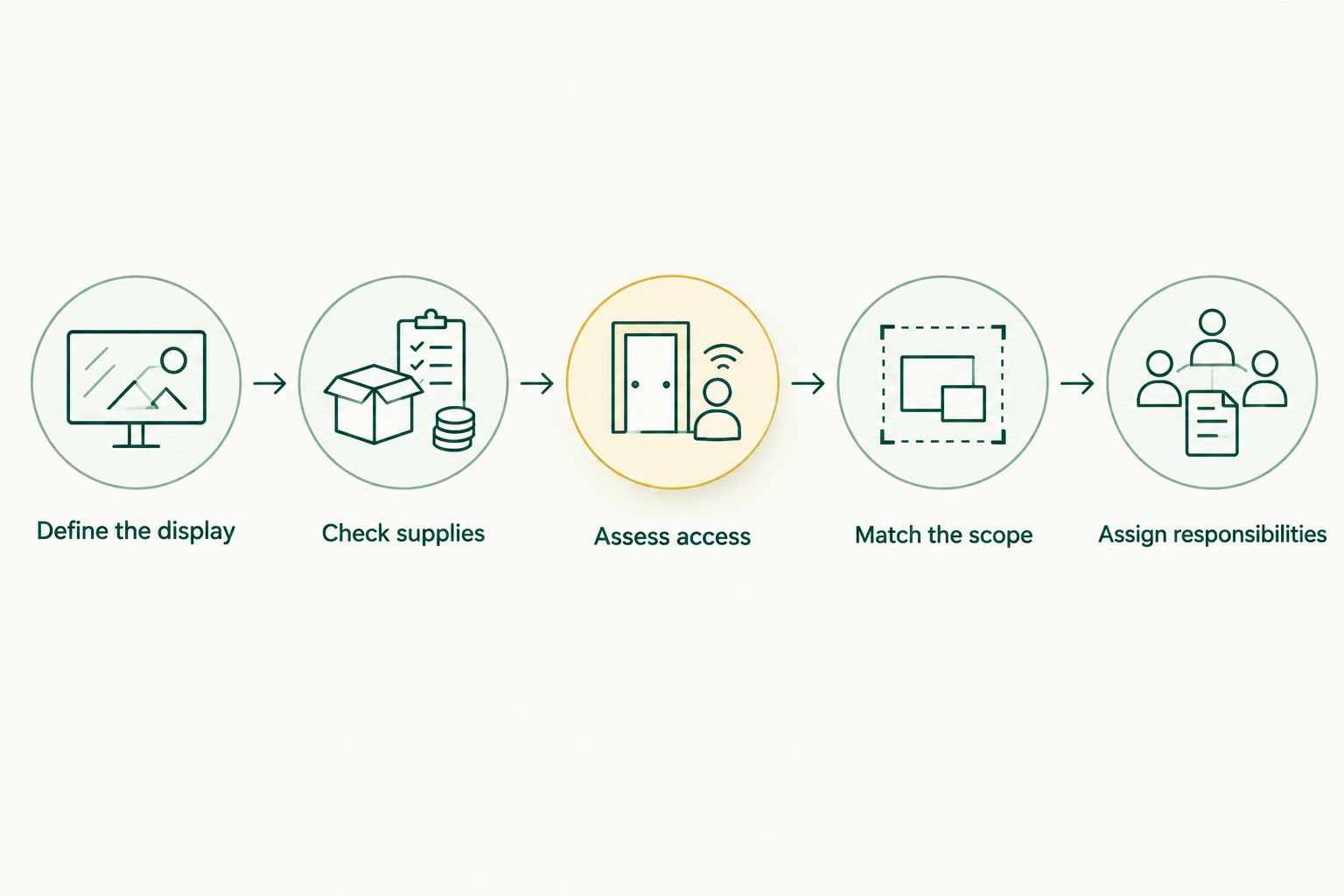
A useful comparison leaves no task floating between you and the installer. If a proposal says “installation,” ask what happens when a section stops working and who returns to remove it.
Plan your Atlanta Christmas light display
Discuss design, installation, maintenance, and takedown/storage for your property.
Questions to settle before choosing
The cheapest-looking plan is not a complete plan when it omits essential work. Resolve the questions below while you can still change the display or clarify the agreement.
Is DIY cheaper if I already own Christmas lights?
Existing lights reduce the supplies you need to acquire only when they work and suit the planned display. You still need compatible attachments, suitable power accessories, safe access, and a removal plan.
Do not expand the display simply to use every strand you own. A smaller, coherent design is easier to compare with a clearly defined professional proposal.
Is hiring a pro worth it for a roofline display?
Hiring a pro is the stronger choice when roofline access exceeds your ability to work safely. A labor saving does not make unsafe access acceptable.
Ask how the installer will attach and remove the lights without assuming every roof, gutter, or siding material takes the same method. Describe the property accurately before accepting a scope.
Does paying for installation include takedown and storage?
Paying for installation includes takedown and storage only when the agreement says so. Confirm both tasks in writing, along with light ownership and the process for arranging removal.
For your 2026 display, settle these details before installation rather than leaving them for the end of the season. An unresolved removal plan is unfinished planning, even when the lights look complete.
FAQ
Is it cheaper to install Christmas lights yourself or hire a pro?
DIY eliminates paid installation labor, but the total comparison depends on supplies, equipment, and service scope. Compare the same display and include maintenance, takedown, and storage before deciding.
What's the best choice for a small Christmas light display?
DIY is a practical choice for a manageable display you can install, maintain, and remove safely. Existing usable lights help, but check accessories and access requirements before committing.
Should I buy Christmas lights before getting an installation quote?
Check the installer's materials and ownership arrangement before buying lights. Do not assume an installer accepts customer-supplied strands or that your chosen lights suit the proposed design.
Do professional Christmas light installers include repairs?
Repairs are included only when the service agreement specifies them. Ask which problems are covered, who supplies replacement components, and how you request maintenance.
Does Atlanta Christmas Lighting Co handle Christmas light takedown?
Atlanta Christmas Lighting Co provides Christmas light design, installation, maintenance, and takedown/storage services across greater Atlanta. Confirm the scope and arrangements for your residential or commercial property.
Should I compare only the installation payment for my 2026 lights?
Compare the entire season, not only the installation payment. Include supplies, equipment, maintenance responsibilities, removal, storage, and ownership of the lights.
Is DIY the better choice for a difficult roofline?
DIY is not the right choice when the work exceeds your ability to access and decorate the roofline safely. Simplify the design or seek an appropriately equipped professional rather than treating access risk as a saving.
One last thing
Choose the removal plan before choosing the installation plan. Every clip and strand you put up creates a later task, and a display that feels manageable during installation still needs a safe route back down.
Keep a copy of the approved layout and note where components belong during takedown. Whether you install the lights yourself or hire help, an organized finish gives you a clearer starting point for the next display.