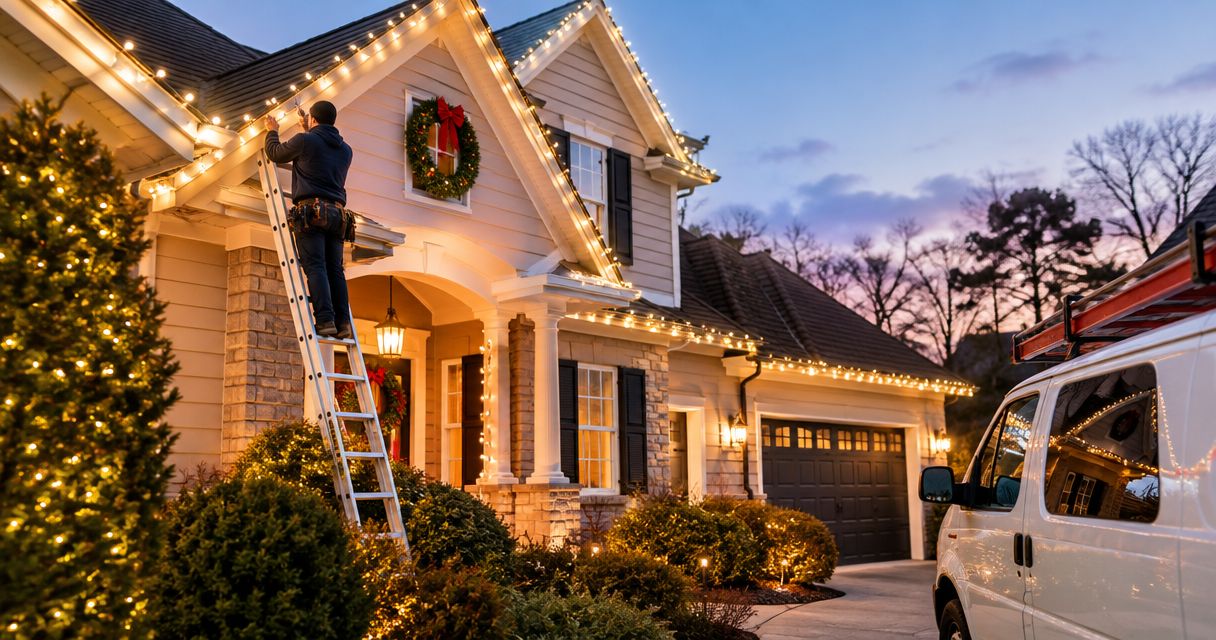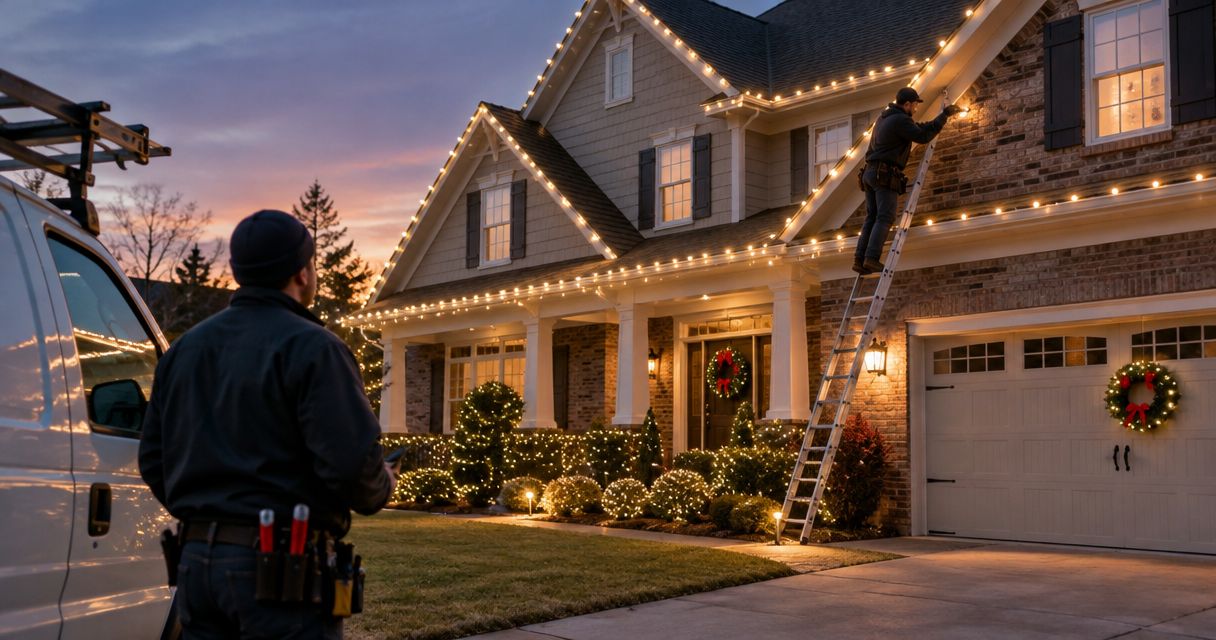
Commercial Christmas light installation charges depend on the agreed display and service scope; a generic rate does not tell you what a commercial property’s installation includes. For your 2026 budget, request a property-specific proposal that separates design, installation, maintenance, takedown, and storage. Check whether the agreement covers the full season or leaves responsibilities with your property team.
- How much do commercial Christmas light installers charge? Compare property-specific proposals with matching display and service scope.
- Atlanta Christmas Lighting Co provides commercial Christmas lighting design, installation, maintenance, takedown, and storage across greater Atlanta.
- Choose full-service scope when you want a provider to handle the seasonal lighting process.
- Confirm maintenance, removal, storage, and equipment ownership before approving a commercial lighting proposal.
How much do commercial Christmas light installers charge?
Evaluate commercial Christmas lighting charges against a written scope, not an isolated installation figure. A quote becomes useful when you can see which parts of the property it covers, what equipment the agreement includes, and who handles the display after installation.
For a 2026 commercial project, organize the proposal around these 5 service stages. They correspond to distinct responsibilities, even when a provider presents them together.
| Service stage | What your proposal should describe | What you need to clarify |
|---|---|---|
| Design | Display layout and selected property features | Who approves the final layout? |
| Installation | Placement, attachment, access, and power setup | What must the property team prepare? |
| Maintenance | Support while the display is installed | How do you report an issue? |
| Takedown | Removal and coordination with site operations | Who sets and confirms the removal schedule? |
| Storage | Handling of equipment after removal | Who stores it, and who owns it? |
If a proposal uses a measurement-based approach, read the Christmas light installation cost per linear foot guide alongside the scope. A measurement alone does not explain maintenance responsibilities, equipment ownership, or the work needed after the display comes down.
Ask the installer to identify exclusions in the same document as the included work. That gives you a usable basis for approval rather than a headline figure followed by unresolved questions.
Why this matters
A commercial lighting project touches more than the person approving the design. Your facilities team, property manager, tenants, and site staff need a clear plan for installation access and seasonal support.
For your 2026 purchasing decision, treat the proposal as an operating plan as well as a budget document. It should tell you what happens before installation, during the display period, and after removal.
The practical question is not simply whether you like the lights. It is whether the agreement assigns the work you expect someone else to handle. Do not approve an installation-only scope when your team expects full-season service.
Compare service scopes before comparing charges
These are comparison categories, not named packages offered by a particular installer. Use them to identify what each proposal actually covers, then ask the provider to confirm the details in writing.
| Scope to compare | Best for | Practical advantage | Limitation to resolve |
|---|---|---|---|
| Installation-only scope | Property teams that have separately assigned design and seasonal support | Keeps the installer’s responsibility focused on installation | Other seasonal tasks still need an owner |
| Installation with maintenance | Properties that want installation and support during the display period | Places ongoing lighting support within the agreed scope | Takedown and storage still require confirmation |
| Full-service scope | Property managers who want the seasonal process handled by a provider | Covers the process from design through removal and storage when explicitly included | You still need to approve the design, coordinate access, and understand the agreement |
The strongest proposal for you is the one that matches your property team’s capacity. An installation-only agreement is not inherently a poor choice, but it is the wrong choice if nobody has accepted responsibility for maintenance or removal.
Likewise, the phrase full service should not replace a written description. Read the actual responsibilities. A service label is less useful than a clear explanation of who does what.
Installation-only scope: assign the remaining work
Best for: property teams with a separate plan for every task outside installation. Before choosing this scope, identify who provides the design, who supplies the equipment, and who handles problems while the lights are installed.
Then settle the end-of-season work. Your team needs a removal plan and somewhere appropriate to keep any equipment it is responsible for storing.
The advantage is a defined installation task. The drawback is that your organization must coordinate the rest of the seasonal process through its own staff or separate agreements.
Do not assume an installer will return for maintenance or takedown because the same company installed the display. Ask whether those services belong to the proposal you are reviewing.
Installation with maintenance: define seasonal support
Best for: properties that want the installer involved while the display is operating. This scope needs a clear reporting process, not just the word maintenance in a service list.
Ask who receives service requests and what information your staff should provide. A location description and a photograph can help communicate the problem without asking the installer to guess which part of a commercial property you mean.
The benefit is an assigned provider for the agreed lighting support. The limitation is that maintenance coverage does not, by itself, establish who removes or stores the display.
For a 2026 agreement, confirm the period covered and the kinds of work included. Keep the answer with the proposal so that the person reporting an issue can refer to the same terms as the person who approved it.
Full-service scope: check the entire seasonal process
Best for: property managers who want design, installation, maintenance, takedown, and storage handled together. The value of this scope is the connection between the stages, rather than installation viewed in isolation.
You still have decisions to make. The provider needs an approved layout, access instructions, a property contact, and agreement on how the site will operate while work takes place.
The advantage is an assigned service provider across the seasonal process. The limitation is that full service does not remove the property owner’s approval and coordination responsibilities.
Read storage terms especially closely. Equipment ownership, responsibility for stored items, and arrangements for a future installation are separate questions; confirm each rather than treating storage as an automatic renewal agreement.
Why commercial Christmas lighting proposals vary
Use these factors to make competing proposals describe the same project. They are scope questions to resolve with the installer, not a formula for estimating an unsupported rate.
- Display layout: Specify which rooflines, entrances, trees, or other features you want included. Mark what is outside the approved design.
- Access requirements: Describe how the installer can reach the work areas and what building access needs approval.
- Equipment responsibility: Establish who supplies the lights and related equipment, and who owns them under the agreement.
- Maintenance scope: Confirm the support included while the display is installed and how your team requests it.
- Operating constraints: Explain delivery routes, customer entrances, tenant requirements, and other site activities the work must accommodate.
- Removal and storage: Identify who handles takedown, where equipment goes afterward, and which responsibilities remain with your organization.
A storefront entrance and a campus-wide display should not be treated as interchangeable requests. Describe the actual features you want illuminated. Otherwise, you are comparing different designs rather than different proposals for the same work.
How to request a comparable commercial lighting proposal
Send the same brief to every provider you are considering. For your 2026 project, the brief should establish the display and service expectations before you ask for a final proposal.
- Define the display. Provide property photographs and identify the specific features you want included. Separate required elements from optional additions.
- Confirm access. Explain site-entry arrangements, operating hours, and the person responsible for approving access to the work areas.
- Assign maintenance. Ask the provider to describe seasonal support, its scope, and the reporting process your staff should follow.
- Plan removal. State your preferred removal arrangements and request confirmation of how scheduling will work.
- Confirm storage. Ask who owns the equipment, who stores it, and what happens before a future installation.
Keep the required display consistent across proposals. Optional additions should appear separately so you can evaluate them without losing sight of the original request.
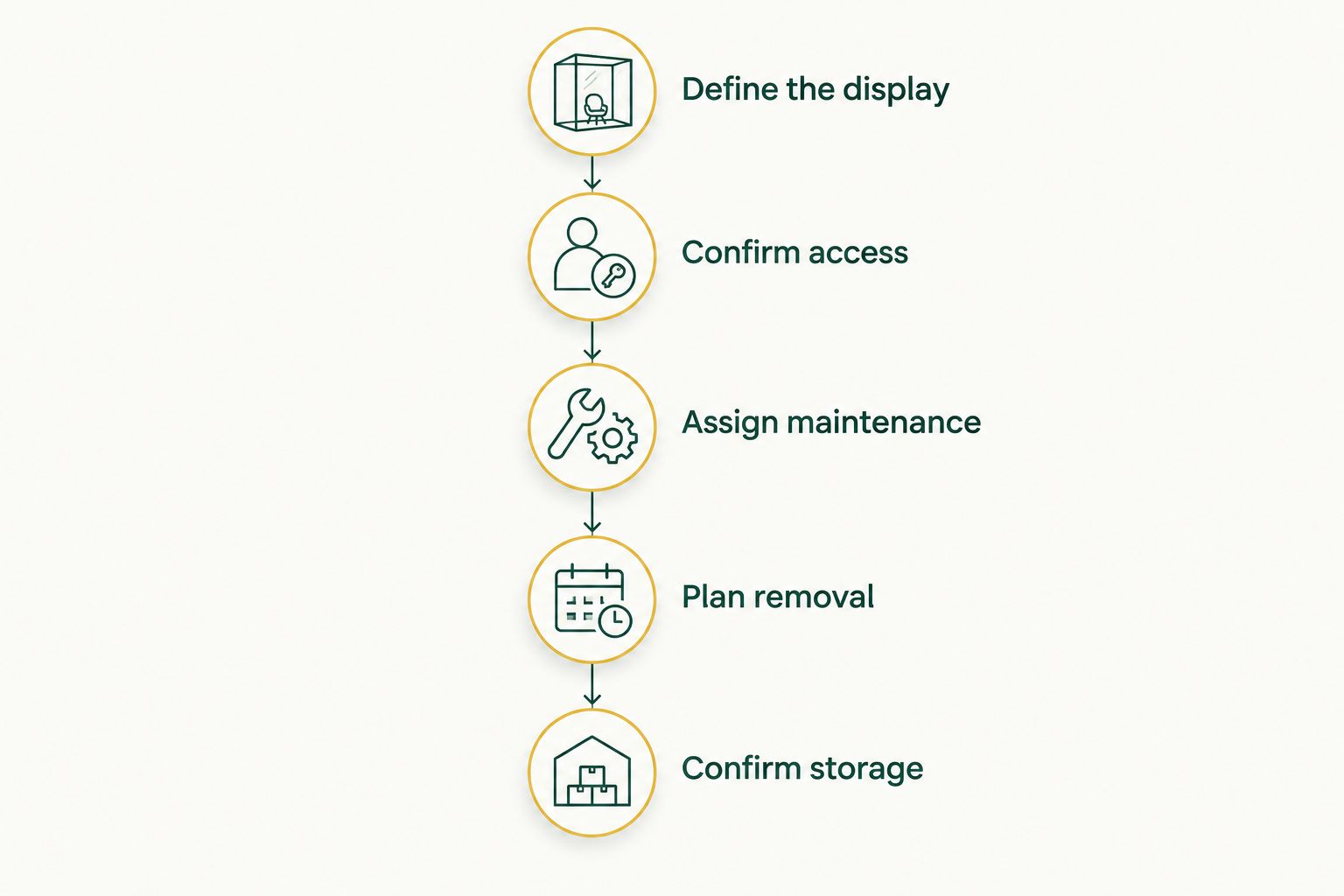
After receiving the proposals, check them against your brief line by line. Ask providers to clarify omissions rather than filling the gaps with assumptions.
What should be included in a commercial lighting quote?
A commercial lighting quote should identify the approved display, the services included, and the responsibilities retained by your property team. It should also explain equipment arrangements and the process for requesting support.
Look for language you can act on. Installation included is less informative than a description of the areas being installed and the access arrangements needed to complete that work.
The same applies after installation. Maintenance, takedown, and storage should each have an explanation that your property manager can use without reconstructing a sales conversation.
Does a linear-foot figure cover the whole commercial project?
A linear-foot figure describes a measurement basis; it does not establish the whole commercial service scope. Ask what the measured portion includes and which services or display elements are described separately.
Do not use roofline length as a substitute for a complete design brief. If your requested display includes entrances or trees, make sure the proposal explicitly addresses those features too.
Is full-service commercial Christmas lighting the right choice?
Full-service commercial Christmas lighting fits a property team that wants a provider to handle the seasonal process rather than installation alone. Choose it when the written agreement includes the stages your team wants assigned externally.
Atlanta Christmas Lighting Co is best for greater Atlanta property managers seeking commercial Christmas lighting design, installation, maintenance, takedown, and storage from one provider. Those services match the company’s stated offering; the proposal still needs to define your property’s display and agreement terms.
You can discuss that scope with Atlanta Christmas Lighting Co. The practical trade-off is straightforward: the company provides the seasonal services, while you remain responsible for approving the design and coordinating property requirements.
Discuss your commercial lighting scope
Plan design, installation, maintenance, takedown, and storage for your greater Atlanta property.
FAQ
How much do commercial Christmas light installers charge?
Commercial Christmas lighting charges need to be evaluated against a property-specific display and service scope. Request a written proposal that identifies design, installation, maintenance, takedown, and storage responsibilities.
What should I ask before approving a commercial Christmas lighting quote?
Ask which property features and seasonal services the proposal includes. Confirm equipment ownership, access requirements, maintenance reporting, removal arrangements, and storage responsibilities.
Is full-service commercial Christmas lighting better than installation only?
Full-service commercial Christmas lighting is the better fit when you want a provider to handle the seasonal process. Installation-only scope fits a property team that has separately assigned the remaining work.
Does commercial Christmas light installation include takedown?
The written proposal determines whether takedown is included. Confirm removal responsibilities and scheduling before approving the installation agreement.
Who owns the Christmas lights after a commercial installation?
The agreement should state who owns the lights and related equipment. Confirm ownership separately from who installs, maintains, or stores the display.
Can Atlanta Christmas Lighting Co handle commercial properties?
Atlanta Christmas Lighting Co provides commercial Christmas lighting services across greater Atlanta. Its stated services include design, installation, maintenance, takedown, and storage.
How should I compare commercial Christmas lighting proposals for 2026?
Compare 2026 proposals against the same property features and seasonal responsibilities. Resolve differences in scope before deciding which agreement fits your property team.
One last thing
Name the person who will report a lighting issue before installation starts. Give that person the approved layout, the provider’s contact details, and the relevant maintenance terms.
That small handoff connects the purchasing decision to the people operating the property. For your 2026 display, keep the proposal available through takedown and storage—not just until the lights turn on.