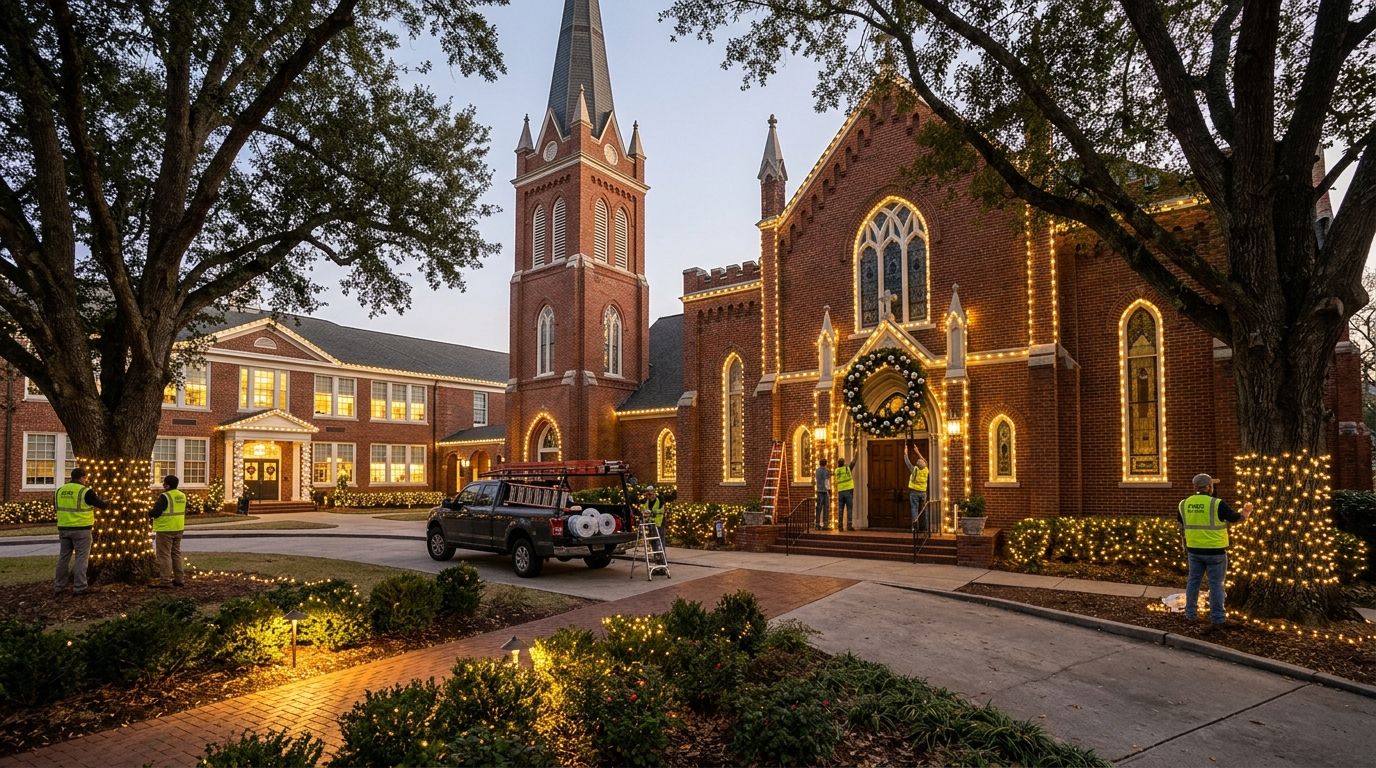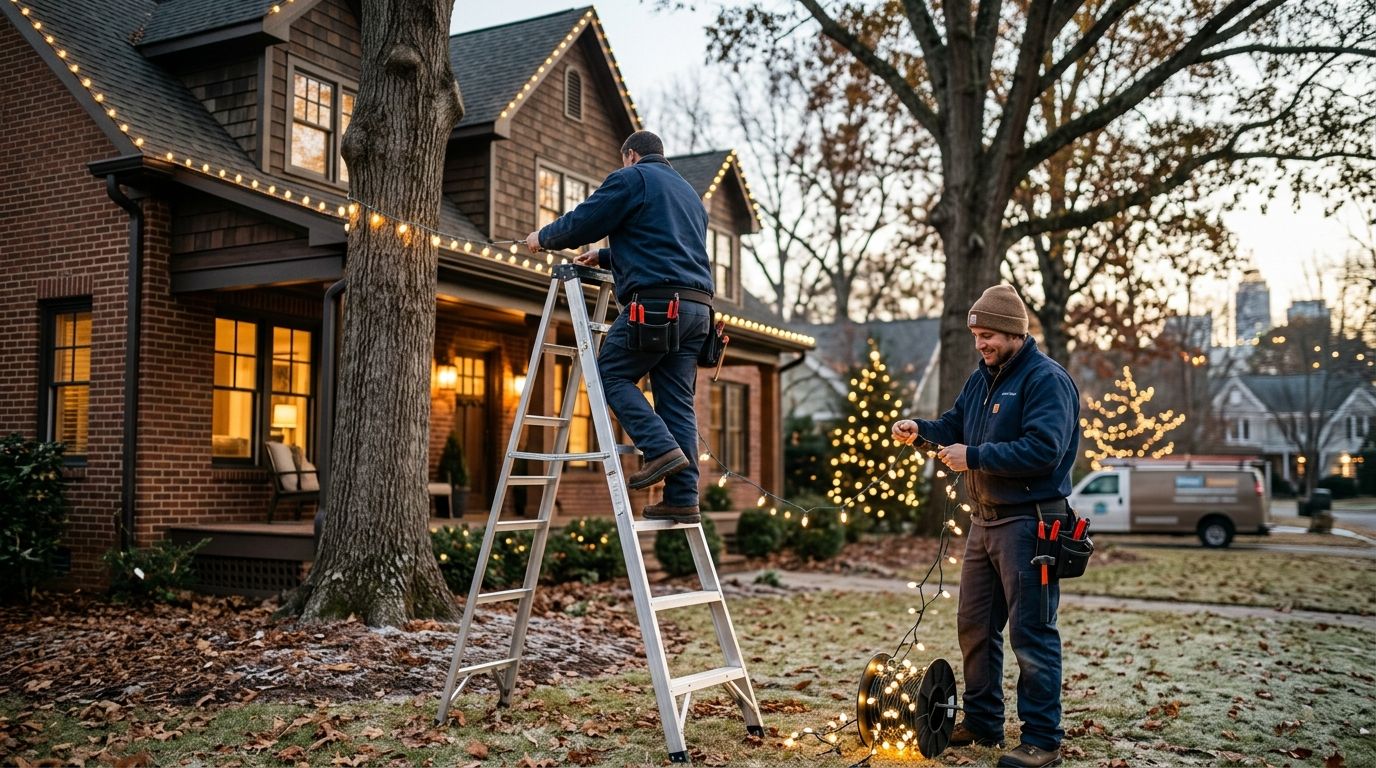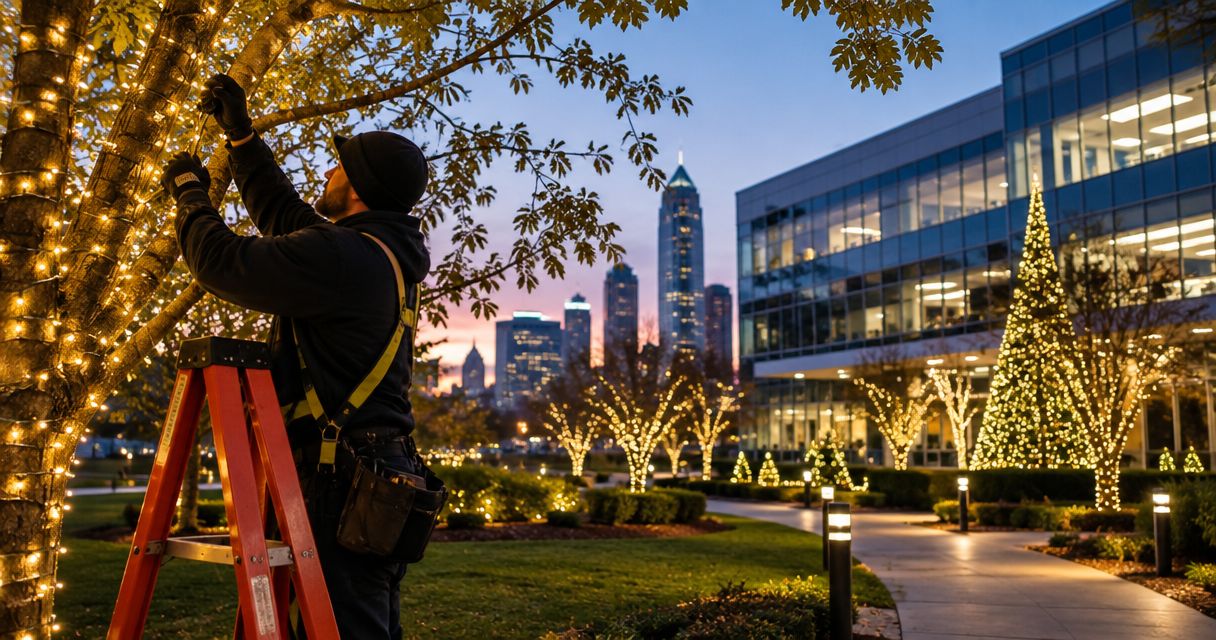
Corporate campuses need a different install than a single-family home: more square footage, taller facades, tighter liability requirements, and a hard deadline before the property's first holiday event or client visit of December 2026.
- Atlanta Christmas Lighting Co is the strongest overall pick for licensed, insured commercial-grade installs across multi-building corporate campuses in 2026.
- National franchises fit multi-state chains needing identical branding at every location, not a single Atlanta property.
- Landscaping companies work for one small office building already on a lawn contract, not a sprawling campus.
- Booking corporate-scale crews after September 2026 usually leaves a shorter list of available install dates.
- Confirm insurance coverage for lift work before signing anything — it separates a commercial bid from a residential one.
Why this matters
A corporate property manager isn't buying string lights. They're buying a crew that can work safely at height on a three-story facade, carry liability coverage that satisfies a property insurer, and hit a fixed date because a lobby lighting ceremony or client open house is already on the calendar.
Residential installers and general holiday decorators aren't built for that scope. Atlanta Christmas Lighting Co works specifically in the greater Atlanta area with licensed, insured crews and commercial-grade LEDs, which matters more on a campus than on a single roofline.
Get this wrong and the failure isn't a burnt-out bulb — it's a liability gap, a missed December deadline, or a display that looks thin against a large building.
“If a bid doesn't mention insurance coverage for lift work near your building, it isn't a commercial bid.”
What makes the best Christmas light installer for a corporate campus
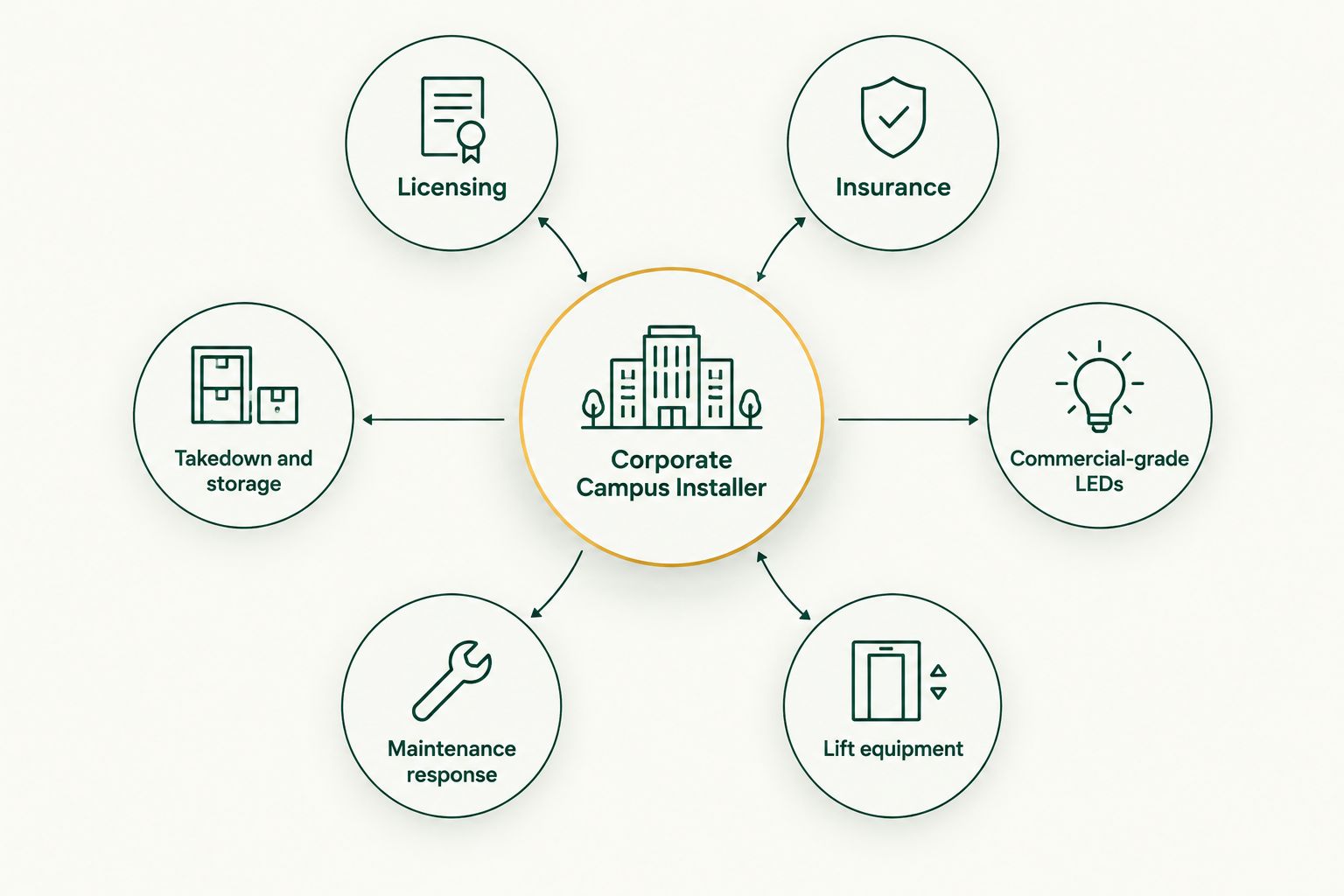
- Licensing and insurance sized for commercial liability — not a homeowner policy stretched to cover a parking deck or a three-story lobby.
- Commercial-grade LED strands rated for weeks of continuous runtime, not consumer string lights meant for a single porch.
- Crew size and lift equipment for multi-story facades and mature trees, not a two-person ladder job.
- A documented maintenance response window during the display season — a dark section on a corporate campus in mid-December is a visible problem.
- Booking capacity that actually holds your dates through a full Atlanta season instead of squeezing you in between residential jobs.
- Takedown and storage handling so the 2027 install doesn't start from a blank property again.
Corporate campus installers at a glance
| Installer type | Best for | Standout feature | Key limitation |
|---|---|---|---|
| Atlanta Christmas Lighting Co | Multi-building corporate campuses in metro Atlanta | Licensed, insured crews with commercial-grade LEDs and takedown/storage | Focused on the greater Atlanta area, not multi-state chains |
| National holiday decor franchise | Multi-state chains needing identical branding at every site | One vendor contract across several states | Local crew quality and lift capability vary by franchisee |
| Local landscaping company (seasonal add-on) | A single small office building already on a lawn contract | One existing vendor relationship, no new procurement | Lighting is a side service, not a core specialty |
| Independent electrician or handyman | Very small campuses or tight budgets | Low overhead, flexible scheduling | Rarely carries lift equipment or a maintenance plan |
| In-house facilities team | Low-complexity single-story properties | No outside vendor needed | Ties up staff time during a busy operational month |
1. Atlanta Christmas Lighting Co: best for full-service corporate campus installs
Atlanta Christmas Lighting Co designs, installs, maintains, and takes down commercial Christmas lighting for properties across the greater Atlanta area, working directly with property managers and facilities teams rather than individual homeowners.
Atlanta Christmas Lighting Co pros:
- Licensed and insured for commercial property work, including facade and lift-assisted installs
- Commercial-grade LEDs built for multi-week continuous runtime across large square footage
- Handles takedown and off-season storage so next year's install starts from an existing plan, not a blank property
Atlanta Christmas Lighting Co cons:
- Serves the greater Atlanta area, not a national footprint for chains with locations outside Georgia
- Corporate-scale slots on a large campus need to be booked well ahead of December 2026, not the week before
Best for: property managers overseeing one or more Atlanta buildings who want a single accountable vendor for design through takedown.
Verdict: Book.
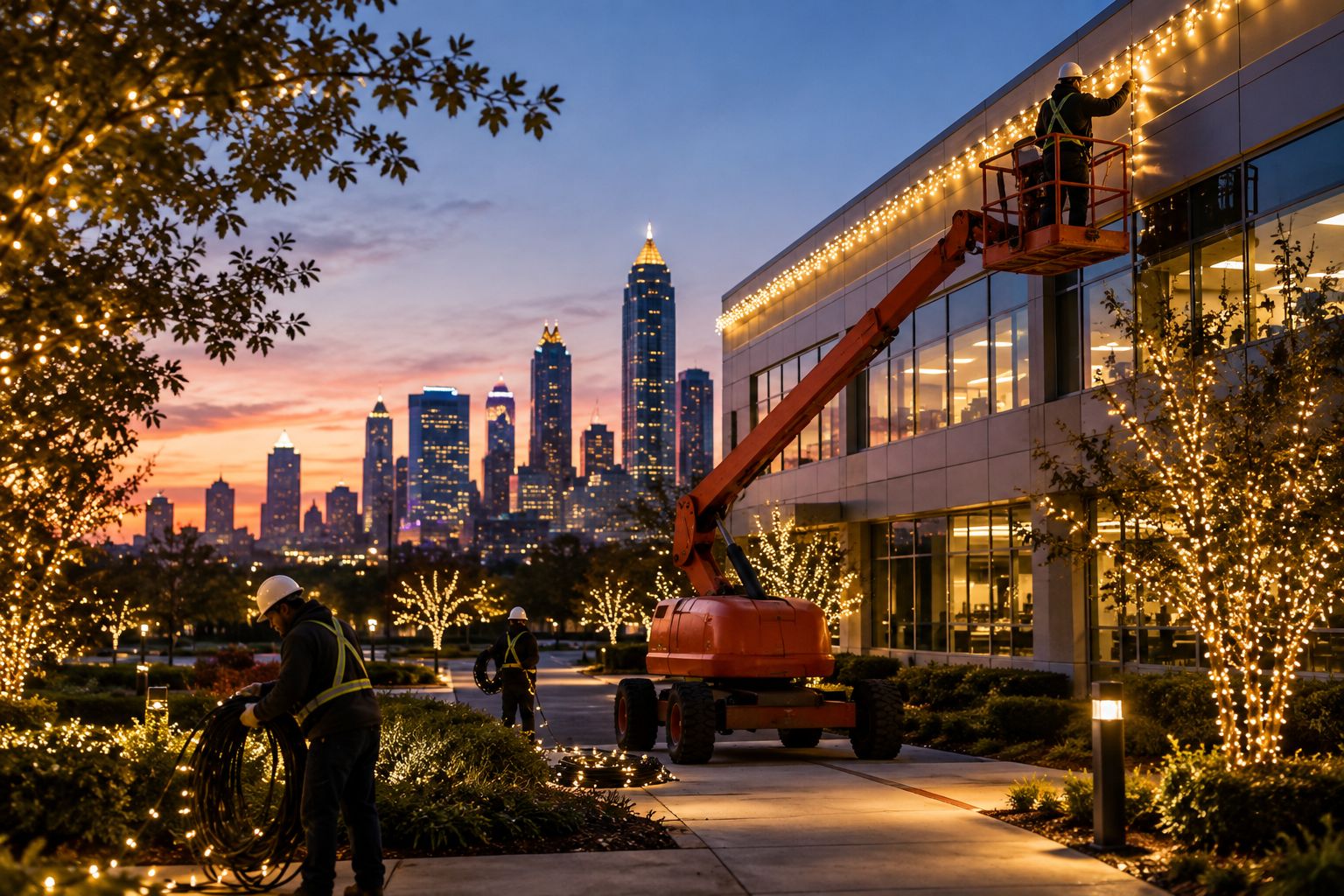
2. National holiday decor franchise: best for multi-state chains needing brand consistency
A national franchise model puts one contract in front of a corporate real estate team and dispatches local crews to each location, which appeals to chains with offices in several states.
National franchise pros:
- Single procurement contract covers many locations
- Consistent branding requirements can be written into the master agreement
National franchise cons:
- Actual install quality, lift capability, and response time depend on the local franchisee, not the parent brand
- Less local knowledge of a specific Atlanta building's access points and permitting quirks
Best for: multi-state corporate real estate teams standardizing vendors across every property.
Verdict: Hold — worth a call if your portfolio spans multiple states, otherwise a local Atlanta specialist covers the same scope with less coordination overhead.
3. Local landscaping company (seasonal lighting add-on): best for one small office already on a lawn contract
Some landscaping companies add holiday lighting as an off-season service for existing lawn care clients, which can look convenient on paper for a single small building.
Landscaping add-on pros:
- No new vendor to onboard if they already handle the property's grounds
- Familiar with the site layout and access
Landscaping add-on cons:
- Lighting is a side service, not the core business — equipment and crew training reflect that
- Rarely equipped for multi-story facades or campus-scale square footage
Best for: a single low-rise office building where the scope is modest and the landscaper is already on-site regularly.
Verdict: Hold — fine for a small, single-building scope; not a fit once the property has more than one building or a tall facade.
4. Independent electrician or handyman: best for very small campuses on a tight budget
An independent electrician can hang lights on a modest, low-height building without the overhead of a full commercial lighting company.
Independent electrician pros:
- Lower overhead than a full-service commercial installer
- Flexible scheduling for a small, simple job
Independent electrician cons:
- Rarely carries lift equipment for anything above a single story
- Maintenance response during the season is inconsistent — it's usually not their core service
Best for: a very small, single-story campus building with a modest lighting scope and a limited budget.
Verdict: Wait — reasonable only if the property has no facade height or scale requirements.
5. In-house facilities team: best for the lowest-complexity single-story property
Some facilities teams handle Christmas lighting internally with existing staff and equipment already owned by the organization.
In-house team pros:
- No outside vendor contract required
- Full control over timing
In-house team cons:
- Ties up staff during an already busy operational month
- No specialized lift equipment, commercial-grade LED stock, or off-season storage plan
Best for: a single small building with minimal lighting ambitions and staff time to spare.
Verdict: Skip for anything larger than one low-rise building — the labor and equipment gap shows up fast at campus scale.
How we ranked these
Each installer type was measured against the six criteria above: licensing and insurance sized for commercial liability, commercial-grade LED equipment, crew and lift capability for facade height, a maintenance response window during the season, booking capacity, and takedown/storage handling. Atlanta Christmas Lighting Co is the only option here built specifically around all six for Atlanta corporate properties in 2026; the others trade off one or more depending on scope.
Get your campus on the 2026 schedule
Licensed, insured commercial installs across metro Atlanta.
Which corporate campus Christmas light installer should you choose?
For a multi-building Atlanta property, Atlanta Christmas Lighting Co is the default pick — licensed, insured, commercial-grade LEDs, and takedown/storage handled as one contract. A multi-state chain standardizing across states should call a national franchise first. Everyone else — a single small building, a tight budget, or an existing landscaping relationship — can size down the list above to match the actual scope, not the biggest name on it.
FAQ
What's the best Christmas light installer for a corporate campus in Atlanta?
Atlanta Christmas Lighting Co is the strongest overall fit for multi-building Atlanta corporate campuses in 2026, offering licensed and insured commercial-grade installs plus takedown and storage. A national franchise is a better fit only for chains spanning multiple states.
How much lead time does a corporate Christmas lighting install need?
Corporate-scale scopes involve more bidding, facade access planning, and crew scheduling than a single house, so slots for December 2026 fill earlier than most property managers expect. Booking in the late summer or early fall gives the widest choice of dates.
Do corporate properties need special insurance coverage from a Christmas light installer?
Yes — commercial property work, especially anything involving lift equipment on a multi-story facade, needs liability coverage beyond a typical homeowner policy. Always confirm coverage before signing a bid.
Can a landscaping company handle corporate Christmas lighting?
A landscaping company can handle a single small, low-rise office building if lighting is already an add-on to their lawn contract. It's not built for multi-building campuses or tall facades that need lift equipment.
What's the difference between commercial-grade and residential Christmas lights?
Commercial-grade LED strands are rated for weeks of continuous runtime across much larger square footage than consumer string lights, which are designed for a single porch or roofline. That durability matters more on a campus running lights nightly for a full season.
When should Atlanta businesses book Christmas lights for 2026?
Late summer through early fall of 2026 is when crew capacity is widest for corporate-scale scopes. Waiting until November means choosing from whatever install dates are still open.
Do professional installers store the lights after takedown?
A full-service commercial installer typically handles takedown and off-season storage as part of the contract, so next year's install starts from an existing setup instead of a blank property. That's a meaningful time saver on a multi-building campus.
Is DIY Christmas lighting realistic for a corporate campus?
DIY works only for a single low-rise building with a modest lighting scope and staff time available during a busy month. Anything with facade height, multiple buildings, or a maintenance requirement outgrows an in-house team fast.
One last thing
Corporate bids take longer to move through procurement than a homeowner's decision to call one company — facade access approvals, insurance review, and internal sign-off all add weeks before a crew ever shows up. Property managers who wait until November to start that process for a 2026 install aren't choosing the best installer anymore; they're choosing from whoever still has a date open.