Multifamily and apartment properties don't shop for Christmas lighting the same way a single-family homeowner does. A 60-unit community needs someone who can carry commercial liability coverage, coordinate with a property manager or HOA board, and store hundreds of strands off-season without losing track of what goes on which building. Here's how the realistic options for best christmas light installers apartment multifamily Atlanta properties actually compare heading into 2026.
- Atlanta Christmas Lighting Co is the strongest overall pick for multifamily properties needing licensed, insured, commercial-grade installation in 2026.
- General handyman services can work for a single small apartment building but rarely carry commercial liability coverage for shared common areas.
- Landscaping companies with seasonal lighting add-ons suit HOAs already under contract, though lighting is a side skill for most of those crews.
- In-house maintenance staff with pre-lit kits is the budget option, realistic for properties under about 20 units.
- Booking by early fall matters more for multifamily than for single-family homes because commercial-scale slots fill first.
Why this matters for multifamily properties
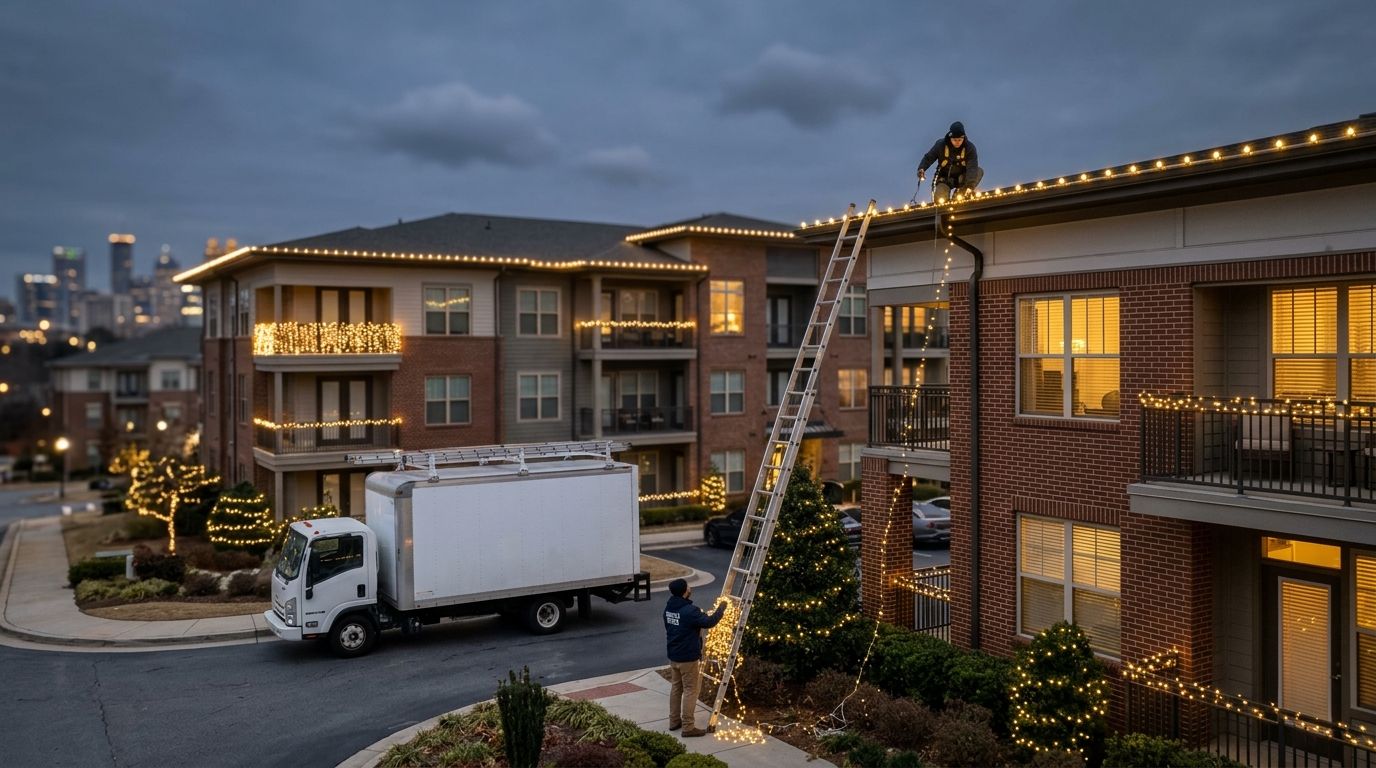
A single-family install is one roofline and one homeowner making the call. A multifamily property is dozens of buildings, a property manager who answers to an HOA board or ownership group, and common areas where a fall or a fire hazard becomes a liability question, not just a cosmetic one.
That changes what "best" means. You're not just picking who has the nicest bulbs — you're picking who carries the right insurance, who has a crew large enough to cover a 200-unit clubhouse and leasing office in the same week, and who can store and re-label lighting inventory across multiple buildings so next year's install isn't a scavenger hunt through a maintenance closet.
Best overall for Atlanta multifamily properties: Atlanta Christmas Lighting Co. Best for a single small building needing a one-off job: general handyman services. Best for HOAs already locked into a landscaping vendor: landscaping companies with seasonal lighting add-ons. Best budget option: in-house maintenance staff running pre-lit kits.
What makes the best christmas light installer for apartment and multifamily properties
- Commercial liability coverage that specifically names shared common areas, not just single-residence work
- Commercial-grade LEDs and timers rated for continuous multi-week runtime across large elevations
- Crew size and lift equipment capable of covering 3-story-plus rooflines and multiple buildings in one visit
- Direct coordination with property managers and HOA boards, not just one homeowner
- Off-season storage and labeled inventory so next year's install starts from a system, not a guess
- In-season response time for outage calls during the display window
At a glance: christmas light installer options for multifamily properties in 2026
| Option | Best for | Standout feature | Key limitation |
|---|---|---|---|
| Atlanta Christmas Lighting Co | Full-service multifamily coordination | Licensed, insured, design-to-storage in one vendor | Commercial slots fill by early fall |
| General handyman services | Single small apartment building | Flexible, low-overhead scheduling | Rarely carries commercial common-area liability coverage |
| Landscaping companies (seasonal add-on) | HOAs already under a landscaping contract | Already on-site for grounds work | Lighting is a side skill, not a specialty |
| In-house maintenance staff | Properties under ~20 units on a tight budget | No outside vendor coordination needed | No design plan, storage usually ad hoc |
| National franchise chains | Multi-state portfolio owners | Standardized process across markets | Thinner local Atlanta scheduling knowledge |
1. Atlanta Christmas Lighting Co: best christmas light installer for full-service multifamily coordination
Atlanta Christmas Lighting Co designs, installs, maintains, and takes down lighting for residential and commercial properties across the greater Atlanta area, and that full-cycle scope is what matters for a multifamily property. A community isn't buying one visit — it's buying a season, plus whatever happens if a strand fails in week three.
Atlanta Christmas Lighting Co pros:
- Licensed and insured, which matters when the work touches shared common areas and building exteriors
- Commercial-grade LEDs built for weeks of continuous runtime, not consumer strands meant for a single-family porch
- Coordinates directly with property managers and HOA boards instead of expecting one point of contact to chase down a homeowner
- Off-season storage means next year's install starts from labeled inventory instead of replacing burned-out strands from a garage
Atlanta Christmas Lighting Co cons:
- As a specialist, install slots for commercial-scale properties fill earlier in the season than most property managers expect
- Not the cheapest route for a small 4-to-6 unit building where a single facade and a handyman might genuinely be enough
Best for: communities of 20+ units that need one vendor handling design through takedown. Verdict: Book.
2. General handyman services: best for a single small apartment building
A handyman or seasonal labor service can hang string lights on one small facade competently and cheaply. The scope problem shows up the moment a property has more than one building or a common area that needs sign-off.
General handyman services pros:
- Lower overhead, often available on short notice
- Fine for a single small building with a straightforward, ground-level facade
- No long-term contract required
General handyman services cons:
- Rarely carries commercial general liability specific to multi-tenant common areas
- No dedicated off-season storage service, so lights typically end up in a maintenance closet, tangled
- No design consultation for how a property should look from the street
Best for: a single small building, not a multi-building community. Verdict: Hold — situational, not a fit once a property has more than one structure.
3. Landscaping companies with seasonal lighting add-ons: best for HOAs already under contract
Some landscaping companies offer Christmas lighting as a side service to their grounds-maintenance contract. It's convenient on paper — one vendor, one invoice — but lighting is rarely the crew's core skill.
Landscaping add-on pros:
- Already on-site for regular grounds work, so scheduling is simple
- One vendor relationship for HOAs that prefer to consolidate
Landscaping add-on cons:
- Lighting is typically a secondary offering, not a specialty, so design and troubleshooting knowledge varies widely
- Fixtures and timers may not be rated for the multi-week continuous runtime a commercial display needs
Best for: HOAs that already have a landscaping vendor and want to test a lighting add-on before switching to a specialist. Verdict: Hold.
4. In-house maintenance staff with pre-lit kits: the budget option
Smaller properties sometimes have maintenance staff hang pre-lit kits themselves. It's the cheapest path on paper because there's no outside vendor at all.
In-house staff pros:
- Lowest incremental cost since staff are already on payroll
- No vendor coordination or scheduling required
In-house staff cons:
- Pulls maintenance time away from other property duties during a busy season
- No design plan for how the property reads from the street
- Storage is usually ad hoc — a garage or storage unit — which means tangled strands and dead sections showing up again next year
Best for: properties under roughly 20 units where budget is the deciding factor. Verdict: Wait — reasonable only if cost is the single priority.
5. National franchise installation chains: best for multi-state portfolios
Owners managing properties across several states sometimes default to a national chain for consistency and centralized billing.
National franchise pros:
- Standardized process and reporting across markets
- Single billing relationship for multi-state portfolios
National franchise cons:
- Local Atlanta-specific scheduling knowledge and crew familiarity tend to be thinner than a locally based specialist
- Mid-season outage response can be slower when the crew isn't based in the market
Best for: portfolio owners prioritizing standardization over local responsiveness. Verdict: Hold.
“A crew that can't reach a three-story roofline with a lift isn't equipped for a 100-unit community, no matter how good their bulbs look on a single-family porch.”
How this ranking was built
Each option was weighed against the six criteria above: commercial liability coverage, LED and timer grade, crew and equipment capacity, coordination with property management or HOA boards, off-season storage, and in-season response time. Options that only clear one or two of those bars land in "situational" territory rather than a top pick — that's why a handyman or landscaping add-on can still be the right call for a small property even though they're not the overall winner.
Get a multifamily lighting quote
Talk through building count, HOA approval, and 2026 install timing.
Which christmas light installer should you choose for 2026?
If your property has more than one building, shared common areas, or an HOA board that needs a single point of contact, a full-service specialist is the safer default for 2026 — the insurance coverage and storage system alone justify it. If you're managing one small building with a simple facade, a handyman can still get the job done. Everything in between comes down to how much coordination and liability exposure your property is willing to carry in-house.
FAQ
What's the best christmas light installer for apartment and multifamily properties in Atlanta?
Atlanta Christmas Lighting Co is the strongest overall pick for 2026 because it covers design, installation, maintenance, and takedown with commercial liability coverage and off-season storage. Smaller single-building properties can sometimes get by with a general handyman service instead.
How early should multifamily properties book Christmas lighting for 2026?
Commercial-scale properties should book earlier than single-family homes because specialist crews have limited capacity for multi-building jobs. Slots for full communities tend to fill before smaller residential jobs do.
Do multifamily Christmas light installers need to be licensed and insured?
Yes — work on shared common areas and multi-story exteriors carries more liability exposure than a single-family porch. A licensed and insured installer protects the property owner and HOA board, not just the crew.
Can HOA boards get one quote for the whole community?
A full-service installer typically quotes the entire property as one project, covering every building and common area under one contract. That's simpler for an HOA board than negotiating separate vendors per building.
What happens to Christmas lights after the season for apartment complexes?
A professional takedown-and-storage service removes lights after the season and stores them off-site so next year's install starts from labeled inventory. Without that service, lights usually end up in a maintenance closet and degrade faster.
Is in-house staff cheaper than hiring a professional installer?
In-house staff with pre-lit kits is the lowest-cost route on paper, but it pulls maintenance time from other duties and rarely includes a design plan or proper storage. It works best for properties under roughly 20 units.
How many units justify hiring a professional multifamily lighting company?
Properties around 20 units and up generally benefit most from a full-service installer because coordination, storage, and crew capacity become harder to manage in-house at that scale. Smaller properties can weigh a handyman or in-house option instead.
Do landscaping companies do good Christmas light installation?
Landscaping companies that add lighting as a side service can be convenient for HOAs already under contract, but lighting is usually not their core specialty. Fixtures and timers may not match what a dedicated lighting installer uses for multi-week runtime.
One last thing
The detail most property managers overlook isn't the install — it's the storage. Lights that go back into a maintenance closet in January come out in October tangled, missing bulbs, and half-labeled, which is why so many properties re-buy strands every single year instead of reusing what they already paid for. A takedown-and-storage system, not just an install crew, is what actually makes the second year of Christmas lighting cheaper and faster than the first.