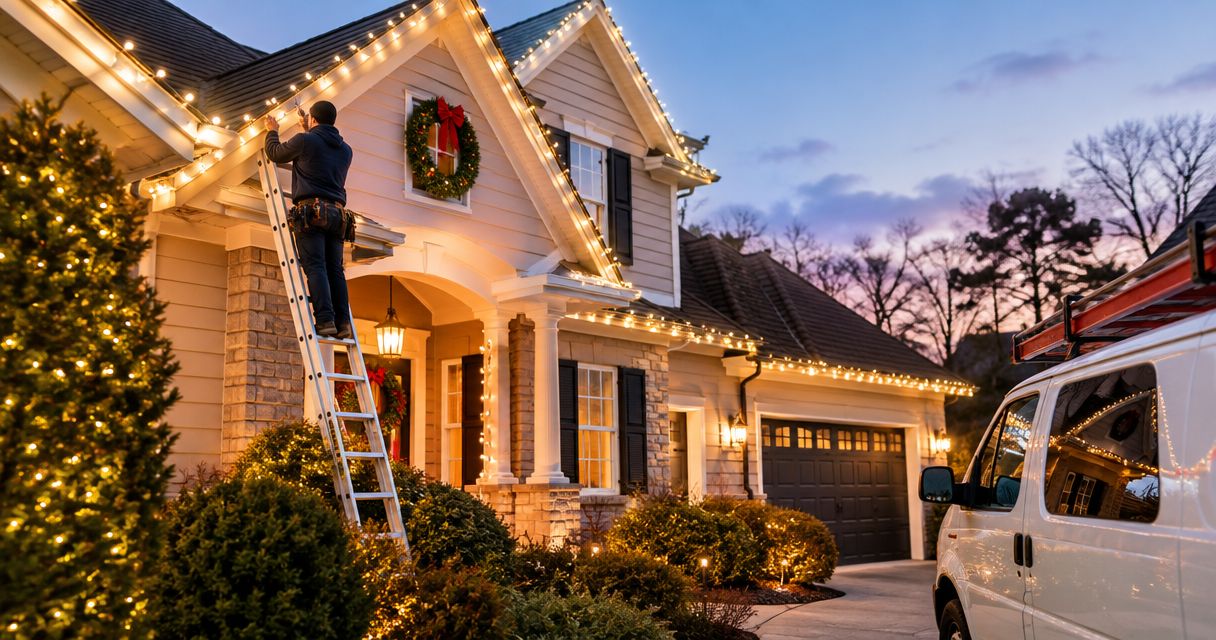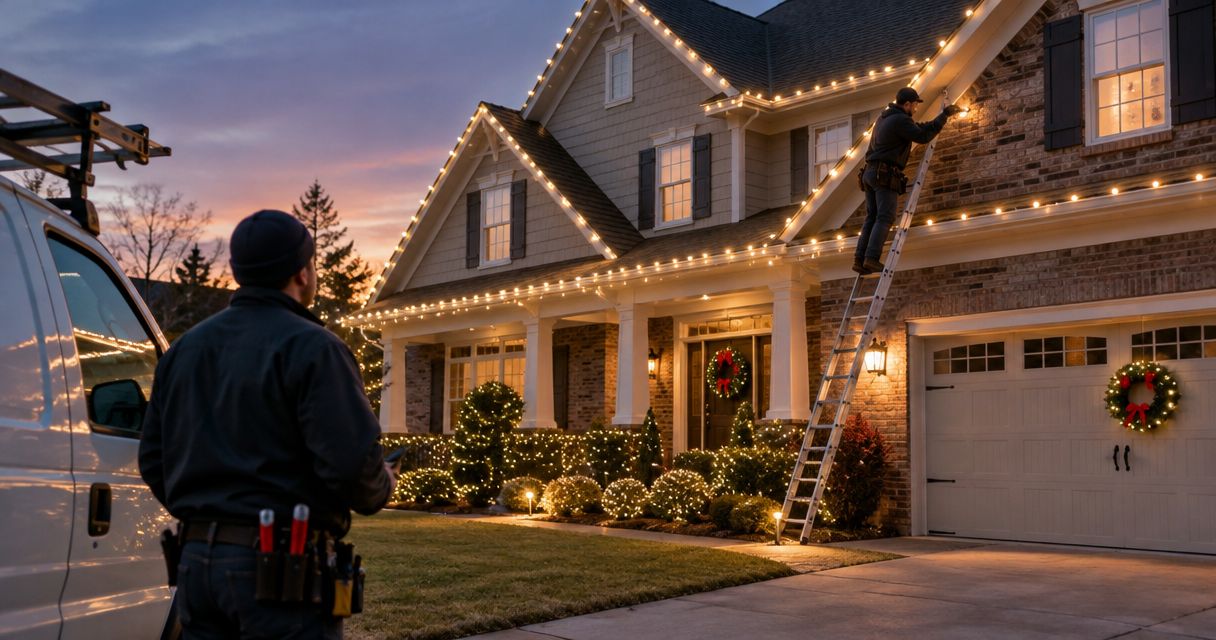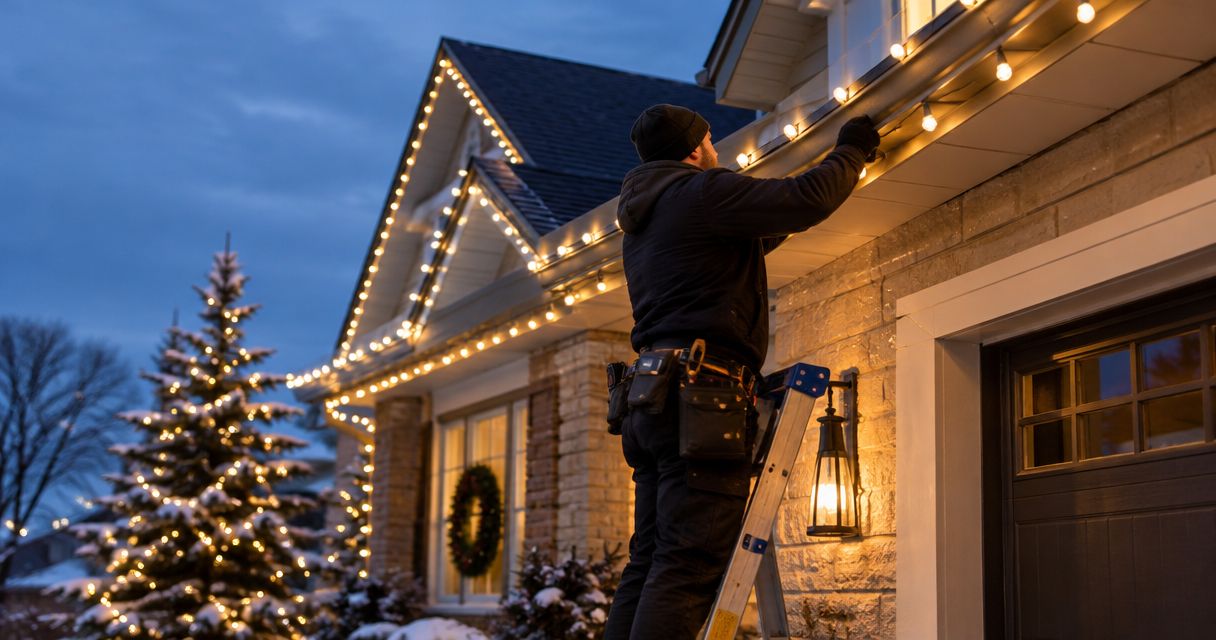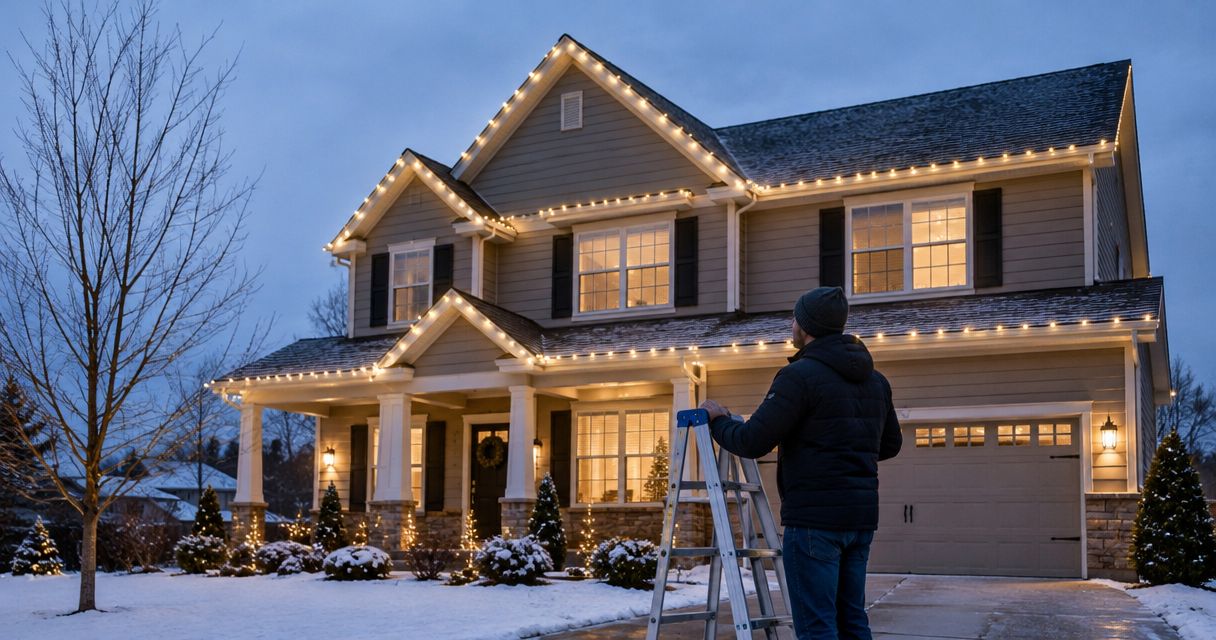
Yes, Christmas lights can be installed safely on a two-story house when the work has a suitable access plan, secure attachment points, and outdoor-rated electrical equipment. Height alone does not determine safety: the installation also needs a practical way to repair and remove the lights without improvising access later.
- Can Christmas lights be installed safely on a two-story house? Yes, with planned access, suitable attachments, and electrical protection.
- Choose professional Christmas light installation for upper rooflines that require work at height.
- Atlanta Christmas Lighting Co provides design, installation, maintenance, and takedown/storage across greater Atlanta.
- Plan maintenance and takedown before approving your two-story Christmas lighting design.
Can Christmas lights be installed safely on a two-story house?
Yes—but a safe installation starts with deciding which parts of the house can be reached safely, not which rooflines would look best. A straightforward front elevation and an upper gable above a sloping driveway require different access decisions, even when both houses have two stories.
For your 2026 display, separate the design decision from the access decision. Atlanta Christmas Lighting Co provides Christmas light design, installation, maintenance, and takedown/storage in greater Atlanta; discuss the upper roofline and its access requirements before approving the layout.
Use these checks to establish whether the proposed design has a workable safety plan:
| Safety check | What a suitable plan addresses | Reason to stop and reassess |
|---|---|---|
| Access | Equipment appropriate for the height, ground, and working position | Reaching sideways or standing on an unsuitable surface |
| Attachments | Clips compatible with the lights and mounting surface | Staples through wiring or improvised fasteners |
| Electrical setup | Outdoor-rated equipment, GFCI protection, and manufacturer limits | Damaged insulation or repeated breaker trips |
| Weather | Conditions suitable for access equipment and electrical work | Wet, icy, or windy working conditions |
| Maintenance | A defined way to reach failed lights | Repairs that require an unplanned climb |
| Removal | Controlled takedown using suitable access | Pulling strands down from the ground |
Why this matters
A two-story display creates work at height more than once. Installation is only the first occasion; a loose strand, failed connection, or eventual takedown can require access to the same difficult spot.
For a 2026 project, judge the whole service cycle rather than the installation alone. A display is not well planned if putting it up is straightforward but maintaining it requires taking new risks.
You can also simplify the design without abandoning it. A lower roofline, entryway, and accessible landscaping give you alternatives when an upper section lacks a suitable access method.
Which installation approach fits your house?
The right approach depends on where the lights go and how someone will reach them. Hiring a professional does not remove every risk, and keeping a display low does not remove electrical hazards.
| Approach | Best for | Advantage | Limitation | Recommendation |
|---|---|---|---|---|
| Professional upper-roofline installation | Homeowners who want second-story lighting without doing elevated work themselves | Gives a contractor responsibility for planning and performing access | Requires checking the proposed method, insurance, and service scope | Choose only after reviewing the access plan |
| Ground-accessible display | Homeowners who want to avoid climbing | Keeps the design focused on reachable features | Does not outline the upper roofline | Choose when safe elevated access is unresolved |
| DIY upper-roofline installation | No homeowner without suitable equipment and relevant competence | Gives you direct control over placement | Leaves elevated work, repairs, and removal with you | Skip when the work requires unfamiliar access equipment or roof access |
Choose a ground-accessible design rather than forcing an unsafe upper-roofline installation. A professional assessment is particularly useful when the intended lighting sits above a porch, steep landscaping, or an area without a stable equipment position.
The same principle applies to rented equipment. Access to a taller ladder or lift is not evidence that the equipment suits the site or that its operator knows how to use it safely.
What should happen before anyone installs the lights?
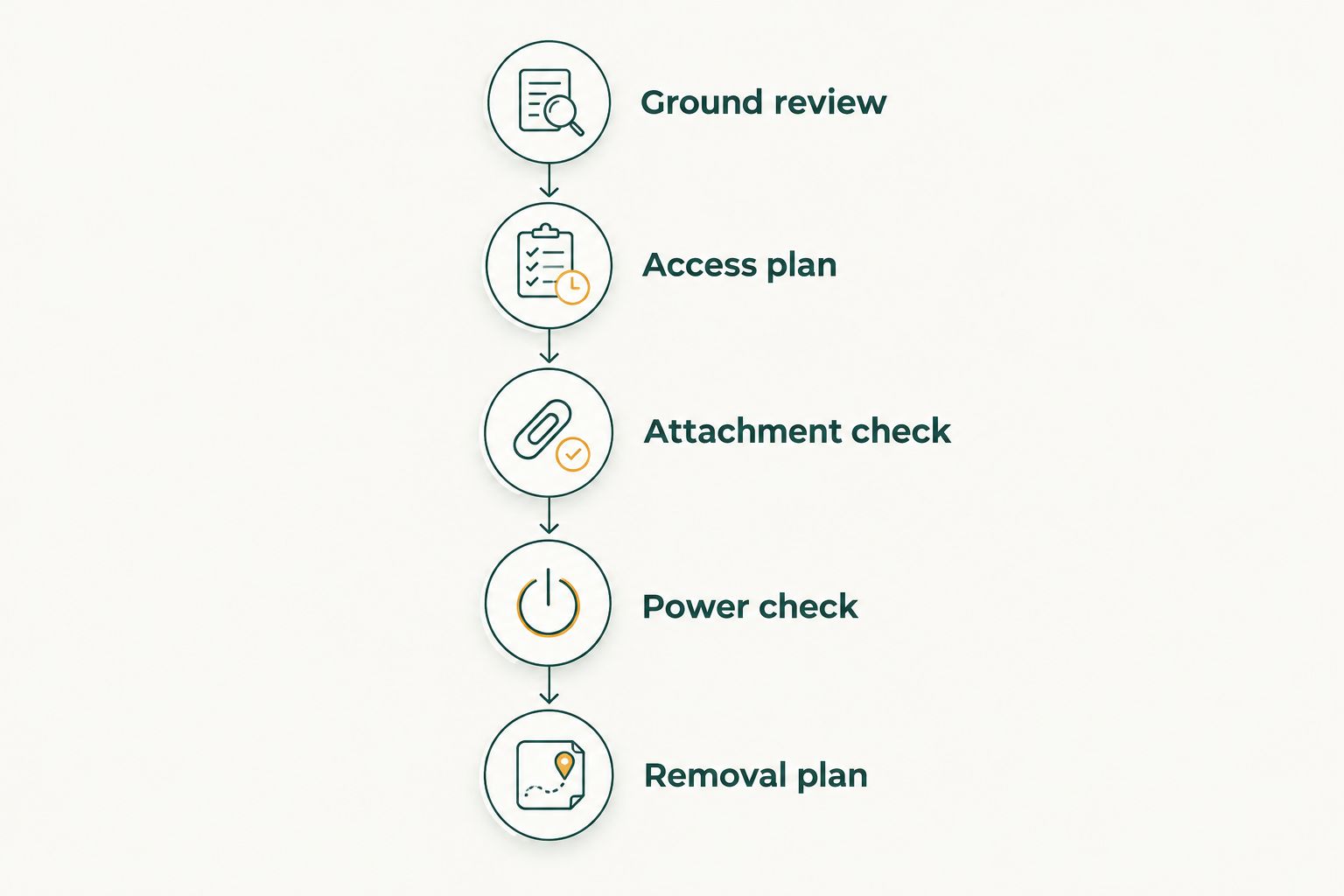
Use this sequence when discussing your 2026 installation. The purpose is to resolve access and electrical questions before the crew starts placing lights.
- Ground review. Identify slopes, steps, landscaping, driveways, and overhead electrical lines from ground level. Explain any areas where equipment must not be placed.
- Access plan. Ask how each upper section will be reached and what conditions would stop the work. Do not accept standing on gutters or reaching from windows as substitutes for appropriate access.
- Attachment check. Confirm that clips suit the mounting surface and the light system. Ask how the installer will avoid puncturing wiring or damaging roofing materials.
- Power check. Identify suitable outdoor power, GFCI protection, cord routes, and the equipment's connection limits. Resolve damaged outlets or wiring with a qualified electrician.
- Removal plan. Establish who handles faults and takedown, including how upper sections will be reached again. Clarify storage responsibilities before the installation begins.
These steps should describe your actual house, not a generic installation process. Ask the installer to identify any section that needs a different access method or a simpler design.
Why safety requirements vary between two-story houses
A story count does not describe the working surface or the route to the lights. These property features determine what the installer needs to assess:
- Ground conditions. Sloping lawns, soft soil, steps, and uneven paving affect equipment placement. A clear-looking area is not automatically a suitable base.
- Roof geometry. Gables, dormers, and rooflines above porches create different reach and access problems. A nearby roof is not automatically an acceptable working platform.
- Mounting surfaces. Gutters, shingles, fascia, and metal roofing require compatible attachment methods. The light cord must not become the structural support for the display.
- Electrical supply. Outlet condition, GFCI protection, equipment ratings, and cord routing determine whether the proposed power arrangement works safely.
- Weather exposure. Rain, ice, wind, and wet surfaces affect both the work and the installed equipment. A booking date does not override unsafe conditions.
- Service access. A location that is difficult to reach for installation remains difficult when something needs attention. Include that reality in the original design.
Ask for a property-specific explanation of these factors. The useful answer identifies what changes on your house, not simply that the crew has installed lights on other two-story homes.
What ladder safety rules should homeowners recognize?
For your 2026 planning, OSHA's portable-ladder guidance provides useful checks—not a complete method for installing lights. A homeowner should recognize warning signs without treating a short checklist as training for elevated work.
For a non-self-supporting ladder, the standard setup principle is approximately 1 foot of base setback for every 4 feet of working length. OSHA also calls for 3 points of contact while climbing. These rules do not make sideways reaching, an unstable base, or an unsuitable ladder acceptable.
When a portable ladder provides access to an upper landing, its side rails generally must extend at least 3 feet above that landing, subject to OSHA's specified alternatives. That requirement concerns access to a landing; it is not permission to climb onto a roof to hang lights.
A ladder also needs to suit its intended use, condition, and load. Keep ladders and installation equipment away from overhead electrical lines, and have the contractor resolve clearance questions before work begins.
Do not use the ladder rules as a reason to attempt an unfamiliar climb. If you cannot maintain the required position while performing the task, change the equipment, the method, or the design.
How do you keep the electrical setup safe?
Use lights, extension cords, timers, and connection accessories rated for their intended outdoor use. Follow each manufacturer's instructions, including connection and load limits; there is no universal safe number of strands for every lighting system.
GFCI protection addresses shock hazards associated with ground faults. It does not make damaged cords usable, waterproof an unsuitable connection, or replace the need to stay within circuit and equipment ratings.
Keep cord routes away from places where doors pinch them or people and vehicles damage them. Use connection protection intended for the equipment rather than improvised wrapping, and never staple through an electrical cord.
If a GFCI or breaker trips repeatedly, leave the affected display off until the cause is identified. Repeatedly resetting it is not a repair, and a lighting installer should not substitute for an electrician when the problem is the house wiring.
For a closer look at the supply side, see the GFCI outlet and safe holiday lighting power setup guide. The power arrangement deserves the same scrutiny as the upper-roofline access.
What should you ask a professional installer?
Atlanta Christmas Lighting Co is a fit for greater Atlanta homeowners seeking Christmas light installation with maintenance and takedown/storage services. That service scope matches the full seasonal task, but you still need to confirm the plan for your particular property.
Ask these questions before accepting an installation proposal:
- How will you reach each upper roofline without overreaching or using unsuitable surfaces?
- What equipment will you use, and where will it stand?
- Which attachments suit my roof, gutters, and fascia?
- How will the power setup account for outdoor use and equipment limits?
- What happens if an upper strand or connection fails?
- Who removes the display, and what does the agreed storage service include?
Request evidence of current insurance rather than relying only on a badge or verbal assurance. Ask about coverage relevant to the work and clarify who will actually perform it, including any subcontractors.
The trade-off with professional Christmas light installation is that you must evaluate a service proposal rather than control every installation choice yourself. Written scope helps: the design, excluded areas, maintenance responsibilities, and takedown arrangement should be clear before work starts.
Discuss your two-story lighting plan
Review design, installation, maintenance, and takedown/storage for your greater Atlanta property.
Is a ground-accessible display safer than lighting the upper roofline?
A ground-accessible display avoids the elevated-work exposure involved in an upper-roofline installation. You still need suitable outdoor equipment, sound attachments, and safe cord routing.
Choose reachable features when the upper design depends on unresolved access. You can approve a smaller display for 2026 without committing to roofline lighting later.
Should you let an installer walk on the roof?
Roof access needs its own assessment; it is not automatically safe because the installer is a professional. Ask why roof access is necessary, how the worker will be protected, and whether another installation method avoids it.
Do not approve walking on the roof solely because it appears to be the quickest route. Roofing condition, slope, weather, and fall protection belong in that decision.
Does safe installation also include takedown?
Yes, a complete safety plan includes controlled takedown and access for repairs. Pulling the lights from the ground can damage cords, clips, or the building surface and leaves falling materials uncontrolled.
Agree on removal responsibilities before installation. The same difficult upper corner will still need attention after the holiday season.
FAQ
Can Christmas lights be installed safely on a two-story house without walking on the roof?
Yes, roof walking is not necessary for every two-story lighting design. A suitable method depends on the roofline, ground conditions, equipment, and reach; ask the installer to explain the approach for your house.
Is a taller ladder enough to install second-story Christmas lights?
No, a taller ladder alone does not establish a safe working method. Equipment suitability, placement, task requirements, electrical clearances, and the user's competence also matter.
Can I install upper-roofline Christmas lights from a bedroom window?
Do not lean out of a bedroom window to install Christmas lights. Choose a method that provides suitable access and a secure working position, or leave that section unlit.
Should Christmas light installers work in rain or ice?
Installation should stop when rain, ice, wind, or wet surfaces make the work unsafe. The crew must assess conditions and follow the limits of its equipment rather than work to a booking deadline.
Do outdoor Christmas lights need GFCI protection?
Use GFCI-protected power for outdoor Christmas lighting and follow applicable electrical requirements. GFCI protection does not replace outdoor-rated equipment, intact wiring, or manufacturer connection limits.
Does Atlanta Christmas Lighting Co handle maintenance and takedown?
Atlanta Christmas Lighting Co provides Christmas light design, installation, maintenance, and takedown/storage across greater Atlanta. Confirm the agreed scope and the access plan for your two-story property before installation.
What should I do if second-story Christmas lights stop working?
Turn off the affected display and arrange appropriate service rather than attempting an unplanned climb. Repeated GFCI or breaker trips need investigation; do not keep resetting the protection.
One last thing
Approve the removal method before you approve the highest strand. That question tests whether the design works as a seasonal service, not just as an installation-day photograph.
Before your 2026 project starts, ask the installer to point out the hardest-to-reach connection and explain how it will be serviced. If the answer depends on figuring it out later, simplify that section now.